

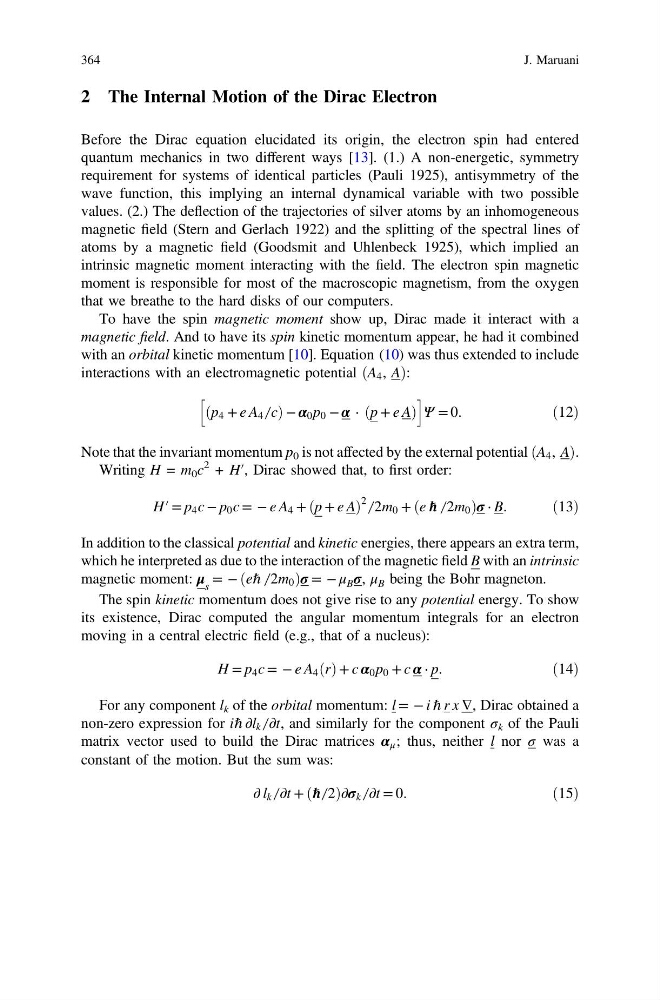
2 The Internal Motion of the Dirac Electron
Before the Dirac equation elucidated its origin, the electron spin had entered
quantum mechanics in two different ways [13]. (1.) A non-energetic, symmetry
requirement for systems of identical particles (Pauli 1925), antisymmetry of the
wave function, this implying an internal dynamical variable with two possible
values. (2.) The deflection of the trajectories of silver atoms by an inhomogeneous
magnetic field (Stern and Gerlach 1922) and the splitting of the spectral lines of
atoms by a magnetic field (Goodsmit and Uhlenbeck 1925), which implied an
intrinsic magnetic moment interacting with the field. The electron spin magnetic
moment is responsible for most of the macroscopic magnetism, from the oxygen
that we breathe to the hard disks of our computers.
To have the spin magnetic moment show up, Dirac made it interact with a
magnetic field. And to have its spin kinetic momentum appear, he had it combined
with an orbital kinetic momentum [10]. Equation (10) was thus extended to include
interactions with an electromagnetic potential ðA 4 , AÞ:
p 4 + e A 4 ̸ c
ð
Þ− α 0 p 0 − α ⋅ ðp + e AÞ
h
i
Ψ = 0.
ð12Þ
Note that the invariant momentum p 0 is not affected by the external potential ðA 4 , AÞ.
Writing H = m 0 c
2 + H′, Dirac showed that, to first order:
H′ = p 4 c − p 0 c = − e A 4 + ðp + e AÞ
2 ̸ 2m 0 + e ℏ ̸ 2m 0
ð
Þ σ ⋅ B.
ð13Þ
In addition to the classical potential and kinetic energies, there appears an extra term,
which he interpreted as due to the interaction of the magnetic field B with an intrinsic
magnetic moment: μ s = − ðeℏ ̸ 2m 0 Þσ = − μ B σ, μ B being the Bohr magneton.
The spin kinetic momentum does not give rise to any potential energy. To show
its existence, Dirac computed the angular momentum integrals for an electron
moving in a central electric field (e.g., that of a nucleus):
H = p 4 c = − e A 4 ðrÞ + c α 0 p 0 + c α ⋅ p.
ð14Þ
For any component l k of the orbital momentum: l = − i ℏ r x ∇, Dirac obtained a
non-zero expression for iℏ ∂l k ̸ ∂t, and similarly for the component σ k of the Pauli
matrix vector used to build the Dirac matrices α μ ; thus, neither l nor σ was a
constant of the motion. But the sum was:
∂ l k ̸ ∂t + ðℏ ̸ 2Þ∂σ k ̸ ∂t = 0.
ð15Þ
364
J. Maruani
Before the Dirac equation elucidated its origin, the electron spin had entered
quantum mechanics in two different ways [13]. (1.) A non-energetic, symmetry
requirement for systems of identical particles (Pauli 1925), antisymmetry of the
wave function, this implying an internal dynamical variable with two possible
values. (2.) The deflection of the trajectories of silver atoms by an inhomogeneous
magnetic field (Stern and Gerlach 1922) and the splitting of the spectral lines of
atoms by a magnetic field (Goodsmit and Uhlenbeck 1925), which implied an
intrinsic magnetic moment interacting with the field. The electron spin magnetic
moment is responsible for most of the macroscopic magnetism, from the oxygen
that we breathe to the hard disks of our computers.
To have the spin magnetic moment show up, Dirac made it interact with a
magnetic field. And to have its spin kinetic momentum appear, he had it combined
with an orbital kinetic momentum [10]. Equation (10) was thus extended to include
interactions with an electromagnetic potential ðA 4 , AÞ:
p 4 + e A 4 ̸ c
ð
Þ− α 0 p 0 − α ⋅ ðp + e AÞ
h
i
Ψ = 0.
ð12Þ
Note that the invariant momentum p 0 is not affected by the external potential ðA 4 , AÞ.
Writing H = m 0 c
2 + H′, Dirac showed that, to first order:
H′ = p 4 c − p 0 c = − e A 4 + ðp + e AÞ
2 ̸ 2m 0 + e ℏ ̸ 2m 0
ð
Þ σ ⋅ B.
ð13Þ
In addition to the classical potential and kinetic energies, there appears an extra term,
which he interpreted as due to the interaction of the magnetic field B with an intrinsic
magnetic moment: μ s = − ðeℏ ̸ 2m 0 Þσ = − μ B σ, μ B being the Bohr magneton.
The spin kinetic momentum does not give rise to any potential energy. To show
its existence, Dirac computed the angular momentum integrals for an electron
moving in a central electric field (e.g., that of a nucleus):
H = p 4 c = − e A 4 ðrÞ + c α 0 p 0 + c α ⋅ p.
ð14Þ
For any component l k of the orbital momentum: l = − i ℏ r x ∇, Dirac obtained a
non-zero expression for iℏ ∂l k ̸ ∂t, and similarly for the component σ k of the Pauli
matrix vector used to build the Dirac matrices α μ ; thus, neither l nor σ was a
constant of the motion. But the sum was:
∂ l k ̸ ∂t + ðℏ ̸ 2Þ∂σ k ̸ ∂t = 0.
ð15Þ
364
J. Maruani