

358
P. Xiang and Y. A. Wang
í µíºµ =
(
∑
i
|c i |
2 E i
)
− h
(
∑
i
|c i |
2
− 1
)
−
⟨ (
í µí¼
N
−
∑
i,j
c
∗
i c j ⟨Ψ i |Ψ j ⟩ N−1
)
g(í µí°«)
⟩
.
(141)
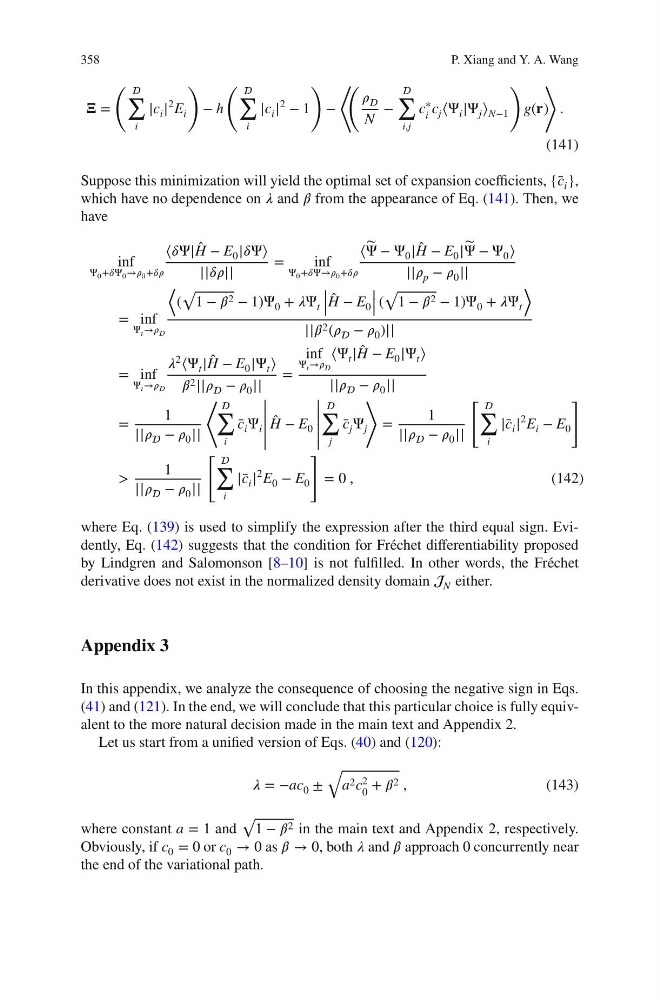
Suppose this minimization will yield the optimal set of expansion coefficients, {̄ c i },
which have no dependence on í µí¼ and í µí»½ from the appearance of Eq. (141). Then, we
have
inf
Ψ 0 +í µí»¿Ψ 0 →í µí¼ 0 +í µí»¿í µí¼
⟨í µí»¿Ψ| ̂
H − E 0 |í µí»¿Ψ⟩
||í µí»¿í µí¼||
=
inf
Ψ 0 +í µí»¿Ψ→í µí¼ 0 +í µí»¿í µí¼
⟨ ̃
Ψ − Ψ 0 | ̂
H − E 0 | ̃
Ψ − Ψ 0 ⟩
||í µí¼ p − í µí¼ 0 ||
= inf
Ψ t →í µí¼
⟨
(
√
1 − í µí»½ 2 − 1)Ψ 0 + í µí¼Ψ t
|
|
|
̂
H − E 0
|
|
|
(
√
1 − í µí»½ 2 − 1)Ψ 0 + í µí¼Ψ t
⟩
||í µí»½ 2 (í µí¼ − í µí¼ 0 )||
= inf
Ψ t →í µí¼
í µí¼
2
⟨Ψ t | ̂
H − E 0 |Ψ t ⟩
í µí»½ 2 ||í µí¼ − í µí¼ 0 ||
=
inf
Ψ t →í µí¼
⟨Ψ t | ̂
H − E 0 |Ψ t ⟩
||í µí¼ − í µí¼ 0 ||
=
1
||í µí¼ − í µí¼ 0 ||
⟨
∑
i
̄
c i Ψ i
|
|
|
|
|
|
̂
H − E 0
|
|
|
|
|
|
∑
j
̄
c j Ψ j
⟩
=
1
||í µí¼ − í µí¼ 0 ||
[
∑
i
|̄ c i |
2 E i − E 0
]
>
1
||í µí¼ − í µí¼ 0 ||
[
∑
i
|̄ c i |
2 E 0 − E 0
]
= 0 ,
(142)
where Eq. (139) is used to simplify the expression after the third equal sign. Evidently, Eq. (142) suggests that the condition for Fréchet differentiability proposed
by Lindgren and Salomonson [8–10] is not fulfilled. In other words, the Fréchet
derivative does not exist in the normalized density domain N either.
Appendix 3
In this appendix, we analyze the consequence of choosing the negative sign in Eqs.
(41) and (121). In the end, we will conclude that this particular choice is fully equivalent to the more natural decision made in the main text and Appendix 2.
Let us start from a unified version of Eqs. (40) and (120):
í µí¼ = −ac 0 ±
√
a 2 c
2
0
+ í µí»½ 2 ,
(143)
where constant a = 1 and
√ 1 − í µí»½ 2 in the main text and Appendix 2, respectively.
Obviously, if c 0 = 0 or c 0 → 0 as í µí»½ → 0, both í µí¼ and í µí»½ approach 0 concurrently near
the end of the variational path.
P. Xiang and Y. A. Wang
í µíºµ =
(
∑
i
|c i |
2 E i
)
− h
(
∑
i
|c i |
2
− 1
)
−
⟨ (
í µí¼
N
−
∑
i,j
c
∗
i c j ⟨Ψ i |Ψ j ⟩ N−1
)
g(í µí°«)
⟩
.
(141)
Suppose this minimization will yield the optimal set of expansion coefficients, {̄ c i },
which have no dependence on í µí¼ and í µí»½ from the appearance of Eq. (141). Then, we
have
inf
Ψ 0 +í µí»¿Ψ 0 →í µí¼ 0 +í µí»¿í µí¼
⟨í µí»¿Ψ| ̂
H − E 0 |í µí»¿Ψ⟩
||í µí»¿í µí¼||
=
inf
Ψ 0 +í µí»¿Ψ→í µí¼ 0 +í µí»¿í µí¼
⟨ ̃
Ψ − Ψ 0 | ̂
H − E 0 | ̃
Ψ − Ψ 0 ⟩
||í µí¼ p − í µí¼ 0 ||
= inf
Ψ t →í µí¼
⟨
(
√
1 − í µí»½ 2 − 1)Ψ 0 + í µí¼Ψ t
|
|
|
̂
H − E 0
|
|
|
(
√
1 − í µí»½ 2 − 1)Ψ 0 + í µí¼Ψ t
⟩
||í µí»½ 2 (í µí¼ − í µí¼ 0 )||
= inf
Ψ t →í µí¼
í µí¼
2
⟨Ψ t | ̂
H − E 0 |Ψ t ⟩
í µí»½ 2 ||í µí¼ − í µí¼ 0 ||
=
inf
Ψ t →í µí¼
⟨Ψ t | ̂
H − E 0 |Ψ t ⟩
||í µí¼ − í µí¼ 0 ||
=
1
||í µí¼ − í µí¼ 0 ||
⟨
∑
i
̄
c i Ψ i
|
|
|
|
|
|
̂
H − E 0
|
|
|
|
|
|
∑
j
̄
c j Ψ j
⟩
=
1
||í µí¼ − í µí¼ 0 ||
[
∑
i
|̄ c i |
2 E i − E 0
]
>
1
||í µí¼ − í µí¼ 0 ||
[
∑
i
|̄ c i |
2 E 0 − E 0
]
= 0 ,
(142)
where Eq. (139) is used to simplify the expression after the third equal sign. Evidently, Eq. (142) suggests that the condition for Fréchet differentiability proposed
by Lindgren and Salomonson [8–10] is not fulfilled. In other words, the Fréchet
derivative does not exist in the normalized density domain N either.
Appendix 3
In this appendix, we analyze the consequence of choosing the negative sign in Eqs.
(41) and (121). In the end, we will conclude that this particular choice is fully equivalent to the more natural decision made in the main text and Appendix 2.
Let us start from a unified version of Eqs. (40) and (120):
í µí¼ = −ac 0 ±
√
a 2 c
2
0
+ í µí»½ 2 ,
(143)
where constant a = 1 and
√ 1 − í µí»½ 2 in the main text and Appendix 2, respectively.
Obviously, if c 0 = 0 or c 0 → 0 as í µí»½ → 0, both í µí¼ and í µí»½ approach 0 concurrently near
the end of the variational path.