

Functional Derivatives and Differentiability in Density-Functional Theory
359
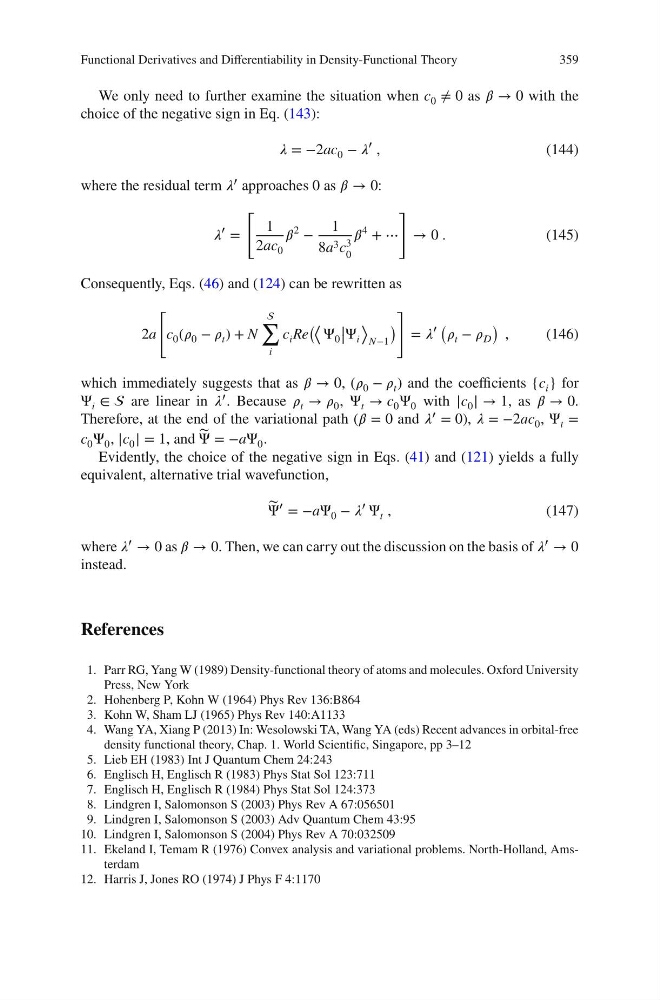
We only need to further examine the situation when c 0 ≠ 0 as í µí»½ → 0 with the
choice of the negative sign in Eq. (143):
í µí¼ = −2ac 0 − í µí¼
′
,
(144)
where the residual term í µí¼
′ approaches 0 as í µí»½ → 0:
í µí¼
′
=
[
1
2ac 0
í µí»½
2
−
1
8a 3 c
3
0
í µí»½
4
+ ⋯
]
→ 0 .
(145)
Consequently, Eqs. (46) and (124) can be rewritten as
2a
[
c 0 (í µí¼ 0 − í µí¼ t ) + N
∑
i
c i Re
(⟨ Ψ 0
|
| Ψ i
⟩
N−1
)
]
= í µí¼
′
(
í µí¼ t − í µí¼
) ,
(146)
which immediately suggests that as í µí»½ → 0, (í µí¼ 0 − í µí¼ t ) and the coefficients {c i } for
Ψ i ∈ are linear in í µí¼
′ . Because í µí¼ t → í µí¼ 0 , Ψ t → c 0 Ψ 0 with |c 0 | → 1, as í µí»½ → 0.
Therefore, at the end of the variational path (í µí»½ = 0 and í µí¼ ′ = 0), í µí¼ = −2ac 0 , Ψ t =
c 0 Ψ 0 , |c 0 | = 1, and ̃
Ψ = −aΨ 0 .
Evidently, the choice of the negative sign in Eqs. (41) and (121) yields a fully
equivalent, alternative trial wavefunction,
̃
Ψ
′
= −aΨ 0 − í µí¼
′
Ψ t ,
(147)
where í µí¼ ′ → 0 as í µí»½ → 0. Then, we can carry out the discussion on the basis of í µí¼ ′ → 0
instead.
References
1. Parr RG, Yang W (1989) Density-functional theory of atoms and molecules. Oxford University
Press, New York
2. Hohenberg P, Kohn W (1964) Phys Rev 136:B864
3. Kohn W, Sham LJ (1965) Phys Rev 140:A1133
4. Wang YA, Xiang P (2013) In: Wesolowski TA, Wang YA (eds) Recent advances in orbital-free
density functional theory, Chap. 1. World Scientific, Singapore, pp 3–12
5. Lieb EH (1983) Int J Quantum Chem 24:243
6. Englisch H, Englisch R (1983) Phys Stat Sol 123:711
7. Englisch H, Englisch R (1984) Phys Stat Sol 124:373
8. Lindgren I, Salomonson S (2003) Phys Rev A 67:056501
9. Lindgren I, Salomonson S (2003) Adv Quantum Chem 43:95
10. Lindgren I, Salomonson S (2004) Phys Rev A 70:032509
11. Ekeland I, Temam R (1976) Convex analysis and variational problems. North-Holland, Amsterdam
12. Harris J, Jones RO (1974) J Phys F 4:1170
359
We only need to further examine the situation when c 0 ≠ 0 as í µí»½ → 0 with the
choice of the negative sign in Eq. (143):
í µí¼ = −2ac 0 − í µí¼
′
,
(144)
where the residual term í µí¼
′ approaches 0 as í µí»½ → 0:
í µí¼
′
=
[
1
2ac 0
í µí»½
2
−
1
8a 3 c
3
0
í µí»½
4
+ ⋯
]
→ 0 .
(145)
Consequently, Eqs. (46) and (124) can be rewritten as
2a
[
c 0 (í µí¼ 0 − í µí¼ t ) + N
∑
i
c i Re
(⟨ Ψ 0
|
| Ψ i
⟩
N−1
)
]
= í µí¼
′
(
í µí¼ t − í µí¼
) ,
(146)
which immediately suggests that as í µí»½ → 0, (í µí¼ 0 − í µí¼ t ) and the coefficients {c i } for
Ψ i ∈ are linear in í µí¼
′ . Because í µí¼ t → í µí¼ 0 , Ψ t → c 0 Ψ 0 with |c 0 | → 1, as í µí»½ → 0.
Therefore, at the end of the variational path (í µí»½ = 0 and í µí¼ ′ = 0), í µí¼ = −2ac 0 , Ψ t =
c 0 Ψ 0 , |c 0 | = 1, and ̃
Ψ = −aΨ 0 .
Evidently, the choice of the negative sign in Eqs. (41) and (121) yields a fully
equivalent, alternative trial wavefunction,
̃
Ψ
′
= −aΨ 0 − í µí¼
′
Ψ t ,
(147)
where í µí¼ ′ → 0 as í µí»½ → 0. Then, we can carry out the discussion on the basis of í µí¼ ′ → 0
instead.
References
1. Parr RG, Yang W (1989) Density-functional theory of atoms and molecules. Oxford University
Press, New York
2. Hohenberg P, Kohn W (1964) Phys Rev 136:B864
3. Kohn W, Sham LJ (1965) Phys Rev 140:A1133
4. Wang YA, Xiang P (2013) In: Wesolowski TA, Wang YA (eds) Recent advances in orbital-free
density functional theory, Chap. 1. World Scientific, Singapore, pp 3–12
5. Lieb EH (1983) Int J Quantum Chem 24:243
6. Englisch H, Englisch R (1983) Phys Stat Sol 123:711
7. Englisch H, Englisch R (1984) Phys Stat Sol 124:373
8. Lindgren I, Salomonson S (2003) Phys Rev A 67:056501
9. Lindgren I, Salomonson S (2003) Adv Quantum Chem 43:95
10. Lindgren I, Salomonson S (2004) Phys Rev A 70:032509
11. Ekeland I, Temam R (1976) Convex analysis and variational problems. North-Holland, Amsterdam
12. Harris J, Jones RO (1974) J Phys F 4:1170