

356
P. Xiang and Y. A. Wang
í µí° = 2í µí¼
√
1 − í µí»½ 2
[
c 0 (í µí¼ 0 − í µí¼ )
N
+
∑
i
c i Re
(⟨ Ψ 0 |
| Ψ i
⟩
N−1
)
]
−í µí¼
2
(
í µí¼
N
−
∞
∑
i,j
c i c j
⟨ Ψ i |
| Ψ j
⟩
N−1
)
,
(130)
and
í µí» = í µí¼
2
(
⟨Ψ t | ̂
H|Ψ t ⟩ − E 0
) − hí µí° − ⟨g(í µí°«) í µí°⟩
= í µí¼
2
( ∞
∑
i,j
c i c j ⟨Ψ i | ̂
H|Ψ j ⟩ − E 0
)
− hí µí° − ⟨g(í µí°«) í µí°⟩
= í µí¼
2
( ∞
∑
i,j
c i c j E j í µí»¿ ij − E 0
)
− hí µí° − ⟨g(í µí°«) í µí°⟩
= í µí¼
2
[ ∞
∑
i=1
c
2
i
(E i − E 0 )
]
− hí µí° − ⟨g(í µí°«) í µí°⟩ ,
(131)
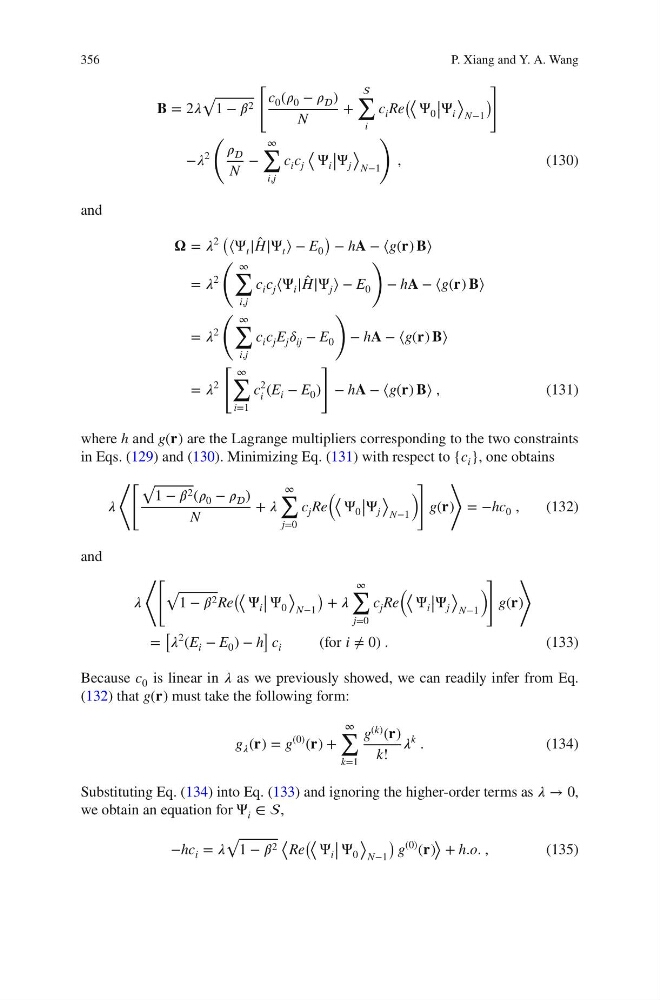
where h and g(í µí°«) are the Lagrange multipliers corresponding to the two constraints
in Eqs. (129) and (130). Minimizing Eq. (131) with respect to {c i }, one obtains
í µí¼
⟨[ √
1 − í µí»½ 2 (í µí¼ 0 − í µí¼ )
N
+ í µí¼
∞
∑
j=0
c j Re
( ⟨ Ψ 0 |
| Ψ j
⟩
N−1
)
]
g(í µí°«)
⟩
= −hc 0 ,
(132)
and
í µí¼
⟨[
√
1 − í µí»½ 2 Re
(⟨ Ψ i |
| Ψ 0
⟩
N−1
) + í µí¼
∞
∑
j=0
c j Re
( ⟨ Ψ i |
| Ψ j
⟩
N−1
)
]
g(í µí°«)
⟩
=
[
í µí¼
2
(E i − E 0 ) − h
]
c i
(for i ≠ 0) .
(133)
Because c 0 is linear in í µí¼ as we previously showed, we can readily infer from Eq.
(132) that g(í µí°«) must take the following form:
g í µí¼ (í µí°«) = g
(0)
(í µí°«) +
∞
∑
k=1
g
(k)
(í µí°«)
k!
í µí¼
k
.
(134)
Substituting Eq. (134) into Eq. (133) and ignoring the higher-order terms as í µí¼ → 0,
we obtain an equation for Ψ i ∈ ,
−hc i = í µí¼
√
1 − í µí»½ 2
⟨
Re
(⟨ Ψ i |
| Ψ 0
⟩
N−1
)
g
(0)
(í µí°«)
⟩ + h.o. ,
(135)
P. Xiang and Y. A. Wang
í µí° = 2í µí¼
√
1 − í µí»½ 2
[
c 0 (í µí¼ 0 − í µí¼ )
N
+
∑
i
c i Re
(⟨ Ψ 0 |
| Ψ i
⟩
N−1
)
]
−í µí¼
2
(
í µí¼
N
−
∞
∑
i,j
c i c j
⟨ Ψ i |
| Ψ j
⟩
N−1
)
,
(130)
and
í µí» = í µí¼
2
(
⟨Ψ t | ̂
H|Ψ t ⟩ − E 0
) − hí µí° − ⟨g(í µí°«) í µí°⟩
= í µí¼
2
( ∞
∑
i,j
c i c j ⟨Ψ i | ̂
H|Ψ j ⟩ − E 0
)
− hí µí° − ⟨g(í µí°«) í µí°⟩
= í µí¼
2
( ∞
∑
i,j
c i c j E j í µí»¿ ij − E 0
)
− hí µí° − ⟨g(í µí°«) í µí°⟩
= í µí¼
2
[ ∞
∑
i=1
c
2
i
(E i − E 0 )
]
− hí µí° − ⟨g(í µí°«) í µí°⟩ ,
(131)
where h and g(í µí°«) are the Lagrange multipliers corresponding to the two constraints
in Eqs. (129) and (130). Minimizing Eq. (131) with respect to {c i }, one obtains
í µí¼
⟨[ √
1 − í µí»½ 2 (í µí¼ 0 − í µí¼ )
N
+ í µí¼
∞
∑
j=0
c j Re
( ⟨ Ψ 0 |
| Ψ j
⟩
N−1
)
]
g(í µí°«)
⟩
= −hc 0 ,
(132)
and
í µí¼
⟨[
√
1 − í µí»½ 2 Re
(⟨ Ψ i |
| Ψ 0
⟩
N−1
) + í µí¼
∞
∑
j=0
c j Re
( ⟨ Ψ i |
| Ψ j
⟩
N−1
)
]
g(í µí°«)
⟩
=
[
í µí¼
2
(E i − E 0 ) − h
]
c i
(for i ≠ 0) .
(133)
Because c 0 is linear in í µí¼ as we previously showed, we can readily infer from Eq.
(132) that g(í µí°«) must take the following form:
g í µí¼ (í µí°«) = g
(0)
(í µí°«) +
∞
∑
k=1
g
(k)
(í µí°«)
k!
í µí¼
k
.
(134)
Substituting Eq. (134) into Eq. (133) and ignoring the higher-order terms as í µí¼ → 0,
we obtain an equation for Ψ i ∈ ,
−hc i = í µí¼
√
1 − í µí»½ 2
⟨
Re
(⟨ Ψ i |
| Ψ 0
⟩
N−1
)
g
(0)
(í µí°«)
⟩ + h.o. ,
(135)