

348
P. Xiang and Y. A. Wang
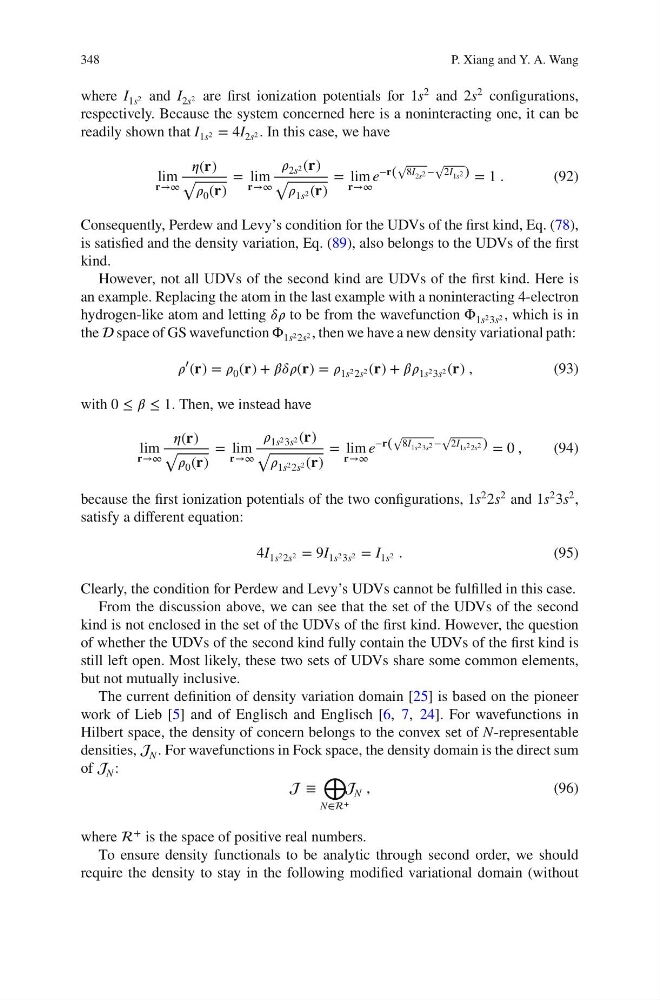
where I 1s 2 and I 2s 2 are first ionization potentials for 1s 2 and 2s 2 configurations,
respectively. Because the system concerned here is a noninteracting one, it can be
readily shown that I 1s 2 = 4I 2s 2 . In this case, we have
lim
í µí°«→∞
í µí¼(í µí°«)
√
í µí¼ 0 (í µí°«)
= lim
í µí°«→∞
í µí¼ 2s 2 (í µí°«)
√
í µí¼ 1s 2 (í µí°«)
= lim
í µí°«→∞
e
−í µí°«(
√
8I 2s 2 −
√
2I 1s 2 ) = 1 .
(92)
Consequently, Perdew and Levy’s condition for the UDVs of the first kind, Eq. (78),
is satisfied and the density variation, Eq. (89), also belongs to the UDVs of the first
kind.
However, not all UDVs of the second kind are UDVs of the first kind. Here is
an example. Replacing the atom in the last example with a noninteracting 4-electron
hydrogen-like atom and letting í µí»¿í µí¼ to be from the wavefunction Φ 1s 2 3s 2 , which is in
the space of GS wavefunction Φ 1s 2 2s 2 , then we have a new density variational path:
í µí¼
′
(í µí°«) = í µí¼ 0 (í µí°«) + í µí»½í µí»¿í µí¼(í µí°«) = í µí¼ 1s 2 2s 2 (í µí°«) + í µí»½í µí¼ 1s 2 3s 2 (í µí°«) ,
(93)
with 0 ≤ í µí»½ ≤ 1. Then, we instead have
lim
í µí°«→∞
í µí¼(í µí°«)
√
í µí¼ 0 (í µí°«)
= lim
í µí°«→∞
í µí¼ 1s 2 3s 2 (í µí°«)
√
í µí¼ 1s 2 2s 2 (í µí°«)
= lim
í µí°«→∞
e
−í µí°«(
√
8I 1s 2 3s 2 −
√
2I 1s 2 2s 2 ) = 0 ,
(94)
because the first ionization potentials of the two configurations, 1s
2
2s
2 and 1s
2
3s
2 ,
satisfy a different equation:
4I 1s 2 2s 2 = 9I 1s 2 3s 2 = I 1s 2 .
(95)
Clearly, the condition for Perdew and Levy’s UDVs cannot be fulfilled in this case.
From the discussion above, we can see that the set of the UDVs of the second
kind is not enclosed in the set of the UDVs of the first kind. However, the question
of whether the UDVs of the second kind fully contain the UDVs of the first kind is
still left open. Most likely, these two sets of UDVs share some common elements,
but not mutually inclusive.
The current definition of density variation domain [25] is based on the pioneer
work of Lieb [5] and of Englisch and Englisch [6, 7, 24]. For wavefunctions in
Hilbert space, the density of concern belongs to the convex set of N-representable
densities, N . For wavefunctions in Fock space, the density domain is the direct sum
of N :
≡
⨁
N∈ +
N ,
(96)
where
+ is the space of positive real numbers.
To ensure density functionals to be analytic through second order, we should
require the density to stay in the following modified variational domain (without
P. Xiang and Y. A. Wang
where I 1s 2 and I 2s 2 are first ionization potentials for 1s 2 and 2s 2 configurations,
respectively. Because the system concerned here is a noninteracting one, it can be
readily shown that I 1s 2 = 4I 2s 2 . In this case, we have
lim
í µí°«→∞
í µí¼(í µí°«)
√
í µí¼ 0 (í µí°«)
= lim
í µí°«→∞
í µí¼ 2s 2 (í µí°«)
√
í µí¼ 1s 2 (í µí°«)
= lim
í µí°«→∞
e
−í µí°«(
√
8I 2s 2 −
√
2I 1s 2 ) = 1 .
(92)
Consequently, Perdew and Levy’s condition for the UDVs of the first kind, Eq. (78),
is satisfied and the density variation, Eq. (89), also belongs to the UDVs of the first
kind.
However, not all UDVs of the second kind are UDVs of the first kind. Here is
an example. Replacing the atom in the last example with a noninteracting 4-electron
hydrogen-like atom and letting í µí»¿í µí¼ to be from the wavefunction Φ 1s 2 3s 2 , which is in
the space of GS wavefunction Φ 1s 2 2s 2 , then we have a new density variational path:
í µí¼
′
(í µí°«) = í µí¼ 0 (í µí°«) + í µí»½í µí»¿í µí¼(í µí°«) = í µí¼ 1s 2 2s 2 (í µí°«) + í µí»½í µí¼ 1s 2 3s 2 (í µí°«) ,
(93)
with 0 ≤ í µí»½ ≤ 1. Then, we instead have
lim
í µí°«→∞
í µí¼(í µí°«)
√
í µí¼ 0 (í µí°«)
= lim
í µí°«→∞
í µí¼ 1s 2 3s 2 (í µí°«)
√
í µí¼ 1s 2 2s 2 (í µí°«)
= lim
í µí°«→∞
e
−í µí°«(
√
8I 1s 2 3s 2 −
√
2I 1s 2 2s 2 ) = 0 ,
(94)
because the first ionization potentials of the two configurations, 1s
2
2s
2 and 1s
2
3s
2 ,
satisfy a different equation:
4I 1s 2 2s 2 = 9I 1s 2 3s 2 = I 1s 2 .
(95)
Clearly, the condition for Perdew and Levy’s UDVs cannot be fulfilled in this case.
From the discussion above, we can see that the set of the UDVs of the second
kind is not enclosed in the set of the UDVs of the first kind. However, the question
of whether the UDVs of the second kind fully contain the UDVs of the first kind is
still left open. Most likely, these two sets of UDVs share some common elements,
but not mutually inclusive.
The current definition of density variation domain [25] is based on the pioneer
work of Lieb [5] and of Englisch and Englisch [6, 7, 24]. For wavefunctions in
Hilbert space, the density of concern belongs to the convex set of N-representable
densities, N . For wavefunctions in Fock space, the density domain is the direct sum
of N :
≡
⨁
N∈ +
N ,
(96)
where
+ is the space of positive real numbers.
To ensure density functionals to be analytic through second order, we should
require the density to stay in the following modified variational domain (without