

Functional Derivatives and Differentiability in Density-Functional Theory
349
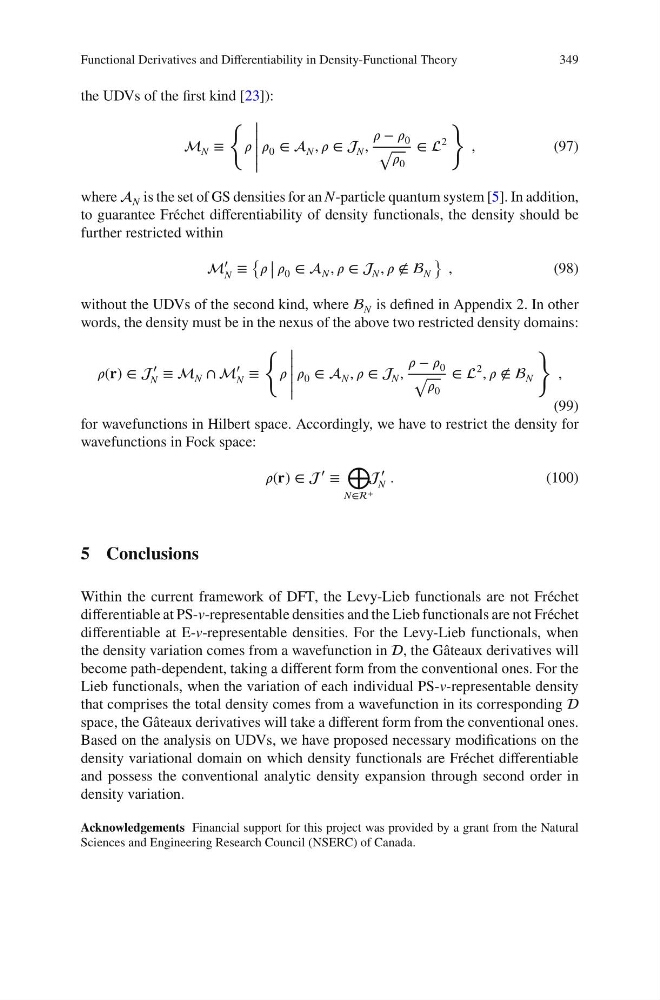
the UDVs of the first kind [23]):
N ≡
{
í µí¼
|
|
|
|
|
|
í µí¼ 0 ∈ N , í µí¼ ∈ N ,
í µí¼ − í µí¼ 0
√ í µí¼ 0
∈
2
}
,
(97)
where N is the set of GS densities for an N-particle quantum system [5]. In addition,
to guarantee Fréchet differentiability of density functionals, the density should be
further restricted within
′
N ≡
{
í µí¼ |
| í µí¼ 0 ∈ N , í µí¼ ∈ N , í µí¼ ∉ N
} ,
(98)
without the UDVs of the second kind, where N is defined in Appendix 2. In other
words, the density must be in the nexus of the above two restricted density domains:
í µí¼(í µí°«) ∈
′
N ≡ N ∩
′
N ≡
{
í µí¼
|
|
|
|
|
|
í µí¼ 0 ∈ N , í µí¼ ∈ N ,
í µí¼ − í µí¼ 0
√
í µí¼ 0
∈
2
, í µí¼ ∉ N
}
,
(99)
for wavefunctions in Hilbert space. Accordingly, we have to restrict the density for
wavefunctions in Fock space:
í µí¼(í µí°«) ∈
′
≡
⨁
N∈ +
′
N .
(100)
5 Conclusions
Within the current framework of DFT, the Levy-Lieb functionals are not Fréchet
differentiable at PS-v-representable densities and the Lieb functionals are not Fréchet
differentiable at E-v-representable densities. For the Levy-Lieb functionals, when
the density variation comes from a wavefunction in , the Gâteaux derivatives will
become path-dependent, taking a different form from the conventional ones. For the
Lieb functionals, when the variation of each individual PS-v-representable density
that comprises the total density comes from a wavefunction in its corresponding
space, the Gâteaux derivatives will take a different form from the conventional ones.
Based on the analysis on UDVs, we have proposed necessary modifications on the
density variational domain on which density functionals are Fréchet differentiable
and possess the conventional analytic density expansion through second order in
density variation.
Acknowledgements Financial support for this project was provided by a grant from the Natural
Sciences and Engineering Research Council (NSERC) of Canada.
349
the UDVs of the first kind [23]):
N ≡
{
í µí¼
|
|
|
|
|
|
í µí¼ 0 ∈ N , í µí¼ ∈ N ,
í µí¼ − í µí¼ 0
√ í µí¼ 0
∈
2
}
,
(97)
where N is the set of GS densities for an N-particle quantum system [5]. In addition,
to guarantee Fréchet differentiability of density functionals, the density should be
further restricted within
′
N ≡
{
í µí¼ |
| í µí¼ 0 ∈ N , í µí¼ ∈ N , í µí¼ ∉ N
} ,
(98)
without the UDVs of the second kind, where N is defined in Appendix 2. In other
words, the density must be in the nexus of the above two restricted density domains:
í µí¼(í µí°«) ∈
′
N ≡ N ∩
′
N ≡
{
í µí¼
|
|
|
|
|
|
í µí¼ 0 ∈ N , í µí¼ ∈ N ,
í µí¼ − í µí¼ 0
√
í µí¼ 0
∈
2
, í µí¼ ∉ N
}
,
(99)
for wavefunctions in Hilbert space. Accordingly, we have to restrict the density for
wavefunctions in Fock space:
í µí¼(í µí°«) ∈
′
≡
⨁
N∈ +
′
N .
(100)
5 Conclusions
Within the current framework of DFT, the Levy-Lieb functionals are not Fréchet
differentiable at PS-v-representable densities and the Lieb functionals are not Fréchet
differentiable at E-v-representable densities. For the Levy-Lieb functionals, when
the density variation comes from a wavefunction in , the Gâteaux derivatives will
become path-dependent, taking a different form from the conventional ones. For the
Lieb functionals, when the variation of each individual PS-v-representable density
that comprises the total density comes from a wavefunction in its corresponding
space, the Gâteaux derivatives will take a different form from the conventional ones.
Based on the analysis on UDVs, we have proposed necessary modifications on the
density variational domain on which density functionals are Fréchet differentiable
and possess the conventional analytic density expansion through second order in
density variation.
Acknowledgements Financial support for this project was provided by a grant from the Natural
Sciences and Engineering Research Council (NSERC) of Canada.