

Functional Derivatives and Differentiability in Density-Functional Theory
347
where K(í µí°«) has no dependence on í µí»¿í µí¼ ′ (í µí°«) and R[í µí¼ 0 , í µí»¿í µí¼ ′ ] satisfies:
lim
í µí»½→0
R[í µí¼ 0 , í µí»¿í µí¼ ′ ]
í µí»½
= 0 .
(85)
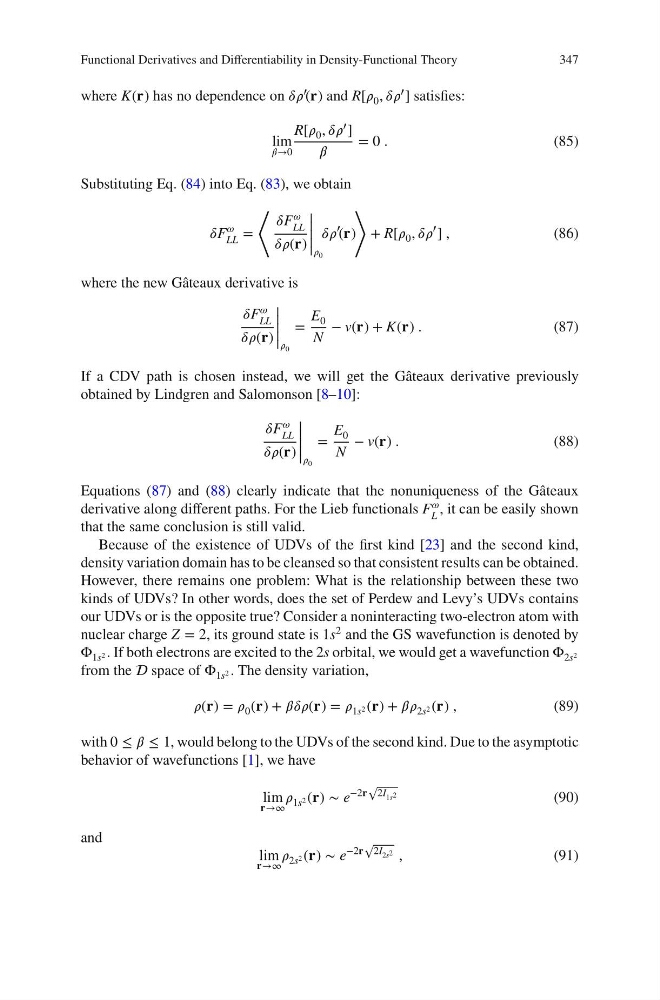
Substituting Eq. (84) into Eq. (83), we obtain
í µí»¿F
í µí¼
LL =
⟨ í µí»¿F
í µí¼
LL
í µí»¿í µí¼(í µí°«)
|
|
|
|
|í µí¼ 0
í µí»¿í µí¼
′
(í µí°«)
⟩
+ R[í µí¼ 0 , í µí»¿í µí¼
′
] ,
(86)
where the new Gâteaux derivative is
í µí»¿F
í µí¼
LL
í µí»¿í µí¼(í µí°«)
|
|
|
|
|í µí¼ 0
=
E 0
N
− v(í µí°«) + K(í µí°«) .
(87)
If a CDV path is chosen instead, we will get the Gâteaux derivative previously
obtained by Lindgren and Salomonson [8–10]:
í µí»¿F
í µí¼
LL
í µí»¿í µí¼(í µí°«)
|
|
|
|
|í µí¼ 0
=
E 0
N
− v(í µí°«) .
(88)
Equations (87) and (88) clearly indicate that the nonuniqueness of the Gâteaux
derivative along different paths. For the Lieb functionals F
í µí¼
L
, it can be easily shown
that the same conclusion is still valid.
Because of the existence of UDVs of the first kind [23] and the second kind,
density variation domain has to be cleansed so that consistent results can be obtained.
However, there remains one problem: What is the relationship between these two
kinds of UDVs? In other words, does the set of Perdew and Levy’s UDVs contains
our UDVs or is the opposite true? Consider a noninteracting two-electron atom with
nuclear charge Z = 2, its ground state is 1s 2 and the GS wavefunction is denoted by
Φ 1s 2 . If both electrons are excited to the 2s orbital, we would get a wavefunction Φ 2s 2
from the space of Φ 1s 2 . The density variation,
í µí¼(í µí°«) = í µí¼ 0 (í µí°«) + í µí»½í µí»¿í µí¼(í µí°«) = í µí¼ 1s 2 (í µí°«) + í µí»½í µí¼ 2s 2 (í µí°«) ,
(89)
with 0 ≤ í µí»½ ≤ 1, would belong to the UDVs of the second kind. Due to the asymptotic
behavior of wavefunctions [1], we have
lim
í µí°«→∞
í µí¼ 1s 2 (í µí°«) ∼ e
−2í µí°«
√ 2I 1s 2
(90)
and
lim
í µí°«→∞
í µí¼ 2s 2 (í µí°«) ∼ e
−2í µí°«
√ 2I 2s 2 ,
(91)
347
where K(í µí°«) has no dependence on í µí»¿í µí¼ ′ (í µí°«) and R[í µí¼ 0 , í µí»¿í µí¼ ′ ] satisfies:
lim
í µí»½→0
R[í µí¼ 0 , í µí»¿í µí¼ ′ ]
í µí»½
= 0 .
(85)
Substituting Eq. (84) into Eq. (83), we obtain
í µí»¿F
í µí¼
LL =
⟨ í µí»¿F
í µí¼
LL
í µí»¿í µí¼(í µí°«)
|
|
|
|
|í µí¼ 0
í µí»¿í µí¼
′
(í µí°«)
⟩
+ R[í µí¼ 0 , í µí»¿í µí¼
′
] ,
(86)
where the new Gâteaux derivative is
í µí»¿F
í µí¼
LL
í µí»¿í µí¼(í µí°«)
|
|
|
|
|í µí¼ 0
=
E 0
N
− v(í µí°«) + K(í µí°«) .
(87)
If a CDV path is chosen instead, we will get the Gâteaux derivative previously
obtained by Lindgren and Salomonson [8–10]:
í µí»¿F
í µí¼
LL
í µí»¿í µí¼(í µí°«)
|
|
|
|
|í µí¼ 0
=
E 0
N
− v(í µí°«) .
(88)
Equations (87) and (88) clearly indicate that the nonuniqueness of the Gâteaux
derivative along different paths. For the Lieb functionals F
í µí¼
L
, it can be easily shown
that the same conclusion is still valid.
Because of the existence of UDVs of the first kind [23] and the second kind,
density variation domain has to be cleansed so that consistent results can be obtained.
However, there remains one problem: What is the relationship between these two
kinds of UDVs? In other words, does the set of Perdew and Levy’s UDVs contains
our UDVs or is the opposite true? Consider a noninteracting two-electron atom with
nuclear charge Z = 2, its ground state is 1s 2 and the GS wavefunction is denoted by
Φ 1s 2 . If both electrons are excited to the 2s orbital, we would get a wavefunction Φ 2s 2
from the space of Φ 1s 2 . The density variation,
í µí¼(í µí°«) = í µí¼ 0 (í µí°«) + í µí»½í µí»¿í µí¼(í µí°«) = í µí¼ 1s 2 (í µí°«) + í µí»½í µí¼ 2s 2 (í µí°«) ,
(89)
with 0 ≤ í µí»½ ≤ 1, would belong to the UDVs of the second kind. Due to the asymptotic
behavior of wavefunctions [1], we have
lim
í µí°«→∞
í µí¼ 1s 2 (í µí°«) ∼ e
−2í µí°«
√ 2I 1s 2
(90)
and
lim
í µí°«→∞
í µí¼ 2s 2 (í µí°«) ∼ e
−2í µí°«
√ 2I 2s 2 ,
(91)