

Functional Derivatives and Differentiability in Density-Functional Theory
343
í µíºµ =
(
∑
i
|c i |
2 E i
)
− h
(
∑
i
|c i |
2
− 1
)
−
⟨(
í µí¼
N
−
∑
i,j
c
∗
i c j ⟨Ψ i |Ψ j ⟩ N−1
)
g(í µí°«)
⟩
,
(64)
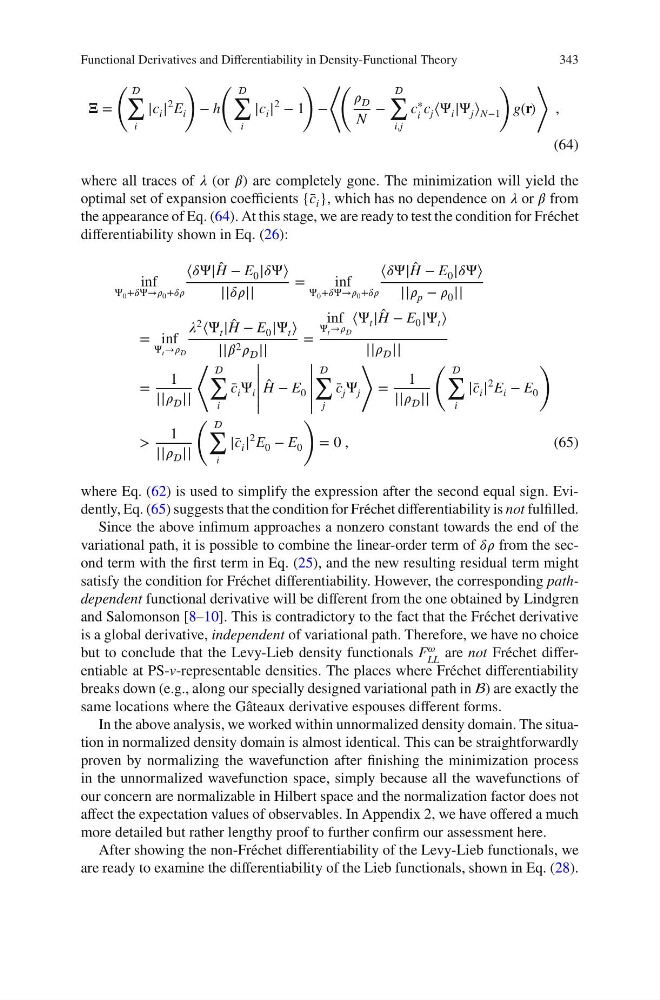
where all traces of í µí¼ (or í µí»½) are completely gone. The minimization will yield the
optimal set of expansion coefficients {̄ c i }, which has no dependence on í µí¼ or í µí»½ from
the appearance of Eq. (64). At this stage, we are ready to test the condition for Fréchet
differentiability shown in Eq. (26):
inf
Ψ 0 +í µí»¿Ψ→í µí¼ 0 +í µí»¿í µí¼
⟨í µí»¿Ψ| ̂
H − E 0 |í µí»¿Ψ⟩
||í µí»¿í µí¼||
=
inf
Ψ 0 +í µí»¿Ψ→í µí¼ 0 +í µí»¿í µí¼
⟨í µí»¿Ψ| ̂
H − E 0 |í µí»¿Ψ⟩
||í µí¼ p − í µí¼ 0 ||
= inf
Ψ t →í µí¼
í µí¼ 2 ⟨Ψ t | ̂
H − E 0 |Ψ t ⟩
||í µí»½ 2 í µí¼ ||
=
inf
Ψ t →í µí¼
⟨Ψ t | ̂
H − E 0 |Ψ t ⟩
||í µí¼ ||
=
1
||í µí¼ ||
⟨
∑
i
̄
c i Ψ i
|
|
|
|
|
|
̂
H − E 0
|
|
|
|
|
|
∑
j
̄
c j Ψ j
⟩
=
1
||í µí¼ ||
(
∑
i
|̄ c i |
2 E i − E 0
)
>
1
||í µí¼ ||
(
∑
i
|̄ c i |
2 E 0 − E 0
)
= 0 ,
(65)
where Eq. (62) is used to simplify the expression after the second equal sign. Evidently, Eq. (65) suggests that the condition for Fréchet differentiability is not fulfilled.
Since the above infimum approaches a nonzero constant towards the end of the
variational path, it is possible to combine the linear-order term of í µí»¿í µí¼ from the second term with the first term in Eq. (25), and the new resulting residual term might
satisfy the condition for Fréchet differentiability. However, the corresponding pathdependent functional derivative will be different from the one obtained by Lindgren
and Salomonson [8–10]. This is contradictory to the fact that the Fréchet derivative
is a global derivative, independent of variational path. Therefore, we have no choice
but to conclude that the Levy-Lieb density functionals F
í µí¼
LL
are not Fréchet differentiable at PS-v-representable densities. The places where Fréchet differentiability
breaks down (e.g., along our specially designed variational path in ) are exactly the
same locations where the Gâteaux derivative espouses different forms.
In the above analysis, we worked within unnormalized density domain. The situation in normalized density domain is almost identical. This can be straightforwardly
proven by normalizing the wavefunction after finishing the minimization process
in the unnormalized wavefunction space, simply because all the wavefunctions of
our concern are normalizable in Hilbert space and the normalization factor does not
affect the expectation values of observables. In Appendix 2, we have offered a much
more detailed but rather lengthy proof to further confirm our assessment here.
After showing the non-Fréchet differentiability of the Levy-Lieb functionals, we
are ready to examine the differentiability of the Lieb functionals, shown in Eq. (28).
343
í µíºµ =
(
∑
i
|c i |
2 E i
)
− h
(
∑
i
|c i |
2
− 1
)
−
⟨(
í µí¼
N
−
∑
i,j
c
∗
i c j ⟨Ψ i |Ψ j ⟩ N−1
)
g(í µí°«)
⟩
,
(64)
where all traces of í µí¼ (or í µí»½) are completely gone. The minimization will yield the
optimal set of expansion coefficients {̄ c i }, which has no dependence on í µí¼ or í µí»½ from
the appearance of Eq. (64). At this stage, we are ready to test the condition for Fréchet
differentiability shown in Eq. (26):
inf
Ψ 0 +í µí»¿Ψ→í µí¼ 0 +í µí»¿í µí¼
⟨í µí»¿Ψ| ̂
H − E 0 |í µí»¿Ψ⟩
||í µí»¿í µí¼||
=
inf
Ψ 0 +í µí»¿Ψ→í µí¼ 0 +í µí»¿í µí¼
⟨í µí»¿Ψ| ̂
H − E 0 |í µí»¿Ψ⟩
||í µí¼ p − í µí¼ 0 ||
= inf
Ψ t →í µí¼
í µí¼ 2 ⟨Ψ t | ̂
H − E 0 |Ψ t ⟩
||í µí»½ 2 í µí¼ ||
=
inf
Ψ t →í µí¼
⟨Ψ t | ̂
H − E 0 |Ψ t ⟩
||í µí¼ ||
=
1
||í µí¼ ||
⟨
∑
i
̄
c i Ψ i
|
|
|
|
|
|
̂
H − E 0
|
|
|
|
|
|
∑
j
̄
c j Ψ j
⟩
=
1
||í µí¼ ||
(
∑
i
|̄ c i |
2 E i − E 0
)
>
1
||í µí¼ ||
(
∑
i
|̄ c i |
2 E 0 − E 0
)
= 0 ,
(65)
where Eq. (62) is used to simplify the expression after the second equal sign. Evidently, Eq. (65) suggests that the condition for Fréchet differentiability is not fulfilled.
Since the above infimum approaches a nonzero constant towards the end of the
variational path, it is possible to combine the linear-order term of í µí»¿í µí¼ from the second term with the first term in Eq. (25), and the new resulting residual term might
satisfy the condition for Fréchet differentiability. However, the corresponding pathdependent functional derivative will be different from the one obtained by Lindgren
and Salomonson [8–10]. This is contradictory to the fact that the Fréchet derivative
is a global derivative, independent of variational path. Therefore, we have no choice
but to conclude that the Levy-Lieb density functionals F
í µí¼
LL
are not Fréchet differentiable at PS-v-representable densities. The places where Fréchet differentiability
breaks down (e.g., along our specially designed variational path in ) are exactly the
same locations where the Gâteaux derivative espouses different forms.
In the above analysis, we worked within unnormalized density domain. The situation in normalized density domain is almost identical. This can be straightforwardly
proven by normalizing the wavefunction after finishing the minimization process
in the unnormalized wavefunction space, simply because all the wavefunctions of
our concern are normalizable in Hilbert space and the normalization factor does not
affect the expectation values of observables. In Appendix 2, we have offered a much
more detailed but rather lengthy proof to further confirm our assessment here.
After showing the non-Fréchet differentiability of the Levy-Lieb functionals, we
are ready to examine the differentiability of the Lieb functionals, shown in Eq. (28).