

342
P. Xiang and Y. A. Wang
where “h.o.” denotes higher-order terms in í µí¼. Obviously, we reach the same conclusion as we derived before: {c i } for Ψ i ∈ is at least linear in í µí¼ towards the end of the
variational path. For those {c i } for Ψ i ∈ , where Ψ i is order-1 strongly orthogonal
to Ψ 0 , the first term in the square brackets on the LHS of Eq. (56) disappears, and
Eq. (56) reduces to
í µí¼
2
⟨ 0
∑
j
c j Re
( ⟨ Ψ i
|
| Ψ j
⟩
N−1
)
g(í µí°«)
⟩
+ í µí¼
2
⟨
∑
j
c j Re
( ⟨ Ψ i
|
| Ψ j
⟩
N−1
)
g(í µí°«)
⟩
= í µí¼
2
(E i − E 0 )c i − hc i .
(59)
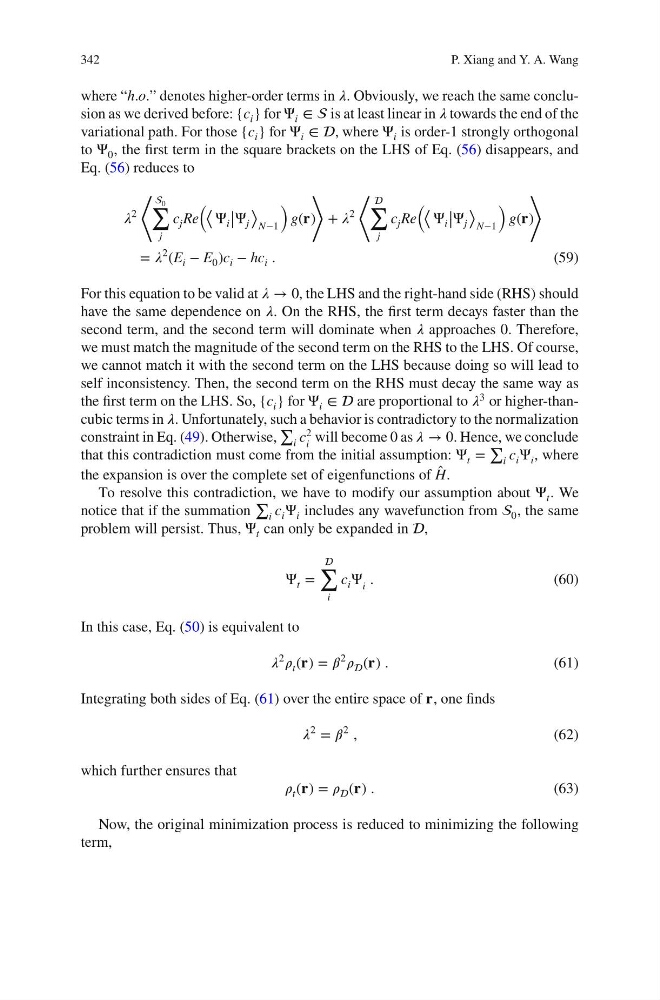
For this equation to be valid at í µí¼ → 0, the LHS and the right-hand side (RHS) should
have the same dependence on í µí¼. On the RHS, the first term decays faster than the
second term, and the second term will dominate when í µí¼ approaches 0. Therefore,
we must match the magnitude of the second term on the RHS to the LHS. Of course,
we cannot match it with the second term on the LHS because doing so will lead to
self inconsistency. Then, the second term on the RHS must decay the same way as
the first term on the LHS. So, {c i } for Ψ i ∈ are proportional to í µí¼
3 or higher-thancubic terms in í µí¼. Unfortunately, such a behavior is contradictory to the normalization
constraint in Eq. (49). Otherwise,
∑
i c
2
i
will become 0 as í µí¼ → 0. Hence, we conclude
that this contradiction must come from the initial assumption: Ψ t =
∑
i c i Ψ i , where
the expansion is over the complete set of eigenfunctions of ̂
H.
To resolve this contradiction, we have to modify our assumption about Ψ t . We
notice that if the summation
∑
i c i Ψ i includes any wavefunction from 0 , the same
problem will persist. Thus, Ψ t can only be expanded in ,
Ψ t =
∑
i
c i Ψ i .
(60)
In this case, Eq. (50) is equivalent to
í µí¼
2
í µí¼ t (í µí°«) = í µí»½
2
í µí¼ (í µí°«) .
(61)
Integrating both sides of Eq. (61) over the entire space of í µí°«, one finds
í µí¼
2
= í µí»½
2
,
(62)
which further ensures that
í µí¼ t (í µí°«) = í µí¼ (í µí°«) .
(63)
Now, the original minimization process is reduced to minimizing the following
term,
P. Xiang and Y. A. Wang
where “h.o.” denotes higher-order terms in í µí¼. Obviously, we reach the same conclusion as we derived before: {c i } for Ψ i ∈ is at least linear in í µí¼ towards the end of the
variational path. For those {c i } for Ψ i ∈ , where Ψ i is order-1 strongly orthogonal
to Ψ 0 , the first term in the square brackets on the LHS of Eq. (56) disappears, and
Eq. (56) reduces to
í µí¼
2
⟨ 0
∑
j
c j Re
( ⟨ Ψ i
|
| Ψ j
⟩
N−1
)
g(í µí°«)
⟩
+ í µí¼
2
⟨
∑
j
c j Re
( ⟨ Ψ i
|
| Ψ j
⟩
N−1
)
g(í µí°«)
⟩
= í µí¼
2
(E i − E 0 )c i − hc i .
(59)
For this equation to be valid at í µí¼ → 0, the LHS and the right-hand side (RHS) should
have the same dependence on í µí¼. On the RHS, the first term decays faster than the
second term, and the second term will dominate when í µí¼ approaches 0. Therefore,
we must match the magnitude of the second term on the RHS to the LHS. Of course,
we cannot match it with the second term on the LHS because doing so will lead to
self inconsistency. Then, the second term on the RHS must decay the same way as
the first term on the LHS. So, {c i } for Ψ i ∈ are proportional to í µí¼
3 or higher-thancubic terms in í µí¼. Unfortunately, such a behavior is contradictory to the normalization
constraint in Eq. (49). Otherwise,
∑
i c
2
i
will become 0 as í µí¼ → 0. Hence, we conclude
that this contradiction must come from the initial assumption: Ψ t =
∑
i c i Ψ i , where
the expansion is over the complete set of eigenfunctions of ̂
H.
To resolve this contradiction, we have to modify our assumption about Ψ t . We
notice that if the summation
∑
i c i Ψ i includes any wavefunction from 0 , the same
problem will persist. Thus, Ψ t can only be expanded in ,
Ψ t =
∑
i
c i Ψ i .
(60)
In this case, Eq. (50) is equivalent to
í µí¼
2
í µí¼ t (í µí°«) = í µí»½
2
í µí¼ (í µí°«) .
(61)
Integrating both sides of Eq. (61) over the entire space of í µí°«, one finds
í µí¼
2
= í µí»½
2
,
(62)
which further ensures that
í µí¼ t (í µí°«) = í µí¼ (í µí°«) .
(63)
Now, the original minimization process is reduced to minimizing the following
term,