

Functional Derivatives and Differentiability in Density-Functional Theory
341
í µí° = 2í µí¼
[
c 0 (í µí¼ 0 − í µí¼ )
N
+
∑
i
c i Re
(⟨ Ψ 0 |
| Ψ i
⟩
N−1
)
]
−í µí¼
2
(
í µí¼
N
−
∞
∑
i,j
c i c j
⟨ Ψ i |
| Ψ j
⟩
N−1
)
,
(53)
and
í µí» = í µí¼
2
(
⟨Ψ t | ̂
H|Ψ t ⟩ − E 0
) − hí µí° − ⟨g(í µí°«) í µí°⟩
= í µí¼
2
( ∞
∑
i,j
c i c j ⟨Ψ i | ̂
H|Ψ j ⟩ − E 0
)
− hí µí° − ⟨g(í µí°«) í µí°⟩
= í µí¼
2
( ∞
∑
i,j
c i c j E j í µí»¿ ij − E 0
)
− hí µí° − ⟨g(í µí°«) í µí°⟩
= í µí¼
2
[ ∞
∑
i=1
c
2
i
(E i − E 0 )
]
− hí µí° − ⟨g(í µí°«) í µí°⟩ ,
(54)
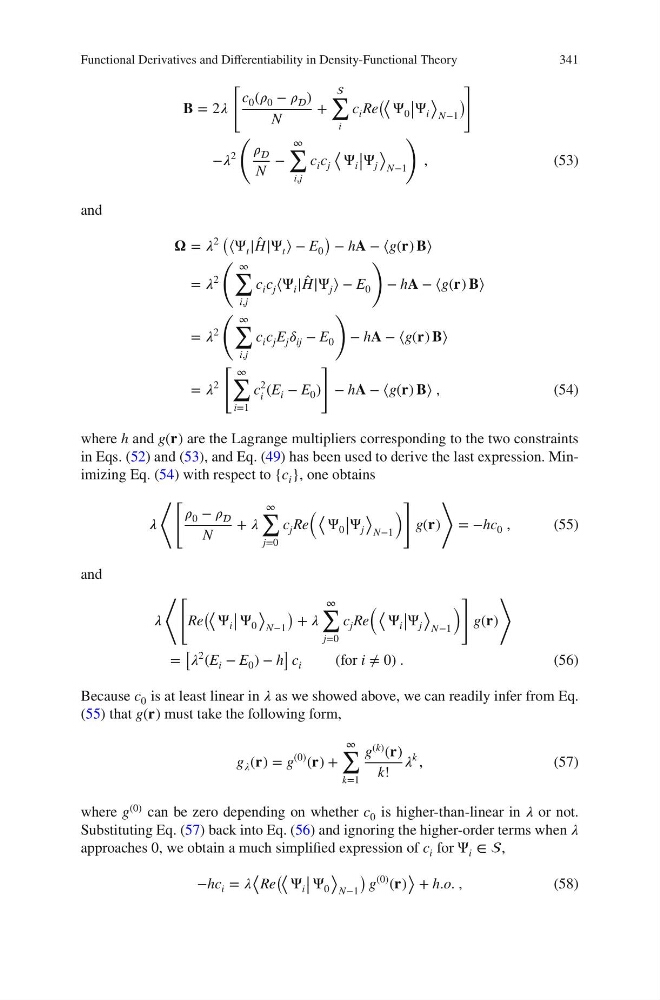
where h and g(í µí°«) are the Lagrange multipliers corresponding to the two constraints
in Eqs. (52) and (53), and Eq. (49) has been used to derive the last expression. Minimizing Eq. (54) with respect to {c i }, one obtains
í µí¼
⟨[
í µí¼ 0 − í µí¼
N
+ í µí¼
∞
∑
j=0
c j Re
( ⟨ Ψ 0 |
| Ψ j
⟩
N−1
)
]
g(í µí°«)
⟩
= −hc 0 ,
(55)
and
í µí¼
⟨[
Re
(⟨ Ψ i
|
| Ψ 0
⟩
N−1
) + í µí¼
∞
∑
j=0
c j Re
( ⟨ Ψ i
|
| Ψ j
⟩
N−1
)
]
g(í µí°«)
⟩
=
[ í µí¼
2
(E i − E 0 ) − h
]
c i
(for i ≠ 0) .
(56)
Because c 0 is at least linear in í µí¼ as we showed above, we can readily infer from Eq.
(55) that g(í µí°«) must take the following form,
g í µí¼ (í µí°«) = g
(0)
(í µí°«) +
∞
∑
k=1
g (k) (í µí°«)
k!
í µí¼
k
,
(57)
where g
(0) can be zero depending on whether c 0 is higher-than-linear in í µí¼ or not.
Substituting Eq. (57) back into Eq. (56) and ignoring the higher-order terms when í µí¼
approaches 0, we obtain a much simplified expression of c i for Ψ i ∈ ,
−hc i = í µí¼
⟨
Re
(⟨ Ψ i
|
| Ψ 0
⟩
N−1
)
g
(0)
(í µí°«)
⟩ + h.o. ,
(58)
341
í µí° = 2í µí¼
[
c 0 (í µí¼ 0 − í µí¼ )
N
+
∑
i
c i Re
(⟨ Ψ 0 |
| Ψ i
⟩
N−1
)
]
−í µí¼
2
(
í µí¼
N
−
∞
∑
i,j
c i c j
⟨ Ψ i |
| Ψ j
⟩
N−1
)
,
(53)
and
í µí» = í µí¼
2
(
⟨Ψ t | ̂
H|Ψ t ⟩ − E 0
) − hí µí° − ⟨g(í µí°«) í µí°⟩
= í µí¼
2
( ∞
∑
i,j
c i c j ⟨Ψ i | ̂
H|Ψ j ⟩ − E 0
)
− hí µí° − ⟨g(í µí°«) í µí°⟩
= í µí¼
2
( ∞
∑
i,j
c i c j E j í µí»¿ ij − E 0
)
− hí µí° − ⟨g(í µí°«) í µí°⟩
= í µí¼
2
[ ∞
∑
i=1
c
2
i
(E i − E 0 )
]
− hí µí° − ⟨g(í µí°«) í µí°⟩ ,
(54)
where h and g(í µí°«) are the Lagrange multipliers corresponding to the two constraints
in Eqs. (52) and (53), and Eq. (49) has been used to derive the last expression. Minimizing Eq. (54) with respect to {c i }, one obtains
í µí¼
⟨[
í µí¼ 0 − í µí¼
N
+ í µí¼
∞
∑
j=0
c j Re
( ⟨ Ψ 0 |
| Ψ j
⟩
N−1
)
]
g(í µí°«)
⟩
= −hc 0 ,
(55)
and
í µí¼
⟨[
Re
(⟨ Ψ i
|
| Ψ 0
⟩
N−1
) + í µí¼
∞
∑
j=0
c j Re
( ⟨ Ψ i
|
| Ψ j
⟩
N−1
)
]
g(í µí°«)
⟩
=
[ í µí¼
2
(E i − E 0 ) − h
]
c i
(for i ≠ 0) .
(56)
Because c 0 is at least linear in í µí¼ as we showed above, we can readily infer from Eq.
(55) that g(í µí°«) must take the following form,
g í µí¼ (í µí°«) = g
(0)
(í µí°«) +
∞
∑
k=1
g (k) (í µí°«)
k!
í µí¼
k
,
(57)
where g
(0) can be zero depending on whether c 0 is higher-than-linear in í µí¼ or not.
Substituting Eq. (57) back into Eq. (56) and ignoring the higher-order terms when í µí¼
approaches 0, we obtain a much simplified expression of c i for Ψ i ∈ ,
−hc i = í µí¼
⟨
Re
(⟨ Ψ i
|
| Ψ 0
⟩
N−1
)
g
(0)
(í µí°«)
⟩ + h.o. ,
(58)