

344
P. Xiang and Y. A. Wang
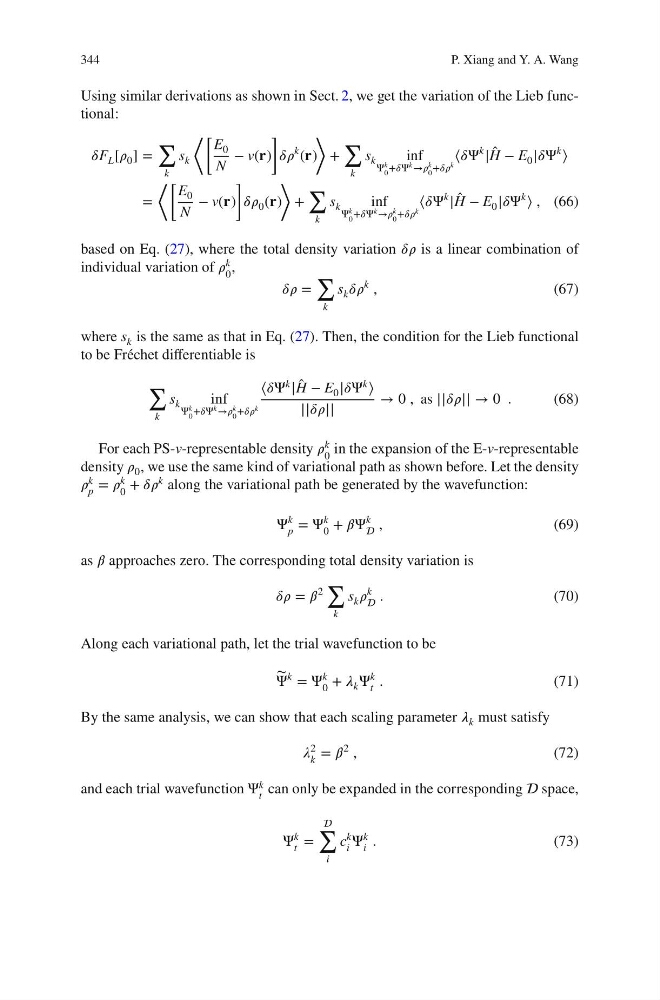
Using similar derivations as shown in Sect. 2, we get the variation of the Lieb functional:
í µí»¿F L [í µí¼ 0 ] =
∑
k
s k
⟨[ E 0
N
− v(í µí°«)
]
í µí»¿í µí¼
k
(í µí°«)
⟩
+
∑
k
s k
inf
Ψ
k
0
+í µí»¿Ψ k →í µí¼
k
0
+í µí»¿í µí¼ k
⟨í µí»¿Ψ
k
| ̂
H − E 0 |í µí»¿Ψ
k
⟩
=
⟨[ E 0
N
− v(í µí°«)
]
í µí»¿í µí¼ 0 (í µí°«)
⟩
+
∑
k
s k
inf
Ψ
k
0
+í µí»¿Ψ k →í µí¼
k
0
+í µí»¿í µí¼ k
⟨í µí»¿Ψ
k
| ̂
H − E 0 |í µí»¿Ψ
k
⟩ , (66)
based on Eq. (27), where the total density variation í µí»¿í µí¼ is a linear combination of
individual variation of í µí¼
k
0
,
í µí»¿í µí¼ =
∑
k
s k í µí»¿í µí¼
k
,
(67)
where s k is the same as that in Eq. (27). Then, the condition for the Lieb functional
to be Fréchet differentiable is
∑
k
s k
inf
Ψ
k
0
+í µí»¿Ψ k →í µí¼
k
0
+í µí»¿í µí¼ k
⟨í µí»¿Ψ
k
| ̂
H − E 0 |í µí»¿Ψ
k
⟩
||í µí»¿í µí¼||
→ 0 , as ||í µí»¿í µí¼|| → 0 .
(68)
For each PS-v-representable density í µí¼
k
0
in the expansion of the E-v-representable
density í µí¼ 0 , we use the same kind of variational path as shown before. Let the density
í µí¼
k
p = í µí¼
k
0
+ í µí»¿í µí¼
k along the variational path be generated by the wavefunction:
Ψ
k
p = Ψ
k
0
+ í µí»½Ψ
k
,
(69)
as í µí»½ approaches zero. The corresponding total density variation is
í µí»¿í µí¼ = í µí»½
2
∑
k
s k í µí¼
k
.
(70)
Along each variational path, let the trial wavefunction to be
̃
Ψ
k
= Ψ
k
0
+ í µí¼ k Ψ
k
t .
(71)
By the same analysis, we can show that each scaling parameter í µí¼ k must satisfy
í µí¼
2
k
= í µí»½
2
,
(72)
and each trial wavefunction Ψ
k
t can only be expanded in the corresponding space,
Ψ
k
t
=
∑
i
c
k
i
Ψ
k
i
.
(73)
P. Xiang and Y. A. Wang
Using similar derivations as shown in Sect. 2, we get the variation of the Lieb functional:
í µí»¿F L [í µí¼ 0 ] =
∑
k
s k
⟨[ E 0
N
− v(í µí°«)
]
í µí»¿í µí¼
k
(í µí°«)
⟩
+
∑
k
s k
inf
Ψ
k
0
+í µí»¿Ψ k →í µí¼
k
0
+í µí»¿í µí¼ k
⟨í µí»¿Ψ
k
| ̂
H − E 0 |í µí»¿Ψ
k
⟩
=
⟨[ E 0
N
− v(í µí°«)
]
í µí»¿í µí¼ 0 (í µí°«)
⟩
+
∑
k
s k
inf
Ψ
k
0
+í µí»¿Ψ k →í µí¼
k
0
+í µí»¿í µí¼ k
⟨í µí»¿Ψ
k
| ̂
H − E 0 |í µí»¿Ψ
k
⟩ , (66)
based on Eq. (27), where the total density variation í µí»¿í µí¼ is a linear combination of
individual variation of í µí¼
k
0
,
í µí»¿í µí¼ =
∑
k
s k í µí»¿í µí¼
k
,
(67)
where s k is the same as that in Eq. (27). Then, the condition for the Lieb functional
to be Fréchet differentiable is
∑
k
s k
inf
Ψ
k
0
+í µí»¿Ψ k →í µí¼
k
0
+í µí»¿í µí¼ k
⟨í µí»¿Ψ
k
| ̂
H − E 0 |í µí»¿Ψ
k
⟩
||í µí»¿í µí¼||
→ 0 , as ||í µí»¿í µí¼|| → 0 .
(68)
For each PS-v-representable density í µí¼
k
0
in the expansion of the E-v-representable
density í µí¼ 0 , we use the same kind of variational path as shown before. Let the density
í µí¼
k
p = í µí¼
k
0
+ í µí»¿í µí¼
k along the variational path be generated by the wavefunction:
Ψ
k
p = Ψ
k
0
+ í µí»½Ψ
k
,
(69)
as í µí»½ approaches zero. The corresponding total density variation is
í µí»¿í µí¼ = í µí»½
2
∑
k
s k í µí¼
k
.
(70)
Along each variational path, let the trial wavefunction to be
̃
Ψ
k
= Ψ
k
0
+ í µí¼ k Ψ
k
t .
(71)
By the same analysis, we can show that each scaling parameter í µí¼ k must satisfy
í µí¼
2
k
= í µí»½
2
,
(72)
and each trial wavefunction Ψ
k
t can only be expanded in the corresponding space,
Ψ
k
t
=
∑
i
c
k
i
Ψ
k
i
.
(73)