

Functional Derivatives and Differentiability in Density-Functional Theory
335
N ≡ {í µí¼ | í µí¼ ≥ 0, ⟨í µí¼⟩ = N,
√ í µí¼ ∈
1
(
3
)} .
(19)
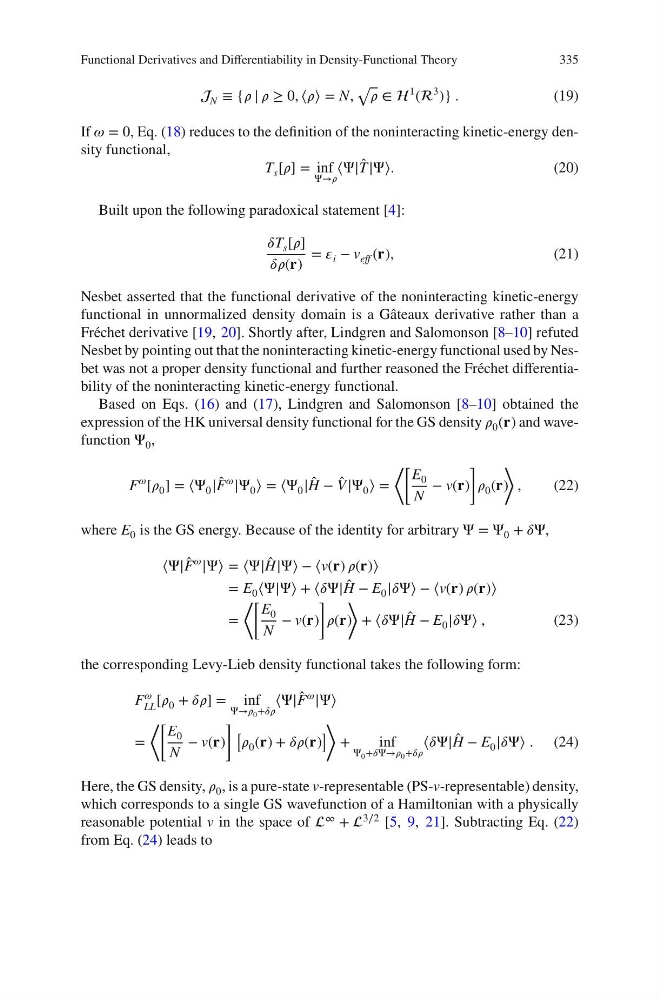
If í µí¼ = 0, Eq. (18) reduces to the definition of the noninteracting kinetic-energy density functional,
T s [í µí¼] = inf
Ψ→í µí¼
⟨Ψ| ̂
T|Ψ⟩.
(20)
Built upon the following paradoxical statement [4]:
í µí»¿T s [í µí¼]
í µí»¿í µí¼(í µí°«)
= í µí¼ i − v eff (í µí°«),
(21)
Nesbet asserted that the functional derivative of the noninteracting kinetic-energy
functional in unnormalized density domain is a Gâteaux derivative rather than a
Fréchet derivative [19, 20]. Shortly after, Lindgren and Salomonson [8–10] refuted
Nesbet by pointing out that the noninteracting kinetic-energy functional used by Nesbet was not a proper density functional and further reasoned the Fréchet differentiability of the noninteracting kinetic-energy functional.
Based on Eqs. (16) and (17), Lindgren and Salomonson [8–10] obtained the
expression of the HK universal density functional for the GS density í µí¼ 0 (í µí°«) and wavefunction Ψ 0 ,
F
í µí¼
[í µí¼ 0 ] = ⟨Ψ 0 | ̂
F
í µí¼
|Ψ 0 ⟩ = ⟨Ψ 0 | ̂
H − ̂
V|Ψ 0 ⟩ =
⟨[ E 0
N
− v(í µí°«)
]
í µí¼ 0 (í µí°«)
⟩
,
(22)
where E 0 is the GS energy. Because of the identity for arbitrary Ψ = Ψ 0 + í µí»¿Ψ,
⟨Ψ| ̂
F
í µí¼
|Ψ⟩ = ⟨Ψ| ̂
H|Ψ⟩ − ⟨v(í µí°«) í µí¼(í µí°«)⟩
= E 0 ⟨Ψ|Ψ⟩ + ⟨í µí»¿Ψ| ̂
H − E 0 |í µí»¿Ψ⟩ − ⟨v(í µí°«) í µí¼(í µí°«)⟩
=
⟨[ E 0
N
− v(í µí°«)
]
í µí¼(í µí°«)
⟩
+ ⟨í µí»¿Ψ| ̂
H − E 0 |í µí»¿Ψ⟩ ,
(23)
the corresponding Levy-Lieb density functional takes the following form:
F
í µí¼
LL [í µí¼ 0 + í µí»¿í µí¼] = inf
Ψ→í µí¼ 0 +í µí»¿í µí¼
⟨Ψ| ̂
F
í µí¼
|Ψ⟩
=
⟨[ E 0
N
− v(í µí°«)
] [ í µí¼ 0 (í µí°«) + í µí»¿í µí¼(í µí°«)
]
⟩
+
inf
Ψ 0 +í µí»¿Ψ→í µí¼ 0 +í µí»¿í µí¼
⟨í µí»¿Ψ| ̂
H − E 0 |í µí»¿Ψ⟩ . (24)
Here, the GS density, í µí¼ 0 , is a pure-state v-representable (PS-v-representable) density,
which corresponds to a single GS wavefunction of a Hamiltonian with a physically
reasonable potential v in the space of ∞ + 3∕2 [5, 9, 21]. Subtracting Eq. (22)
from Eq. (24) leads to
335
N ≡ {í µí¼ | í µí¼ ≥ 0, ⟨í µí¼⟩ = N,
√ í µí¼ ∈
1
(
3
)} .
(19)
If í µí¼ = 0, Eq. (18) reduces to the definition of the noninteracting kinetic-energy density functional,
T s [í µí¼] = inf
Ψ→í µí¼
⟨Ψ| ̂
T|Ψ⟩.
(20)
Built upon the following paradoxical statement [4]:
í µí»¿T s [í µí¼]
í µí»¿í µí¼(í µí°«)
= í µí¼ i − v eff (í µí°«),
(21)
Nesbet asserted that the functional derivative of the noninteracting kinetic-energy
functional in unnormalized density domain is a Gâteaux derivative rather than a
Fréchet derivative [19, 20]. Shortly after, Lindgren and Salomonson [8–10] refuted
Nesbet by pointing out that the noninteracting kinetic-energy functional used by Nesbet was not a proper density functional and further reasoned the Fréchet differentiability of the noninteracting kinetic-energy functional.
Based on Eqs. (16) and (17), Lindgren and Salomonson [8–10] obtained the
expression of the HK universal density functional for the GS density í µí¼ 0 (í µí°«) and wavefunction Ψ 0 ,
F
í µí¼
[í µí¼ 0 ] = ⟨Ψ 0 | ̂
F
í µí¼
|Ψ 0 ⟩ = ⟨Ψ 0 | ̂
H − ̂
V|Ψ 0 ⟩ =
⟨[ E 0
N
− v(í µí°«)
]
í µí¼ 0 (í µí°«)
⟩
,
(22)
where E 0 is the GS energy. Because of the identity for arbitrary Ψ = Ψ 0 + í µí»¿Ψ,
⟨Ψ| ̂
F
í µí¼
|Ψ⟩ = ⟨Ψ| ̂
H|Ψ⟩ − ⟨v(í µí°«) í µí¼(í µí°«)⟩
= E 0 ⟨Ψ|Ψ⟩ + ⟨í µí»¿Ψ| ̂
H − E 0 |í µí»¿Ψ⟩ − ⟨v(í µí°«) í µí¼(í µí°«)⟩
=
⟨[ E 0
N
− v(í µí°«)
]
í µí¼(í µí°«)
⟩
+ ⟨í µí»¿Ψ| ̂
H − E 0 |í µí»¿Ψ⟩ ,
(23)
the corresponding Levy-Lieb density functional takes the following form:
F
í µí¼
LL [í µí¼ 0 + í µí»¿í µí¼] = inf
Ψ→í µí¼ 0 +í µí»¿í µí¼
⟨Ψ| ̂
F
í µí¼
|Ψ⟩
=
⟨[ E 0
N
− v(í µí°«)
] [ í µí¼ 0 (í µí°«) + í µí»¿í µí¼(í µí°«)
]
⟩
+
inf
Ψ 0 +í µí»¿Ψ→í µí¼ 0 +í µí»¿í µí¼
⟨í µí»¿Ψ| ̂
H − E 0 |í µí»¿Ψ⟩ . (24)
Here, the GS density, í µí¼ 0 , is a pure-state v-representable (PS-v-representable) density,
which corresponds to a single GS wavefunction of a Hamiltonian with a physically
reasonable potential v in the space of ∞ + 3∕2 [5, 9, 21]. Subtracting Eq. (22)
from Eq. (24) leads to