

334
P. Xiang and Y. A. Wang
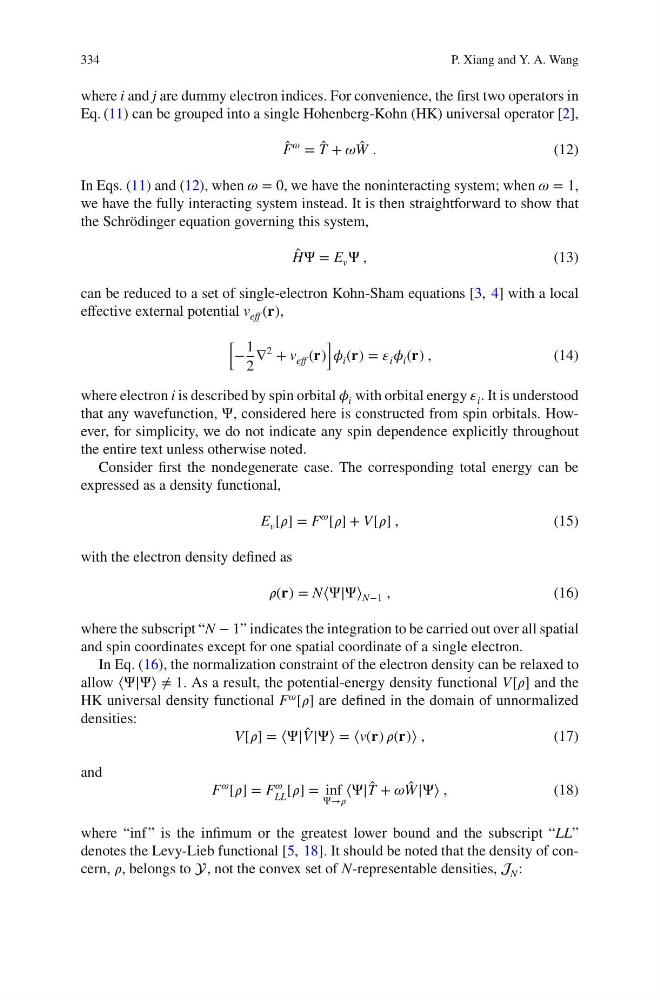
where i and j are dummy electron indices. For convenience, the first two operators in
Eq. (11) can be grouped into a single Hohenberg-Kohn (HK) universal operator [2],
̂
F
í µí¼
= ̂
T + í µí¼ ̂
W .
(12)
In Eqs. (11) and (12), when í µí¼ = 0, we have the noninteracting system; when í µí¼ = 1,
we have the fully interacting system instead. It is then straightforward to show that
the Schrödinger equation governing this system,
̂
HΨ = E v Ψ ,
(13)
can be reduced to a set of single-electron Kohn-Sham equations [3, 4] with a local
effective external potential v eff (í µí°«),
[
−
1
2
∇
2
+ v eff (í µí°«)
]
í µí¼ i (í µí°«) = í µí¼ i í µí¼ i (í µí°«) ,
(14)
where electron i is described by spin orbital í µí¼ i with orbital energy í µí¼ i . It is understood
that any wavefunction, Ψ, considered here is constructed from spin orbitals. However, for simplicity, we do not indicate any spin dependence explicitly throughout
the entire text unless otherwise noted.
Consider first the nondegenerate case. The corresponding total energy can be
expressed as a density functional,
E v [í µí¼] = F
í µí¼
[í µí¼] + V[í µí¼] ,
(15)
with the electron density defined as
í µí¼(í µí°«) = N⟨Ψ|Ψ⟩ N−1 ,
(16)
where the subscript “N − 1” indicates the integration to be carried out over all spatial
and spin coordinates except for one spatial coordinate of a single electron.
In Eq. (16), the normalization constraint of the electron density can be relaxed to
allow ⟨Ψ|Ψ⟩ ≠ 1. As a result, the potential-energy density functional V[í µí¼] and the
HK universal density functional F
í µí¼
[í µí¼] are defined in the domain of unnormalized
densities:
V[í µí¼] = ⟨Ψ| ̂
V|Ψ⟩ = ⟨v(í µí°«) í µí¼(í µí°«)⟩ ,
(17)
and
F
í µí¼
[í µí¼] = F
í µí¼
LL
[í µí¼] = inf
Ψ→í µí¼
⟨Ψ| ̂
T + í µí¼ ̂
W|Ψ⟩ ,
(18)
where “inf ” is the infimum or the greatest lower bound and the subscript “LL”
denotes the Levy-Lieb functional [5, 18]. It should be noted that the density of concern, í µí¼, belongs to , not the convex set of N-representable densities, N :
P. Xiang and Y. A. Wang
where i and j are dummy electron indices. For convenience, the first two operators in
Eq. (11) can be grouped into a single Hohenberg-Kohn (HK) universal operator [2],
̂
F
í µí¼
= ̂
T + í µí¼ ̂
W .
(12)
In Eqs. (11) and (12), when í µí¼ = 0, we have the noninteracting system; when í µí¼ = 1,
we have the fully interacting system instead. It is then straightforward to show that
the Schrödinger equation governing this system,
̂
HΨ = E v Ψ ,
(13)
can be reduced to a set of single-electron Kohn-Sham equations [3, 4] with a local
effective external potential v eff (í µí°«),
[
−
1
2
∇
2
+ v eff (í µí°«)
]
í µí¼ i (í µí°«) = í µí¼ i í µí¼ i (í µí°«) ,
(14)
where electron i is described by spin orbital í µí¼ i with orbital energy í µí¼ i . It is understood
that any wavefunction, Ψ, considered here is constructed from spin orbitals. However, for simplicity, we do not indicate any spin dependence explicitly throughout
the entire text unless otherwise noted.
Consider first the nondegenerate case. The corresponding total energy can be
expressed as a density functional,
E v [í µí¼] = F
í µí¼
[í µí¼] + V[í µí¼] ,
(15)
with the electron density defined as
í µí¼(í µí°«) = N⟨Ψ|Ψ⟩ N−1 ,
(16)
where the subscript “N − 1” indicates the integration to be carried out over all spatial
and spin coordinates except for one spatial coordinate of a single electron.
In Eq. (16), the normalization constraint of the electron density can be relaxed to
allow ⟨Ψ|Ψ⟩ ≠ 1. As a result, the potential-energy density functional V[í µí¼] and the
HK universal density functional F
í µí¼
[í µí¼] are defined in the domain of unnormalized
densities:
V[í µí¼] = ⟨Ψ| ̂
V|Ψ⟩ = ⟨v(í µí°«) í µí¼(í µí°«)⟩ ,
(17)
and
F
í µí¼
[í µí¼] = F
í µí¼
LL
[í µí¼] = inf
Ψ→í µí¼
⟨Ψ| ̂
T + í µí¼ ̂
W|Ψ⟩ ,
(18)
where “inf ” is the infimum or the greatest lower bound and the subscript “LL”
denotes the Levy-Lieb functional [5, 18]. It should be noted that the density of concern, í µí¼, belongs to , not the convex set of N-representable densities, N :