

Functional Derivatives and Differentiability in Density-Functional Theory
333
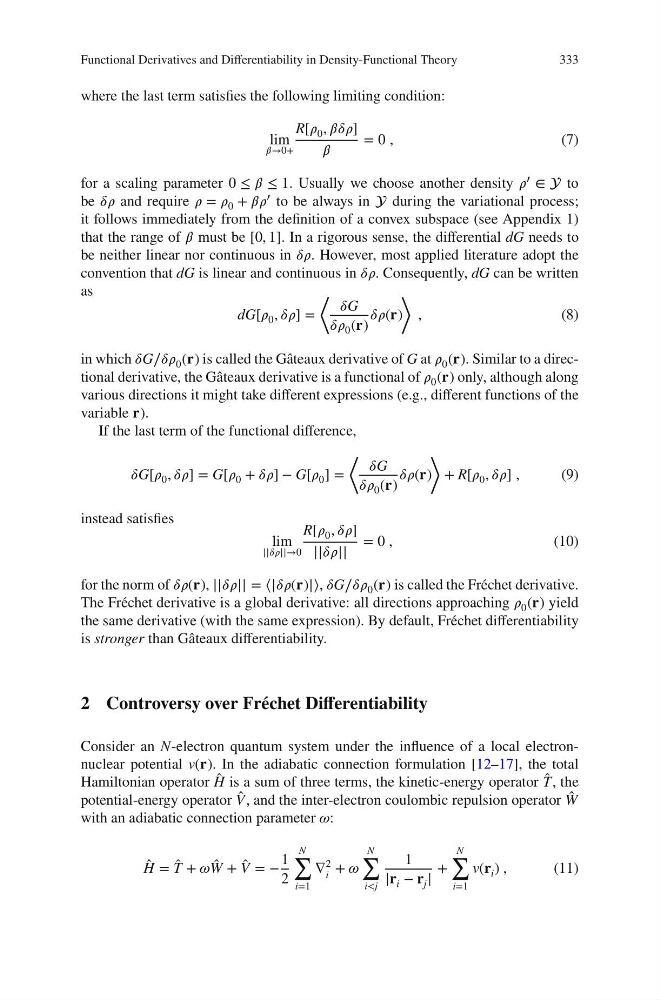
where the last term satisfies the following limiting condition:
lim
í µí»½→0+
R[í µí¼ 0 , í µí»½í µí»¿í µí¼]
í µí»½
= 0 ,
(7)
for a scaling parameter 0 ≤ í µí»½ ≤ 1. Usually we choose another density í µí¼
′
∈ to
be í µí»¿í µí¼ and require í µí¼ = í µí¼ 0 + í µí»½í µí¼ ′ to be always in during the variational process;
it follows immediately from the definition of a convex subspace (see Appendix 1)
that the range of í µí»½ must be [0, 1]. In a rigorous sense, the differential dG needs to
be neither linear nor continuous in í µí»¿í µí¼. However, most applied literature adopt the
convention that dG is linear and continuous in í µí»¿í µí¼. Consequently, dG can be written
as
dG[í µí¼ 0 , í µí»¿í µí¼] =
⟨ í µí»¿G
í µí»¿í µí¼ 0 (í µí°«)
í µí»¿í µí¼(í µí°«)
⟩
,
(8)
in which í µí»¿G∕í µí»¿í µí¼ 0 (í µí°«) is called the Gâteaux derivative of G at í µí¼ 0 (í µí°«). Similar to a directional derivative, the Gâteaux derivative is a functional of í µí¼ 0 (í µí°«) only, although along
various directions it might take different expressions (e.g., different functions of the
variable í µí°«).
If the last term of the functional difference,
í µí»¿G[í µí¼ 0 , í µí»¿í µí¼] = G[í µí¼ 0 + í µí»¿í µí¼] − G[í µí¼ 0 ] =
⟨ í µí»¿G
í µí»¿í µí¼ 0 (í µí°«)
í µí»¿í µí¼(í µí°«)
⟩
+ R[í µí¼ 0 , í µí»¿í µí¼] ,
(9)
instead satisfies
lim
||í µí»¿í µí¼||→0
R[í µí¼ 0 , í µí»¿í µí¼]
||í µí»¿í µí¼||
= 0 ,
(10)
for the norm of í µí»¿í µí¼(í µí°«), ||í µí»¿í µí¼|| = ⟨|í µí»¿í µí¼(í µí°«)|⟩, í µí»¿G∕í µí»¿í µí¼ 0 (í µí°«) is called the Fréchet derivative.
The Fréchet derivative is a global derivative: all directions approaching í µí¼ 0 (í µí°«) yield
the same derivative (with the same expression). By default, Fréchet differentiability
is stronger than Gâteaux differentiability.
2 Controversy over Fréchet Differentiability
Consider an N-electron quantum system under the influence of a local electronnuclear potential v(í µí°«). In the adiabatic connection formulation [12–17], the total
Hamiltonian operator ̂
H is a sum of three terms, the kinetic-energy operator ̂
T, the
potential-energy operator ̂
V, and the inter-electron coulombic repulsion operator ̂
W
with an adiabatic connection parameter í µí¼:
̂
H = ̂
T + í µí¼ ̂
W + ̂
V = −
1
2
N
∑
i=1
∇
2
i + í µí¼
N
∑
i
|í µí°« i − í µí°« j |
+
N
∑
i=1
v(í µí°« i ) ,
(11)
333
where the last term satisfies the following limiting condition:
lim
í µí»½→0+
R[í µí¼ 0 , í µí»½í µí»¿í µí¼]
í µí»½
= 0 ,
(7)
for a scaling parameter 0 ≤ í µí»½ ≤ 1. Usually we choose another density í µí¼
′
∈ to
be í µí»¿í µí¼ and require í µí¼ = í µí¼ 0 + í µí»½í µí¼ ′ to be always in during the variational process;
it follows immediately from the definition of a convex subspace (see Appendix 1)
that the range of í µí»½ must be [0, 1]. In a rigorous sense, the differential dG needs to
be neither linear nor continuous in í µí»¿í µí¼. However, most applied literature adopt the
convention that dG is linear and continuous in í µí»¿í µí¼. Consequently, dG can be written
as
dG[í µí¼ 0 , í µí»¿í µí¼] =
⟨ í µí»¿G
í µí»¿í µí¼ 0 (í µí°«)
í µí»¿í µí¼(í µí°«)
⟩
,
(8)
in which í µí»¿G∕í µí»¿í µí¼ 0 (í µí°«) is called the Gâteaux derivative of G at í µí¼ 0 (í µí°«). Similar to a directional derivative, the Gâteaux derivative is a functional of í µí¼ 0 (í µí°«) only, although along
various directions it might take different expressions (e.g., different functions of the
variable í µí°«).
If the last term of the functional difference,
í µí»¿G[í µí¼ 0 , í µí»¿í µí¼] = G[í µí¼ 0 + í µí»¿í µí¼] − G[í µí¼ 0 ] =
⟨ í µí»¿G
í µí»¿í µí¼ 0 (í µí°«)
í µí»¿í µí¼(í µí°«)
⟩
+ R[í µí¼ 0 , í µí»¿í µí¼] ,
(9)
instead satisfies
lim
||í µí»¿í µí¼||→0
R[í µí¼ 0 , í µí»¿í µí¼]
||í µí»¿í µí¼||
= 0 ,
(10)
for the norm of í µí»¿í µí¼(í µí°«), ||í µí»¿í µí¼|| = ⟨|í µí»¿í µí¼(í µí°«)|⟩, í µí»¿G∕í µí»¿í µí¼ 0 (í µí°«) is called the Fréchet derivative.
The Fréchet derivative is a global derivative: all directions approaching í µí¼ 0 (í µí°«) yield
the same derivative (with the same expression). By default, Fréchet differentiability
is stronger than Gâteaux differentiability.
2 Controversy over Fréchet Differentiability
Consider an N-electron quantum system under the influence of a local electronnuclear potential v(í µí°«). In the adiabatic connection formulation [12–17], the total
Hamiltonian operator ̂
H is a sum of three terms, the kinetic-energy operator ̂
T, the
potential-energy operator ̂
V, and the inter-electron coulombic repulsion operator ̂
W
with an adiabatic connection parameter í µí¼:
̂
H = ̂
T + í µí¼ ̂
W + ̂
V = −
1
2
N
∑
i=1
∇
2
i + í µí¼
N
∑
i
|í µí°« i − í µí°« j |
+
N
∑
i=1
v(í µí°« i ) ,
(11)