

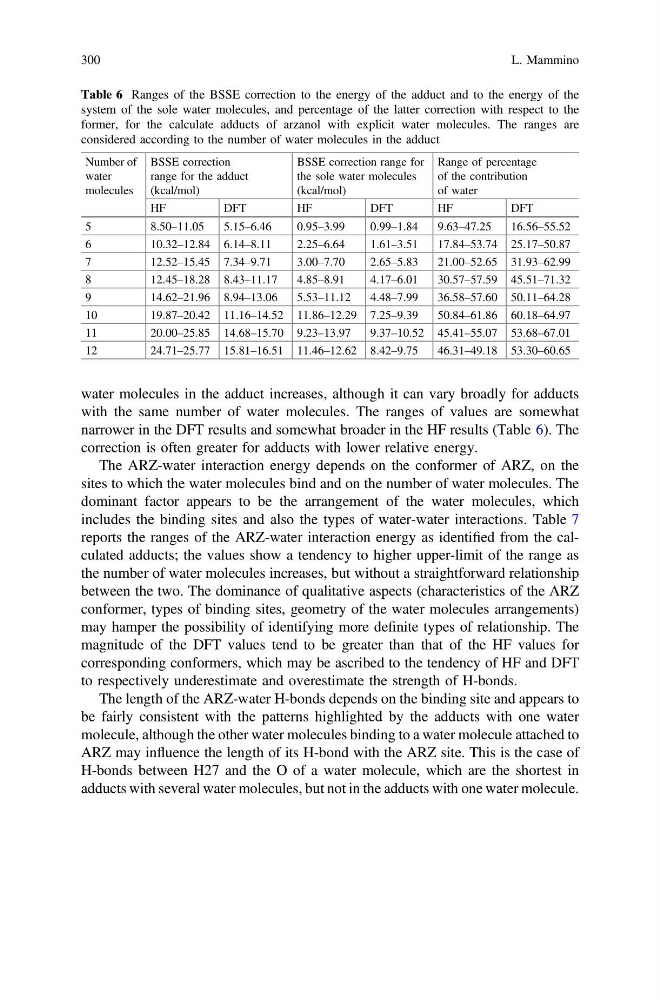
water molecules in the adduct increases, although it can vary broadly for adducts
with the same number of water molecules. The ranges of values are somewhat
narrower in the DFT results and somewhat broader in the HF results (Table 6). The
correction is often greater for adducts with lower relative energy.
The ARZ-water interaction energy depends on the conformer of ARZ, on the
sites to which the water molecules bind and on the number of water molecules. The
dominant factor appears to be the arrangement of the water molecules, which
includes the binding sites and also the types of water-water interactions. Table 7
reports the ranges of the ARZ-water interaction energy as identified from the calculated adducts; the values show a tendency to higher upper-limit of the range as
the number of water molecules increases, but without a straightforward relationship
between the two. The dominance of qualitative aspects (characteristics of the ARZ
conformer, types of binding sites, geometry of the water molecules arrangements)
may hamper the possibility of identifying more definite types of relationship. The
magnitude of the DFT values tend to be greater than that of the HF values for
corresponding conformers, which may be ascribed to the tendency of HF and DFT
to respectively underestimate and overestimate the strength of H-bonds.
The length of the ARZ-water H-bonds depends on the binding site and appears to
be fairly consistent with the patterns highlighted by the adducts with one water
molecule, although the other water molecules binding to a water molecule attached to
ARZ may influence the length of its H-bond with the ARZ site. This is the case of
H-bonds between H27 and the O of a water molecule, which are the shortest in
adducts with several water molecules, but not in the adducts with one water molecule.
Table 6 Ranges of the BSSE correction to the energy of the adduct and to the energy of the
system of the sole water molecules, and percentage of the latter correction with respect to the
former, for the calculate adducts of arzanol with explicit water molecules. The ranges are
considered according to the number of water molecules in the adduct
Number of
water
molecules
BSSE correction
range for the adduct
(kcal/mol)
BSSE correction range for
the sole water molecules
(kcal/mol)
Range of percentage
of the contribution
of water
HF
DFT
HF
DFT
HF
DFT
5
8.50–11.05
5.15–6.46
0.95–3.99
0.99–1.84
9.63–47.25
16.56–55.52
6
10.32–12.84 6.14–8.11
2.25–6.64
1.61–3.51
17.84–53.74 25.17–50.87
7
12.52–15.45 7.34–9.71
3.00–7.70
2.65–5.83
21.00–52.65 31.93–62.99
8
12.45–18.28 8.43–11.17
4.85–8.91
4.17–6.01
30.57–57.59 45.51–71.32
9
14.62–21.96 8.94–13.06
5.53–11.12
4.48–7.99
36.58–57.60 50.11–64.28
10
19.87–20.42 11.16–14.52 11.86–12.29 7.25–9.39
50.84–61.86 60.18–64.97
11
20.00–25.85 14.68–15.70 9.23–13.97
9.37–10.52 45.41–55.07 53.68–67.01
12
24.71–25.77 15.81–16.51 11.46–12.62 8.42–9.75
46.31–49.18 53.30–60.65
300
L. Mammino
with the same number of water molecules. The ranges of values are somewhat
narrower in the DFT results and somewhat broader in the HF results (Table 6). The
correction is often greater for adducts with lower relative energy.
The ARZ-water interaction energy depends on the conformer of ARZ, on the
sites to which the water molecules bind and on the number of water molecules. The
dominant factor appears to be the arrangement of the water molecules, which
includes the binding sites and also the types of water-water interactions. Table 7
reports the ranges of the ARZ-water interaction energy as identified from the calculated adducts; the values show a tendency to higher upper-limit of the range as
the number of water molecules increases, but without a straightforward relationship
between the two. The dominance of qualitative aspects (characteristics of the ARZ
conformer, types of binding sites, geometry of the water molecules arrangements)
may hamper the possibility of identifying more definite types of relationship. The
magnitude of the DFT values tend to be greater than that of the HF values for
corresponding conformers, which may be ascribed to the tendency of HF and DFT
to respectively underestimate and overestimate the strength of H-bonds.
The length of the ARZ-water H-bonds depends on the binding site and appears to
be fairly consistent with the patterns highlighted by the adducts with one water
molecule, although the other water molecules binding to a water molecule attached to
ARZ may influence the length of its H-bond with the ARZ site. This is the case of
H-bonds between H27 and the O of a water molecule, which are the shortest in
adducts with several water molecules, but not in the adducts with one water molecule.
Table 6 Ranges of the BSSE correction to the energy of the adduct and to the energy of the
system of the sole water molecules, and percentage of the latter correction with respect to the
former, for the calculate adducts of arzanol with explicit water molecules. The ranges are
considered according to the number of water molecules in the adduct
Number of
water
molecules
BSSE correction
range for the adduct
(kcal/mol)
BSSE correction range for
the sole water molecules
(kcal/mol)
Range of percentage
of the contribution
of water
HF
DFT
HF
DFT
HF
DFT
5
8.50–11.05
5.15–6.46
0.95–3.99
0.99–1.84
9.63–47.25
16.56–55.52
6
10.32–12.84 6.14–8.11
2.25–6.64
1.61–3.51
17.84–53.74 25.17–50.87
7
12.52–15.45 7.34–9.71
3.00–7.70
2.65–5.83
21.00–52.65 31.93–62.99
8
12.45–18.28 8.43–11.17
4.85–8.91
4.17–6.01
30.57–57.59 45.51–71.32
9
14.62–21.96 8.94–13.06
5.53–11.12
4.48–7.99
36.58–57.60 50.11–64.28
10
19.87–20.42 11.16–14.52 11.86–12.29 7.25–9.39
50.84–61.86 60.18–64.97
11
20.00–25.85 14.68–15.70 9.23–13.97
9.37–10.52 45.41–55.07 53.68–67.01
12
24.71–25.77 15.81–16.51 11.46–12.62 8.42–9.75
46.31–49.18 53.30–60.65
300
L. Mammino