

cases observed concern IMHBs where H27 is the donor (H27⋯O8 or H27⋯O10).
The length of the H-bond between H27 and the O of the water molecule attached to
it is the shortest ARZ-water H-bond length in these adducts, suggesting that this
H-bond might be among the strongest if not the strongest. No breaking has been
observed for the first IHB (which is considerably stronger than H27⋯O8 or
H27⋯O10), consistently with the results for the adducts of other ACPLs [16, 17].
For similar reasons (the acceptor being an sp
2 O), no breaking is observed for
IMHBs in which O23 is the acceptor. The O-H⋯π interaction is broken in a number
of cases, with a water molecule inserting itself between the H and the C29=C30
π-bond. The tendency of the water molecules to cluster together may prompt major
changes during optimization, leading to chains of water molecules alternatingly
binding to a site of ARZ and playing bridging roles.
The relative energies of adducts with the same number of water molecules
depend on their geometrical arrangement and binding sites more than on the relative
energy of the isolated conformer. The BSSE correction increases as the number of
2-s-r-βδ-9-aq-x
2-d-w-η-α-6aq
4-s-r-a-γε-8aq-x
3-s-w-a-γτ-9aq
3-s-w-b-γτ-9aq-e
3-s-w-b-γτ-11aq
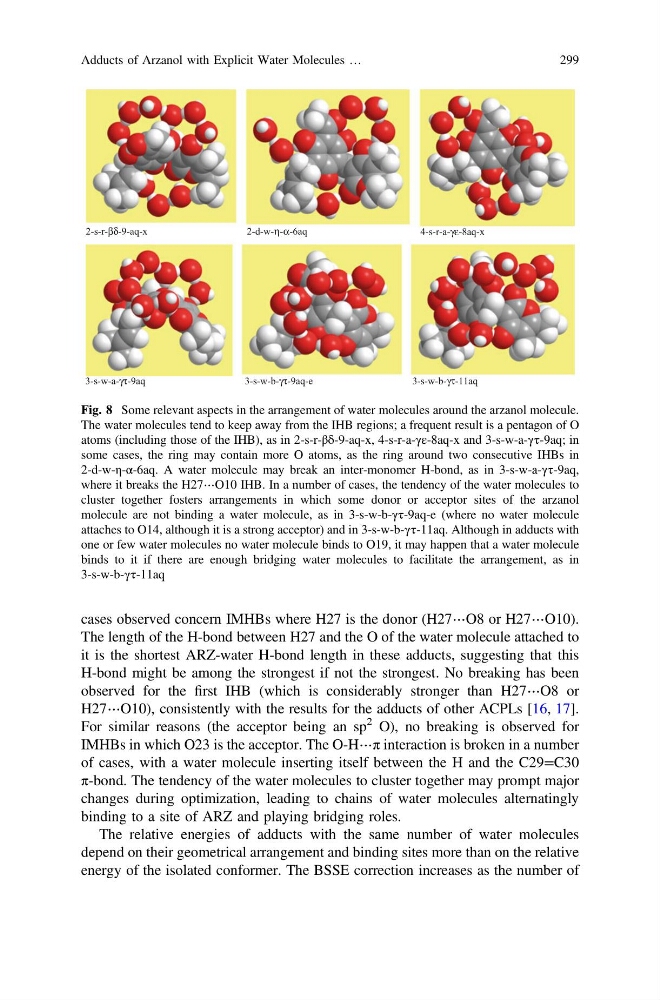
Fig. 8 Some relevant aspects in the arrangement of water molecules around the arzanol molecule.
The water molecules tend to keep away from the IHB regions; a frequent result is a pentagon of O
atoms (including those of the IHB), as in 2-s-r-βδ-9-aq-x, 4-s-r-a-γε-8aq-x and 3-s-w-a-γτ-9aq; in
some cases, the ring may contain more O atoms, as the ring around two consecutive IHBs in
2-d-w-η-α-6aq. A water molecule may break an inter-monomer H-bond, as in 3-s-w-a-γτ-9aq,
where it breaks the H27⋯O10 IHB. In a number of cases, the tendency of the water molecules to
cluster together fosters arrangements in which some donor or acceptor sites of the arzanol
molecule are not binding a water molecule, as in 3-s-w-b-γτ-9aq-e (where no water molecule
attaches to O14, although it is a strong acceptor) and in 3-s-w-b-γτ-11aq. Although in adducts with
one or few water molecules no water molecule binds to O19, it may happen that a water molecule
binds to it if there are enough bridging water molecules to facilitate the arrangement, as in
3-s-w-b-γτ-11aq
Adducts of Arzanol with Explicit Water Molecules …
299
The length of the H-bond between H27 and the O of the water molecule attached to
it is the shortest ARZ-water H-bond length in these adducts, suggesting that this
H-bond might be among the strongest if not the strongest. No breaking has been
observed for the first IHB (which is considerably stronger than H27⋯O8 or
H27⋯O10), consistently with the results for the adducts of other ACPLs [16, 17].
For similar reasons (the acceptor being an sp
2 O), no breaking is observed for
IMHBs in which O23 is the acceptor. The O-H⋯π interaction is broken in a number
of cases, with a water molecule inserting itself between the H and the C29=C30
π-bond. The tendency of the water molecules to cluster together may prompt major
changes during optimization, leading to chains of water molecules alternatingly
binding to a site of ARZ and playing bridging roles.
The relative energies of adducts with the same number of water molecules
depend on their geometrical arrangement and binding sites more than on the relative
energy of the isolated conformer. The BSSE correction increases as the number of
2-s-r-βδ-9-aq-x
2-d-w-η-α-6aq
4-s-r-a-γε-8aq-x
3-s-w-a-γτ-9aq
3-s-w-b-γτ-9aq-e
3-s-w-b-γτ-11aq
Fig. 8 Some relevant aspects in the arrangement of water molecules around the arzanol molecule.
The water molecules tend to keep away from the IHB regions; a frequent result is a pentagon of O
atoms (including those of the IHB), as in 2-s-r-βδ-9-aq-x, 4-s-r-a-γε-8aq-x and 3-s-w-a-γτ-9aq; in
some cases, the ring may contain more O atoms, as the ring around two consecutive IHBs in
2-d-w-η-α-6aq. A water molecule may break an inter-monomer H-bond, as in 3-s-w-a-γτ-9aq,
where it breaks the H27⋯O10 IHB. In a number of cases, the tendency of the water molecules to
cluster together fosters arrangements in which some donor or acceptor sites of the arzanol
molecule are not binding a water molecule, as in 3-s-w-b-γτ-9aq-e (where no water molecule
attaches to O14, although it is a strong acceptor) and in 3-s-w-b-γτ-11aq. Although in adducts with
one or few water molecules no water molecule binds to O19, it may happen that a water molecule
binds to it if there are enough bridging water molecules to facilitate the arrangement, as in
3-s-w-b-γτ-11aq
Adducts of Arzanol with Explicit Water Molecules …
299