

3.4 Results in Water Solution for the Adducts of Arzanol
with More Than One Water Molecule
When solute–solvent intermolecular H-bonds are possible, the combination of
explicit consideration of those solvent molecules that are expected to be more
closely linked to the solute molecule (as those H-bonded to it or bridging them), and
a bulk effect for the rest of the solvent, can provide a better picture of the situation
in solution than the sole PCM calculations on the central molecule, while remaining
within QM calculations affordability because of the limited number of discrete
solvent molecules. Calculations in water solution were performed on selected
adducts considering the entire adduct as a solute and utilising the PCM model. They
were performed as SP calculations, because of affordability reasons in view of the
size of the supermolecular structures of the adducts.
The results show a decrease in the relative energy for most adducts, with greater
decrease for adducts having higher relative energy in vacuo. This is consistent with
common behaviours for isolated molecules. Few exceptions may appear for lower
energy adducts, more frequently in the DFT results. The identification of the lowest
energy adduct may differ from that in vacuo, but remains among the lower energy
adducts in vacuo. No significant patterns for the energy decrease can be identified in
terms of types of the conformers of ARZ.
The solvent effect (free energy of solvation, ΔG solv ) is mostly negative in the
DFT results; in the HF results, it is mostly negative for adducts with smaller
numbers of water molecules and positive for several adducts with higher numbers
of water molecules. Given the expectation that a molecular unit incorporating water
molecules in its outer region would have some solubility in water, the DFT results
are likely more realistic. The electrostatic component of ΔG solv (G el ) is always
negative, with values always smaller than −20 kcal/mol; its magnitude varies rather
randomly with adducts of different conformers, but shows a tendency to an average
increase as the number of water molecules increases.
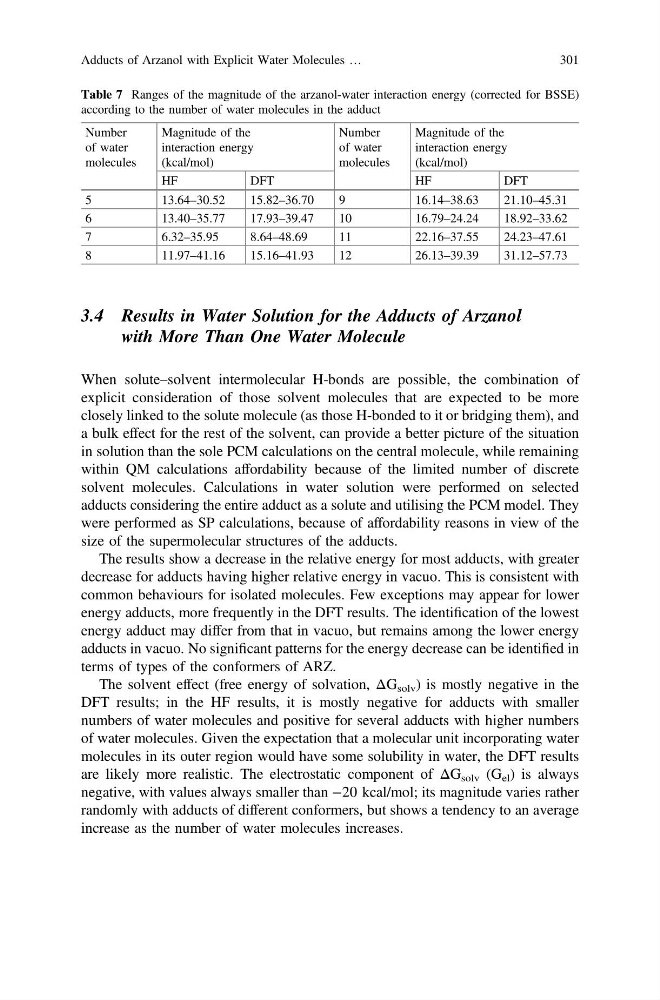
Table 7 Ranges of the magnitude of the arzanol-water interaction energy (corrected for BSSE)
according to the number of water molecules in the adduct
Number
of water
molecules
Magnitude of the
interaction energy
(kcal/mol)
Number
of water
molecules
Magnitude of the
interaction energy
(kcal/mol)
HF
DFT
HF
DFT
5
13.64–30.52
15.82–36.70
9
16.14–38.63
21.10–45.31
6
13.40–35.77
17.93–39.47
10
16.79–24.24
18.92–33.62
7
6.32–35.95
8.64–48.69
11
22.16–37.55
24.23–47.61
8
11.97–41.16
15.16–41.93
12
26.13–39.39
31.12–57.73
Adducts of Arzanol with Explicit Water Molecules …
301
with More Than One Water Molecule
When solute–solvent intermolecular H-bonds are possible, the combination of
explicit consideration of those solvent molecules that are expected to be more
closely linked to the solute molecule (as those H-bonded to it or bridging them), and
a bulk effect for the rest of the solvent, can provide a better picture of the situation
in solution than the sole PCM calculations on the central molecule, while remaining
within QM calculations affordability because of the limited number of discrete
solvent molecules. Calculations in water solution were performed on selected
adducts considering the entire adduct as a solute and utilising the PCM model. They
were performed as SP calculations, because of affordability reasons in view of the
size of the supermolecular structures of the adducts.
The results show a decrease in the relative energy for most adducts, with greater
decrease for adducts having higher relative energy in vacuo. This is consistent with
common behaviours for isolated molecules. Few exceptions may appear for lower
energy adducts, more frequently in the DFT results. The identification of the lowest
energy adduct may differ from that in vacuo, but remains among the lower energy
adducts in vacuo. No significant patterns for the energy decrease can be identified in
terms of types of the conformers of ARZ.
The solvent effect (free energy of solvation, ΔG solv ) is mostly negative in the
DFT results; in the HF results, it is mostly negative for adducts with smaller
numbers of water molecules and positive for several adducts with higher numbers
of water molecules. Given the expectation that a molecular unit incorporating water
molecules in its outer region would have some solubility in water, the DFT results
are likely more realistic. The electrostatic component of ΔG solv (G el ) is always
negative, with values always smaller than −20 kcal/mol; its magnitude varies rather
randomly with adducts of different conformers, but shows a tendency to an average
increase as the number of water molecules increases.
Table 7 Ranges of the magnitude of the arzanol-water interaction energy (corrected for BSSE)
according to the number of water molecules in the adduct
Number
of water
molecules
Magnitude of the
interaction energy
(kcal/mol)
Number
of water
molecules
Magnitude of the
interaction energy
(kcal/mol)
HF
DFT
HF
DFT
5
13.64–30.52
15.82–36.70
9
16.14–38.63
21.10–45.31
6
13.40–35.77
17.93–39.47
10
16.79–24.24
18.92–33.62
7
6.32–35.95
8.64–48.69
11
22.16–37.55
24.23–47.61
8
11.97–41.16
15.16–41.93
12
26.13–39.39
31.12–57.73
Adducts of Arzanol with Explicit Water Molecules …
301