

Geometric Phase and Interference Effects in Ultracold Chemical Reactions
273
10
-7
10
-6
10
-5
10
-4
10
-3
10
-2
10
-1
10
0
10
1
10
2
Energy (K)
10
-18
10
-16
10
-14
10
-12
10
-10
Rate Coefficient (cm 3
/s)
J = 0-4
J = 0
J = 1
J = 2
J = 3
J = 4
Evn+Odd Symm
NGP
GP
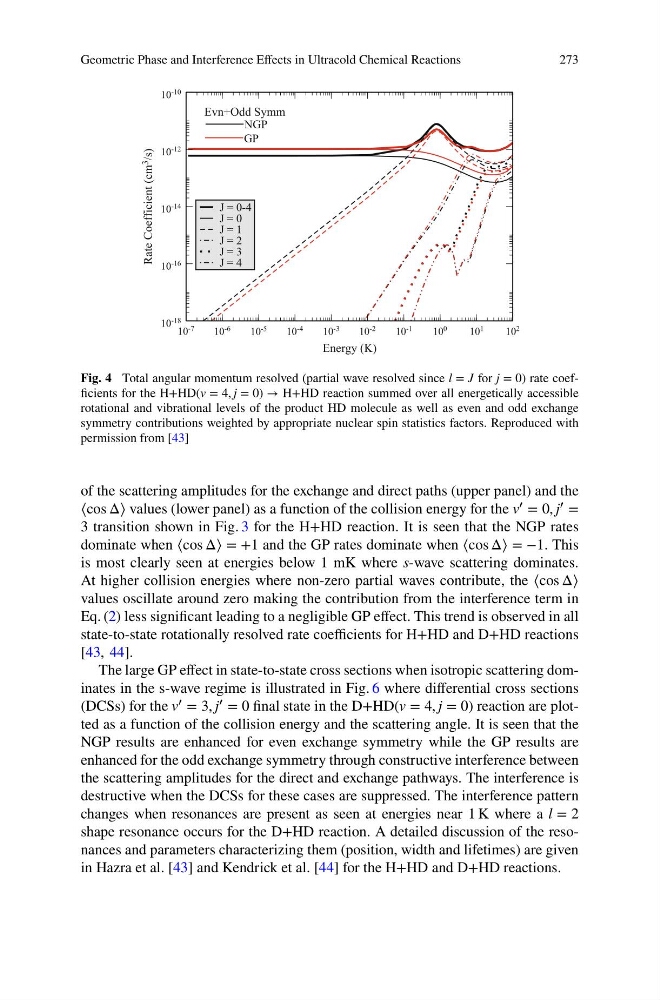
Fig. 4 Total angular momentum resolved (partial wave resolved since l = J for j = 0) rate coefficients for the H+HD(v = 4, j = 0) → H+HD reaction summed over all energetically accessible
rotational and vibrational levels of the product HD molecule as well as even and odd exchange
symmetry contributions weighted by appropriate nuclear spin statistics factors. Reproduced with
permission from [43]
of the scattering amplitudes for the exchange and direct paths (upper panel) and the
⟨cos Δ⟩ values (lower panel) as a function of the collision energy for the v
′
= 0, j
′
=
3 transition shown in Fig. 3 for the H+HD reaction. It is seen that the NGP rates
dominate when ⟨cos Δ⟩ = +1 and the GP rates dominate when ⟨cos Δ⟩ = −1. This
is most clearly seen at energies below 1 mK where s-wave scattering dominates.
At higher collision energies where non-zero partial waves contribute, the ⟨cos Δ⟩
values oscillate around zero making the contribution from the interference term in
Eq. (2) less significant leading to a negligible GP effect. This trend is observed in all
state-to-state rotationally resolved rate coefficients for H+HD and D+HD reactions
[43, 44].
The large GP effect in state-to-state cross sections when isotropic scattering dominates in the s-wave regime is illustrated in Fig. 6 where differential cross sections
(DCSs) for the v ′ = 3, j ′ = 0 final state in the D+HD(v = 4, j = 0) reaction are plotted as a function of the collision energy and the scattering angle. It is seen that the
NGP results are enhanced for even exchange symmetry while the GP results are
enhanced for the odd exchange symmetry through constructive interference between
the scattering amplitudes for the direct and exchange pathways. The interference is
destructive when the DCSs for these cases are suppressed. The interference pattern
changes when resonances are present as seen at energies near 1 K where a l = 2
shape resonance occurs for the D+HD reaction. A detailed discussion of the resonances and parameters characterizing them (position, width and lifetimes) are given
in Hazra et al. [43] and Kendrick et al. [44] for the H+HD and D+HD reactions.
273
10
-7
10
-6
10
-5
10
-4
10
-3
10
-2
10
-1
10
0
10
1
10
2
Energy (K)
10
-18
10
-16
10
-14
10
-12
10
-10
Rate Coefficient (cm 3
/s)
J = 0-4
J = 0
J = 1
J = 2
J = 3
J = 4
Evn+Odd Symm
NGP
GP
Fig. 4 Total angular momentum resolved (partial wave resolved since l = J for j = 0) rate coefficients for the H+HD(v = 4, j = 0) → H+HD reaction summed over all energetically accessible
rotational and vibrational levels of the product HD molecule as well as even and odd exchange
symmetry contributions weighted by appropriate nuclear spin statistics factors. Reproduced with
permission from [43]
of the scattering amplitudes for the exchange and direct paths (upper panel) and the
⟨cos Δ⟩ values (lower panel) as a function of the collision energy for the v
′
= 0, j
′
=
3 transition shown in Fig. 3 for the H+HD reaction. It is seen that the NGP rates
dominate when ⟨cos Δ⟩ = +1 and the GP rates dominate when ⟨cos Δ⟩ = −1. This
is most clearly seen at energies below 1 mK where s-wave scattering dominates.
At higher collision energies where non-zero partial waves contribute, the ⟨cos Δ⟩
values oscillate around zero making the contribution from the interference term in
Eq. (2) less significant leading to a negligible GP effect. This trend is observed in all
state-to-state rotationally resolved rate coefficients for H+HD and D+HD reactions
[43, 44].
The large GP effect in state-to-state cross sections when isotropic scattering dominates in the s-wave regime is illustrated in Fig. 6 where differential cross sections
(DCSs) for the v ′ = 3, j ′ = 0 final state in the D+HD(v = 4, j = 0) reaction are plotted as a function of the collision energy and the scattering angle. It is seen that the
NGP results are enhanced for even exchange symmetry while the GP results are
enhanced for the odd exchange symmetry through constructive interference between
the scattering amplitudes for the direct and exchange pathways. The interference is
destructive when the DCSs for these cases are suppressed. The interference pattern
changes when resonances are present as seen at energies near 1 K where a l = 2
shape resonance occurs for the D+HD reaction. A detailed discussion of the resonances and parameters characterizing them (position, width and lifetimes) are given
in Hazra et al. [43] and Kendrick et al. [44] for the H+HD and D+HD reactions.