

Geometric Phase and Interference Effects in Ultracold Chemical Reactions
271
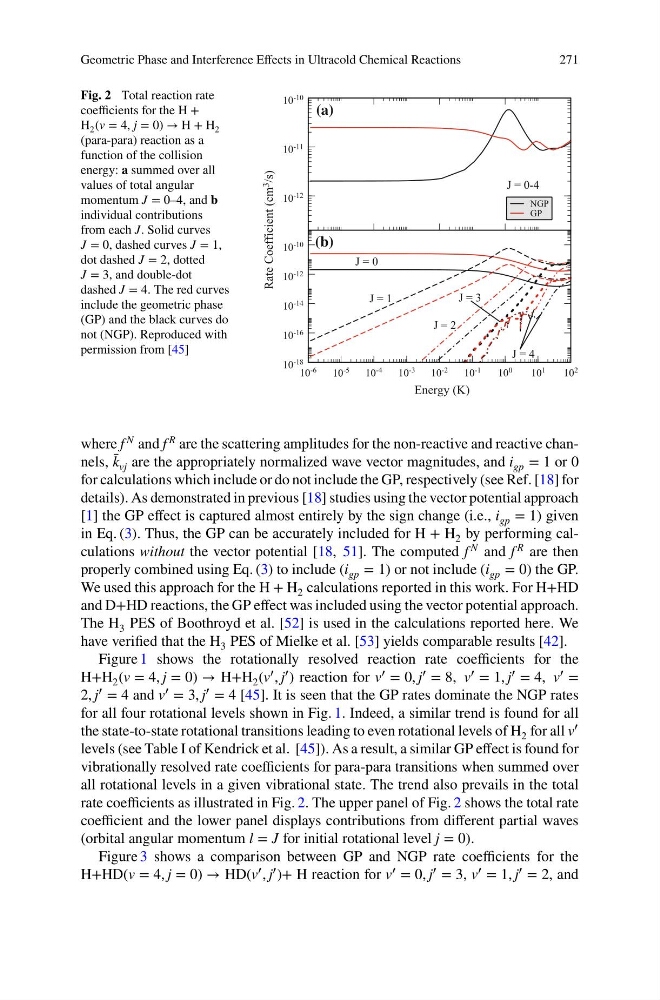
Fig. 2 Total reaction rate
coefficients for the H +
H 2 (v = 4, j = 0) → H + H 2
(para-para) reaction as a
function of the collision
energy: a summed over all
values of total angular
momentum J = 0–4, and b
individual contributions
from each J. Solid curves
J = 0, dashed curves J = 1,
dot dashed J = 2, dotted
J = 3, and double-dot
dashed J = 4. The red curves
include the geometric phase
(GP) and the black curves do
not (NGP). Reproduced with
permission from [45]
10 -12
10 -11
10 -10
NGP
GP
10 -6 10 -5 10 -4 10 -3 10 -2
10 -1
10 0
10 1
10 2
Energy (K)
10 -18
10 -16
10 -14
10 -12
10 -10
(a)
(b)
J = 0-4
J = 0
J = 1
J = 2
J = 3
J = 4
Rate Coefficient (cm 3
/s)
where f
N and f
R are the scattering amplitudes for the non-reactive and reactive channels, ̄
k vj are the appropriately normalized wave vector magnitudes, and i gp = 1 or 0
for calculations which include or do not include the GP, respectively (see Ref. [18] for
details). As demonstrated in previous [18] studies using the vector potential approach
[1] the GP effect is captured almost entirely by the sign change (i.e., i gp = 1) given
in Eq. (3). Thus, the GP can be accurately included for H + H 2 by performing calculations without the vector potential [18, 51]. The computed f
N and f
R are then
properly combined using Eq. (3) to include (i gp = 1) or not include (i gp = 0) the GP.
We used this approach for the H + H 2 calculations reported in this work. For H+HD
and D+HD reactions, the GP effect was included using the vector potential approach.
The H 3 PES of Boothroyd et al. [52] is used in the calculations reported here. We
have verified that the H 3 PES of Mielke et al. [53] yields comparable results [42].
Figure 1 shows the rotationally resolved reaction rate coefficients for the
H+H 2 (v = 4, j = 0) → H+H 2 (v ′ , j ′ ) reaction for v ′ = 0, j ′ = 8, v ′ = 1, j ′ = 4, v ′ =
2, j
′
= 4 and v
′
= 3, j
′
= 4 [45]. It is seen that the GP rates dominate the NGP rates
for all four rotational levels shown in Fig. 1. Indeed, a similar trend is found for all
the state-to-state rotational transitions leading to even rotational levels of H 2 for all v ′
levels (see Table I of Kendrick et al. [45]). As a result, a similar GP effect is found for
vibrationally resolved rate coefficients for para-para transitions when summed over
all rotational levels in a given vibrational state. The trend also prevails in the total
rate coefficients as illustrated in Fig. 2. The upper panel of Fig. 2 shows the total rate
coefficient and the lower panel displays contributions from different partial waves
(orbital angular momentum l = J for initial rotational level j = 0).
Figure 3 shows a comparison between GP and NGP rate coefficients for the
H+HD(v = 4, j = 0) → HD(v ′ , j ′ )+ H reaction for v ′ = 0, j ′ = 3, v ′ = 1, j ′ = 2, and
271
Fig. 2 Total reaction rate
coefficients for the H +
H 2 (v = 4, j = 0) → H + H 2
(para-para) reaction as a
function of the collision
energy: a summed over all
values of total angular
momentum J = 0–4, and b
individual contributions
from each J. Solid curves
J = 0, dashed curves J = 1,
dot dashed J = 2, dotted
J = 3, and double-dot
dashed J = 4. The red curves
include the geometric phase
(GP) and the black curves do
not (NGP). Reproduced with
permission from [45]
10 -12
10 -11
10 -10
NGP
GP
10 -6 10 -5 10 -4 10 -3 10 -2
10 -1
10 0
10 1
10 2
Energy (K)
10 -18
10 -16
10 -14
10 -12
10 -10
(a)
(b)
J = 0-4
J = 0
J = 1
J = 2
J = 3
J = 4
Rate Coefficient (cm 3
/s)
where f
N and f
R are the scattering amplitudes for the non-reactive and reactive channels, ̄
k vj are the appropriately normalized wave vector magnitudes, and i gp = 1 or 0
for calculations which include or do not include the GP, respectively (see Ref. [18] for
details). As demonstrated in previous [18] studies using the vector potential approach
[1] the GP effect is captured almost entirely by the sign change (i.e., i gp = 1) given
in Eq. (3). Thus, the GP can be accurately included for H + H 2 by performing calculations without the vector potential [18, 51]. The computed f
N and f
R are then
properly combined using Eq. (3) to include (i gp = 1) or not include (i gp = 0) the GP.
We used this approach for the H + H 2 calculations reported in this work. For H+HD
and D+HD reactions, the GP effect was included using the vector potential approach.
The H 3 PES of Boothroyd et al. [52] is used in the calculations reported here. We
have verified that the H 3 PES of Mielke et al. [53] yields comparable results [42].
Figure 1 shows the rotationally resolved reaction rate coefficients for the
H+H 2 (v = 4, j = 0) → H+H 2 (v ′ , j ′ ) reaction for v ′ = 0, j ′ = 8, v ′ = 1, j ′ = 4, v ′ =
2, j
′
= 4 and v
′
= 3, j
′
= 4 [45]. It is seen that the GP rates dominate the NGP rates
for all four rotational levels shown in Fig. 1. Indeed, a similar trend is found for all
the state-to-state rotational transitions leading to even rotational levels of H 2 for all v ′
levels (see Table I of Kendrick et al. [45]). As a result, a similar GP effect is found for
vibrationally resolved rate coefficients for para-para transitions when summed over
all rotational levels in a given vibrational state. The trend also prevails in the total
rate coefficients as illustrated in Fig. 2. The upper panel of Fig. 2 shows the total rate
coefficient and the lower panel displays contributions from different partial waves
(orbital angular momentum l = J for initial rotational level j = 0).
Figure 3 shows a comparison between GP and NGP rate coefficients for the
H+HD(v = 4, j = 0) → HD(v ′ , j ′ )+ H reaction for v ′ = 0, j ′ = 3, v ′ = 1, j ′ = 2, and