

270
N. Balakrishnan and B. K. Kendrick
[49, 50] in the inner hyper-radial region where the three-body interaction is strong
and the Delves hyperspherical coordinates in the outer region where the three-body
forces vanish and different atom-diatom configurations emerge. The APH coordinates are independent of the different atom-diatom arrangement channels and allow
an evenhanded description of all three arrangement channels in an A+BC system
compared to the Delves hyperspherical coordinates. The method accurately treats the
body-frame Eckart singularities [50] associated with non-zero total angular momentum quantum number J and includes the geometric phase using the general vector
potential approach [15, 16, 18]. The geometric phase is included only in the APH
coordinates as it is relevant only in the region of three-body interaction where the
CI is located. Regardless of the choice of the hyperspherical coordinates, the basic
numerical approach involves a sector-adiabatic formalism. The hyper radius (í µí¼) is
divided into a large number of sectors and at the center of each sector, the total wave
function is expanded in terms of five-dimensional hyperspherical surface functions.
The surface functions are in turn expanded in primitive angular functions. Convergence is sought with respect to the number of primitive functions included in the
expansion. A sequential truncation/diagonalization procedure is used to reduce the
size the surface function matrix. The expansion coefficients depend on the hyper
radius but within a sector they are assumed to be independent of í µí¼. Coupled channel
equations resulting from the Schrödinger equation with this expansion of the total
wave function in terms of hyperspherical surface functions are solved from sectorto-sector. Asymptotic boundary conditions are applied in Jacobi coordinates at the
last sector in í µí¼ to evaluate the reactance and scattering matrices from which cross
sections and rate coefficients are computed using standard expressions [49].
4 Results
In a series of papers [42–45], we have carried out a detailed analysis of geometric
phase effects in the H+H 2 , H+HD and D+HD reactions with the H 2 /HD molecule
excited to the v = 4 vibrational level. As discussed previously, the vibrationally adiabatic potential curves display a barrierless path for v > 3 with a small potential well
compared to v = 0 which proceeds through an energy barrier. For the symmetric
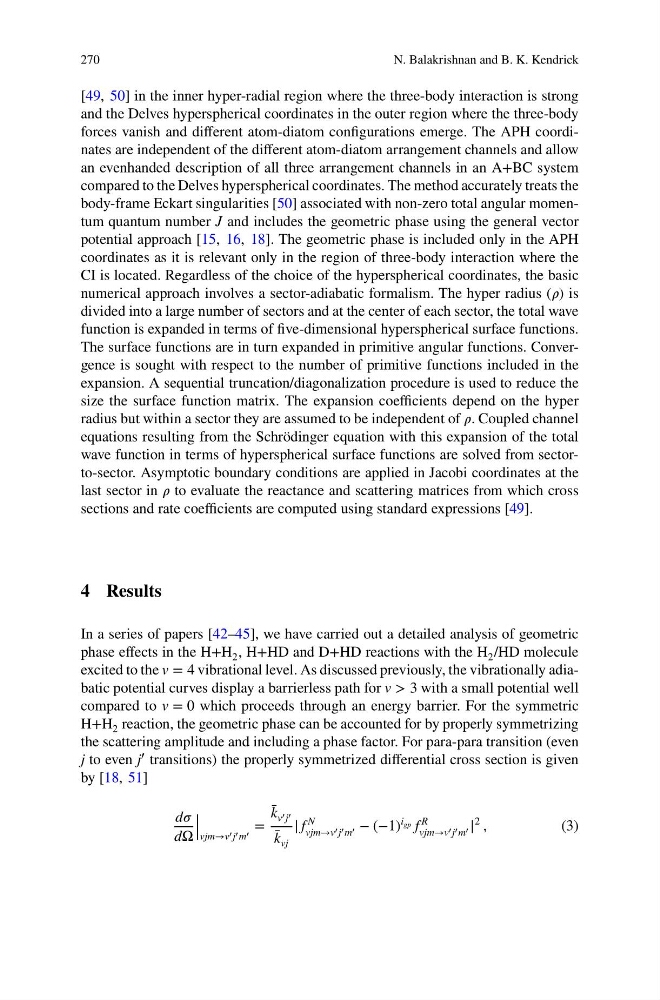
H+H 2 reaction, the geometric phase can be accounted for by properly symmetrizing
the scattering amplitude and including a phase factor. For para-para transition (even
j to even j ′ transitions) the properly symmetrized differential cross section is given
by [18, 51]
dí µí¼
dΩ
|
|
|vjm→v ′ j ′ m ′ =
̄
k v ′ j ′
̄
k vj
| f
N
vjm→v ′ j ′ m ′ − (−1)
i gp f
R
vjm→v ′ j ′ m ′ |
2
,
(3)
N. Balakrishnan and B. K. Kendrick
[49, 50] in the inner hyper-radial region where the three-body interaction is strong
and the Delves hyperspherical coordinates in the outer region where the three-body
forces vanish and different atom-diatom configurations emerge. The APH coordinates are independent of the different atom-diatom arrangement channels and allow
an evenhanded description of all three arrangement channels in an A+BC system
compared to the Delves hyperspherical coordinates. The method accurately treats the
body-frame Eckart singularities [50] associated with non-zero total angular momentum quantum number J and includes the geometric phase using the general vector
potential approach [15, 16, 18]. The geometric phase is included only in the APH
coordinates as it is relevant only in the region of three-body interaction where the
CI is located. Regardless of the choice of the hyperspherical coordinates, the basic
numerical approach involves a sector-adiabatic formalism. The hyper radius (í µí¼) is
divided into a large number of sectors and at the center of each sector, the total wave
function is expanded in terms of five-dimensional hyperspherical surface functions.
The surface functions are in turn expanded in primitive angular functions. Convergence is sought with respect to the number of primitive functions included in the
expansion. A sequential truncation/diagonalization procedure is used to reduce the
size the surface function matrix. The expansion coefficients depend on the hyper
radius but within a sector they are assumed to be independent of í µí¼. Coupled channel
equations resulting from the Schrödinger equation with this expansion of the total
wave function in terms of hyperspherical surface functions are solved from sectorto-sector. Asymptotic boundary conditions are applied in Jacobi coordinates at the
last sector in í µí¼ to evaluate the reactance and scattering matrices from which cross
sections and rate coefficients are computed using standard expressions [49].
4 Results
In a series of papers [42–45], we have carried out a detailed analysis of geometric
phase effects in the H+H 2 , H+HD and D+HD reactions with the H 2 /HD molecule
excited to the v = 4 vibrational level. As discussed previously, the vibrationally adiabatic potential curves display a barrierless path for v > 3 with a small potential well
compared to v = 0 which proceeds through an energy barrier. For the symmetric
H+H 2 reaction, the geometric phase can be accounted for by properly symmetrizing
the scattering amplitude and including a phase factor. For para-para transition (even
j to even j ′ transitions) the properly symmetrized differential cross section is given
by [18, 51]
dí µí¼
dΩ
|
|
|vjm→v ′ j ′ m ′ =
̄
k v ′ j ′
̄
k vj
| f
N
vjm→v ′ j ′ m ′ − (−1)
i gp f
R
vjm→v ′ j ′ m ′ |
2
,
(3)