

Geometric Phase and Interference Effects in Ultracold Chemical Reactions
269
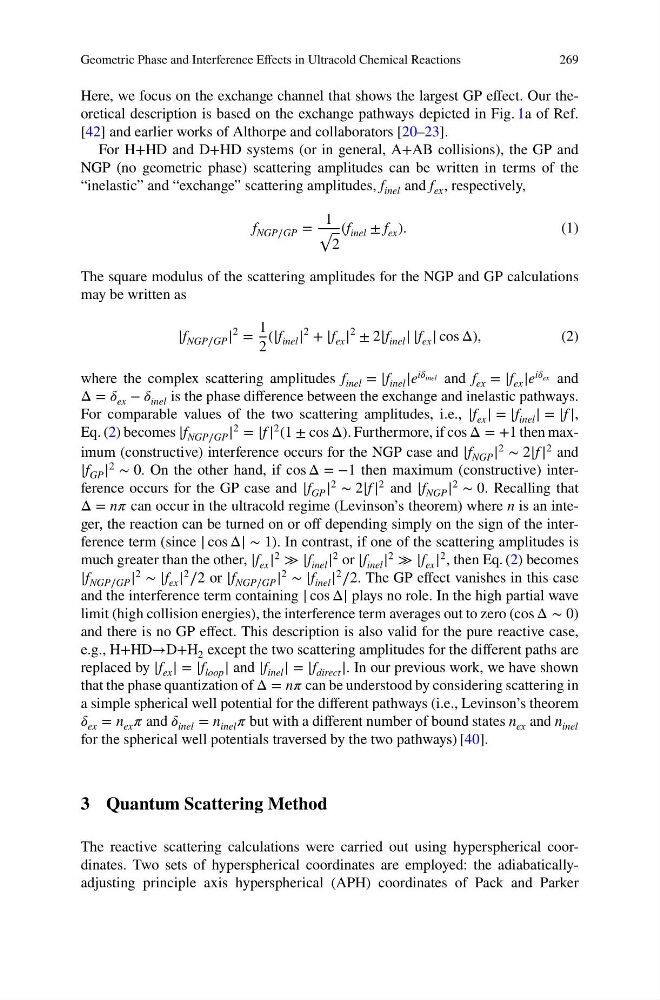
Here, we focus on the exchange channel that shows the largest GP effect. Our theoretical description is based on the exchange pathways depicted in Fig. 1a of Ref.
[42] and earlier works of Althorpe and collaborators [20–23].
For H+HD and D+HD systems (or in general, A+AB collisions), the GP and
NGP (no geometric phase) scattering amplitudes can be written in terms of the
“inelastic” and “exchange” scattering amplitudes, f inel and f ex , respectively,
f NGP∕GP =
1
√
2
(f inel ± f ex ).
(1)
The square modulus of the scattering amplitudes for the NGP and GP calculations
may be written as
|f NGP∕GP |
2
=
1
2
(|f inel |
2
+ |f ex |
2
± 2|f inel | |f ex | cos Δ),
(2)
where the complex scattering amplitudes f inel = |f inel |e ií µí»¿ inel and f ex = |f ex |e ií µí»¿ ex and
Δ = í µí»¿ ex − í µí»¿ inel is the phase difference between the exchange and inelastic pathways.
For comparable values of the two scattering amplitudes, i.e., |f ex | = |f inel | = |f |,
Eq. (2) becomes |f NGP∕GP | 2 = |f | 2 (1 ± cos Δ). Furthermore, if cos Δ = +1 then maximum (constructive) interference occurs for the NGP case and |f NGP |
2
∼ 2|f |
2 and
|f GP |
2
∼ 0. On the other hand, if cos Δ = −1 then maximum (constructive) interference occurs for the GP case and |f GP | 2 ∼ 2|f | 2 and |f NGP | 2 ∼ 0. Recalling that
Δ = ní µí¼ can occur in the ultracold regime (Levinson’s theorem) where n is an integer, the reaction can be turned on or off depending simply on the sign of the interference term (since | cos Δ| ∼ 1). In contrast, if one of the scattering amplitudes is
much greater than the other, |f ex |
2
≫ |f inel |
2 or |f inel |
2
≫ |f ex |
2 , then Eq. (2) becomes
|f NGP∕GP | 2 ∼ |f ex | 2 ∕2 or |f NGP∕GP | 2 ∼ |f inel | 2 ∕2. The GP effect vanishes in this case
and the interference term containing | cos Δ| plays no role. In the high partial wave
limit (high collision energies), the interference term averages out to zero (cos Δ ∼ 0)
and there is no GP effect. This description is also valid for the pure reactive case,
e.g., H+HD→D+H 2 except the two scattering amplitudes for the different paths are
replaced by |f ex | = |f loop | and |f inel | = |f direct |. In our previous work, we have shown
that the phase quantization of Δ = ní µí¼ can be understood by considering scattering in
a simple spherical well potential for the different pathways (i.e., Levinson’s theorem
í µí»¿ ex = n ex í µí¼ and í µí»¿ inel = n inel í µí¼ but with a different number of bound states n ex and n inel
for the spherical well potentials traversed by the two pathways) [40].
3 Quantum Scattering Method
The reactive scattering calculations were carried out using hyperspherical coordinates. Two sets of hyperspherical coordinates are employed: the adiabaticallyadjusting principle axis hyperspherical (APH) coordinates of Pack and Parker
269
Here, we focus on the exchange channel that shows the largest GP effect. Our theoretical description is based on the exchange pathways depicted in Fig. 1a of Ref.
[42] and earlier works of Althorpe and collaborators [20–23].
For H+HD and D+HD systems (or in general, A+AB collisions), the GP and
NGP (no geometric phase) scattering amplitudes can be written in terms of the
“inelastic” and “exchange” scattering amplitudes, f inel and f ex , respectively,
f NGP∕GP =
1
√
2
(f inel ± f ex ).
(1)
The square modulus of the scattering amplitudes for the NGP and GP calculations
may be written as
|f NGP∕GP |
2
=
1
2
(|f inel |
2
+ |f ex |
2
± 2|f inel | |f ex | cos Δ),
(2)
where the complex scattering amplitudes f inel = |f inel |e ií µí»¿ inel and f ex = |f ex |e ií µí»¿ ex and
Δ = í µí»¿ ex − í µí»¿ inel is the phase difference between the exchange and inelastic pathways.
For comparable values of the two scattering amplitudes, i.e., |f ex | = |f inel | = |f |,
Eq. (2) becomes |f NGP∕GP | 2 = |f | 2 (1 ± cos Δ). Furthermore, if cos Δ = +1 then maximum (constructive) interference occurs for the NGP case and |f NGP |
2
∼ 2|f |
2 and
|f GP |
2
∼ 0. On the other hand, if cos Δ = −1 then maximum (constructive) interference occurs for the GP case and |f GP | 2 ∼ 2|f | 2 and |f NGP | 2 ∼ 0. Recalling that
Δ = ní µí¼ can occur in the ultracold regime (Levinson’s theorem) where n is an integer, the reaction can be turned on or off depending simply on the sign of the interference term (since | cos Δ| ∼ 1). In contrast, if one of the scattering amplitudes is
much greater than the other, |f ex |
2
≫ |f inel |
2 or |f inel |
2
≫ |f ex |
2 , then Eq. (2) becomes
|f NGP∕GP | 2 ∼ |f ex | 2 ∕2 or |f NGP∕GP | 2 ∼ |f inel | 2 ∕2. The GP effect vanishes in this case
and the interference term containing | cos Δ| plays no role. In the high partial wave
limit (high collision energies), the interference term averages out to zero (cos Δ ∼ 0)
and there is no GP effect. This description is also valid for the pure reactive case,
e.g., H+HD→D+H 2 except the two scattering amplitudes for the different paths are
replaced by |f ex | = |f loop | and |f inel | = |f direct |. In our previous work, we have shown
that the phase quantization of Δ = ní µí¼ can be understood by considering scattering in
a simple spherical well potential for the different pathways (i.e., Levinson’s theorem
í µí»¿ ex = n ex í µí¼ and í µí»¿ inel = n inel í µí¼ but with a different number of bound states n ex and n inel
for the spherical well potentials traversed by the two pathways) [40].
3 Quantum Scattering Method
The reactive scattering calculations were carried out using hyperspherical coordinates. Two sets of hyperspherical coordinates are employed: the adiabaticallyadjusting principle axis hyperspherical (APH) coordinates of Pack and Parker