

268
N. Balakrishnan and B. K. Kendrick
10
-14
10
-13
10
-12
10
-11
NGP
GP
10 -14
10
-13
10
-12
10
-11
NGP
GP
10 -6
10 -4
10 -2
10 0
10 2
Energy (K)
10 -14
10
-13
10
-12
10
-11
NGP
GP
10 -6
10 -4
10 -2
10 0
10 2
Energy (K)
10
-14
10
-13
10 -12
10
-11
NGP
GP
Rate Coefficient (cm 3
/s)
Rate Coefficient (cm 3
/s)
(a)
(b)
(d)
(c)
v = 0, j = 8
v = 1, j = 4
v = 2, j = 4
v = 3, j = 4
`
`
`
`
`
`
`
`
J = 0-4
J = 0-4
J = 0-4
J = 0-4
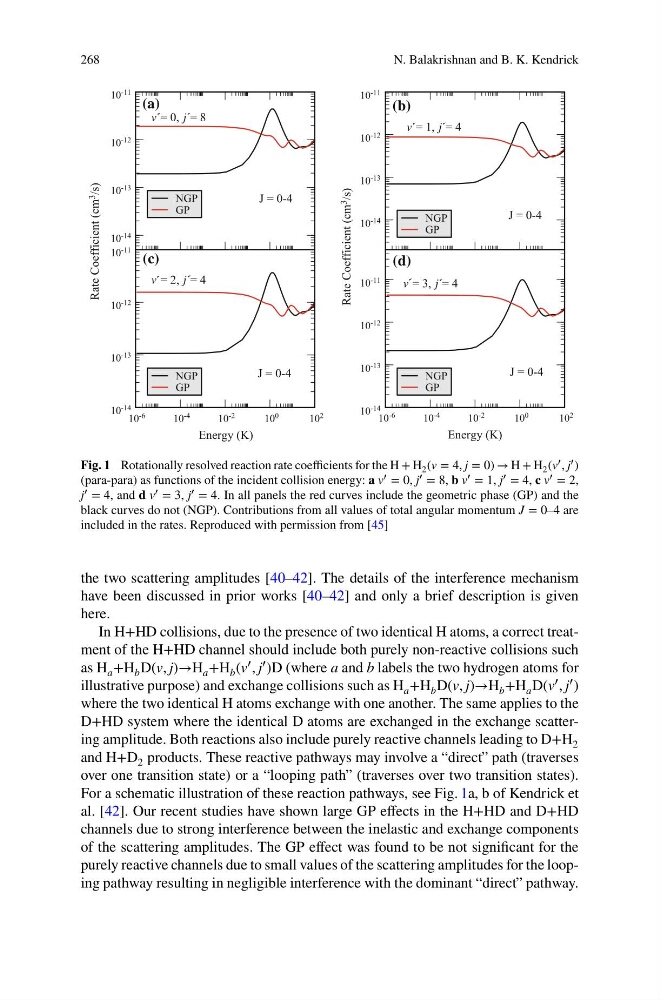
Fig. 1 Rotationally resolved reaction rate coefficients for the H + H 2 (v = 4, j = 0) → H + H 2 (v ′ , j ′ )
(para-para) as functions of the incident collision energy: a v ′ = 0, j ′ = 8, b v ′ = 1, j ′ = 4, c v ′ = 2,
j ′ = 4, and d v ′ = 3, j ′ = 4. In all panels the red curves include the geometric phase (GP) and the
black curves do not (NGP). Contributions from all values of total angular momentum J = 0–4 are
included in the rates. Reproduced with permission from [45]
the two scattering amplitudes [40–42]. The details of the interference mechanism
have been discussed in prior works [40–42] and only a brief description is given
here.
In H+HD collisions, due to the presence of two identical H atoms, a correct treatment of the H+HD channel should include both purely non-reactive collisions such
as H a +H b D(v, j)→H a +H b (v ′ , j ′ )D (where a and b labels the two hydrogen atoms for
illustrative purpose) and exchange collisions such as H a +H b D(v, j)→H b +H a D(v
′
, j
′ )
where the two identical H atoms exchange with one another. The same applies to the
D+HD system where the identical D atoms are exchanged in the exchange scattering amplitude. Both reactions also include purely reactive channels leading to D+H 2
and H+D 2 products. These reactive pathways may involve a “direct” path (traverses
over one transition state) or a “looping path” (traverses over two transition states).
For a schematic illustration of these reaction pathways, see Fig. 1a, b of Kendrick et
al. [42]. Our recent studies have shown large GP effects in the H+HD and D+HD
channels due to strong interference between the inelastic and exchange components
of the scattering amplitudes. The GP effect was found to be not significant for the
purely reactive channels due to small values of the scattering amplitudes for the looping pathway resulting in negligible interference with the dominant “direct” pathway.
N. Balakrishnan and B. K. Kendrick
10
-14
10
-13
10
-12
10
-11
NGP
GP
10 -14
10
-13
10
-12
10
-11
NGP
GP
10 -6
10 -4
10 -2
10 0
10 2
Energy (K)
10 -14
10
-13
10
-12
10
-11
NGP
GP
10 -6
10 -4
10 -2
10 0
10 2
Energy (K)
10
-14
10
-13
10 -12
10
-11
NGP
GP
Rate Coefficient (cm 3
/s)
Rate Coefficient (cm 3
/s)
(a)
(b)
(d)
(c)
v = 0, j = 8
v = 1, j = 4
v = 2, j = 4
v = 3, j = 4
`
`
`
`
`
`
`
`
J = 0-4
J = 0-4
J = 0-4
J = 0-4
Fig. 1 Rotationally resolved reaction rate coefficients for the H + H 2 (v = 4, j = 0) → H + H 2 (v ′ , j ′ )
(para-para) as functions of the incident collision energy: a v ′ = 0, j ′ = 8, b v ′ = 1, j ′ = 4, c v ′ = 2,
j ′ = 4, and d v ′ = 3, j ′ = 4. In all panels the red curves include the geometric phase (GP) and the
black curves do not (NGP). Contributions from all values of total angular momentum J = 0–4 are
included in the rates. Reproduced with permission from [45]
the two scattering amplitudes [40–42]. The details of the interference mechanism
have been discussed in prior works [40–42] and only a brief description is given
here.
In H+HD collisions, due to the presence of two identical H atoms, a correct treatment of the H+HD channel should include both purely non-reactive collisions such
as H a +H b D(v, j)→H a +H b (v ′ , j ′ )D (where a and b labels the two hydrogen atoms for
illustrative purpose) and exchange collisions such as H a +H b D(v, j)→H b +H a D(v
′
, j
′ )
where the two identical H atoms exchange with one another. The same applies to the
D+HD system where the identical D atoms are exchanged in the exchange scattering amplitude. Both reactions also include purely reactive channels leading to D+H 2
and H+D 2 products. These reactive pathways may involve a “direct” path (traverses
over one transition state) or a “looping path” (traverses over two transition states).
For a schematic illustration of these reaction pathways, see Fig. 1a, b of Kendrick et
al. [42]. Our recent studies have shown large GP effects in the H+HD and D+HD
channels due to strong interference between the inelastic and exchange components
of the scattering amplitudes. The GP effect was found to be not significant for the
purely reactive channels due to small values of the scattering amplitudes for the looping pathway resulting in negligible interference with the dominant “direct” pathway.