

258
D. G. Green and G. F. Gribakin
k (a.u.)
0.00
1.00
2.00
3.00
4.00
5.00
6.00
7.00
8.00
9.00
10.00
γ
k (a.u.)
0
0.2
0.4
0.6
0.8 0
0.2
0.4
0.6
0.8 0
0.2
0.4
0.6
0.8
k (a.u.)
3s
3p
2s, 2p
3s
3p
3p
3s
2s,2p
s-wave
p-wave
d-wave
2s, 2p
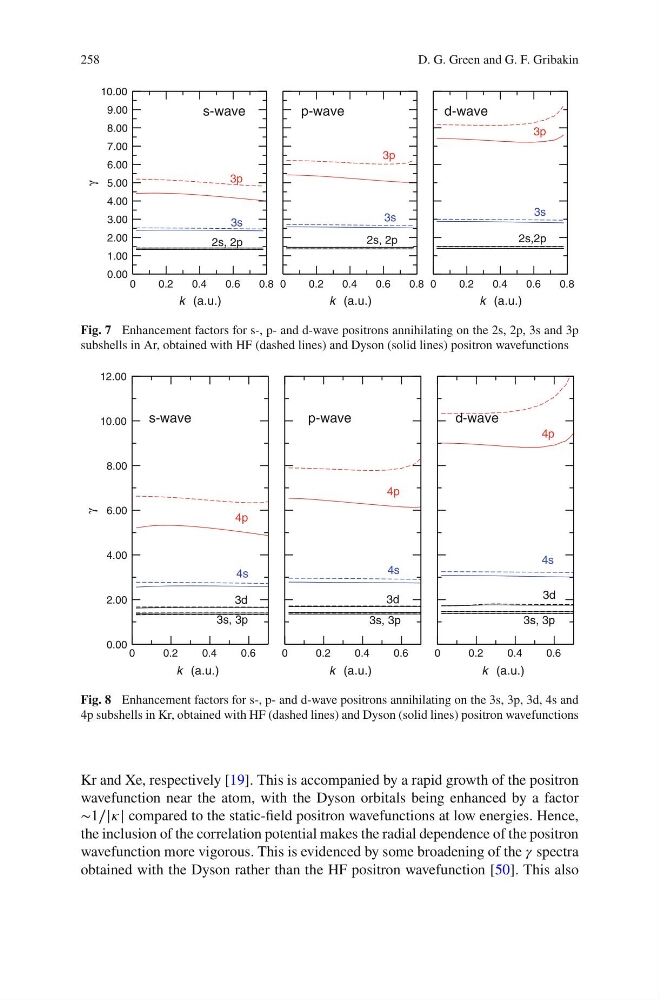
Fig. 7 Enhancement factors for s-, p- and d-wave positrons annihilating on the 2s, 2p, 3s and 3p
subshells in Ar, obtained with HF (dashed lines) and Dyson (solid lines) positron wavefunctions
k (a.u.)
k (a.u.)
2.00
4.00
6.00
8.00
10.00
12.00
γ
0
0 . 2
0 . 4
0 . 6
0
0.2
0.4
0.6
0.00
0
0.2
0.4
0.6
k (a.u.)
4s
4p
3s, 3p
3d
3s, 3p
s-wave
p-wave
d-wave
3d
4p
4s
3s, 3p
3d
4s
4p
Fig. 8 Enhancement factors for s-, p- and d-wave positrons annihilating on the 3s, 3p, 3d, 4s and
4p subshells in Kr, obtained with HF (dashed lines) and Dyson (solid lines) positron wavefunctions
Kr and Xe, respectively [19]. This is accompanied by a rapid growth of the positron
wavefunction near the atom, with the Dyson orbitals being enhanced by a factor
∼1∕|í µí¼ | compared to the static-field positron wavefunctions at low energies. Hence,
the inclusion of the correlation potential makes the radial dependence of the positron
wavefunction more vigorous. This is evidenced by some broadening of the í µí»¾ spectra
obtained with the Dyson rather than the HF positron wavefunction [50]. This also
D. G. Green and G. F. Gribakin
k (a.u.)
0.00
1.00
2.00
3.00
4.00
5.00
6.00
7.00
8.00
9.00
10.00
γ
k (a.u.)
0
0.2
0.4
0.6
0.8 0
0.2
0.4
0.6
0.8 0
0.2
0.4
0.6
0.8
k (a.u.)
3s
3p
2s, 2p
3s
3p
3p
3s
2s,2p
s-wave
p-wave
d-wave
2s, 2p
Fig. 7 Enhancement factors for s-, p- and d-wave positrons annihilating on the 2s, 2p, 3s and 3p
subshells in Ar, obtained with HF (dashed lines) and Dyson (solid lines) positron wavefunctions
k (a.u.)
k (a.u.)
2.00
4.00
6.00
8.00
10.00
12.00
γ
0
0 . 2
0 . 4
0 . 6
0
0.2
0.4
0.6
0.00
0
0.2
0.4
0.6
k (a.u.)
4s
4p
3s, 3p
3d
3s, 3p
s-wave
p-wave
d-wave
3d
4p
4s
3s, 3p
3d
4s
4p
Fig. 8 Enhancement factors for s-, p- and d-wave positrons annihilating on the 3s, 3p, 3d, 4s and
4p subshells in Kr, obtained with HF (dashed lines) and Dyson (solid lines) positron wavefunctions
Kr and Xe, respectively [19]. This is accompanied by a rapid growth of the positron
wavefunction near the atom, with the Dyson orbitals being enhanced by a factor
∼1∕|í µí¼ | compared to the static-field positron wavefunctions at low energies. Hence,
the inclusion of the correlation potential makes the radial dependence of the positron
wavefunction more vigorous. This is evidenced by some broadening of the í µí»¾ spectra
obtained with the Dyson rather than the HF positron wavefunction [50]. This also