

Enhancement Factors for Positron Annihilation on Valence . . .
257
k (a.u.)
0.00
1.00
2.00
3.00
4.00
5.00
γ
k (a.u.)
0
0.2 0.4 0.6 0.8
1 0
0.2 0.4 0.6 0.8
1 0
0.2 0.4 0.6 0.8
1
k (a.u.)
2s
2p
1s
1s
2s
2p
1s
2s
2p
s-wave
p-wave
d-wave
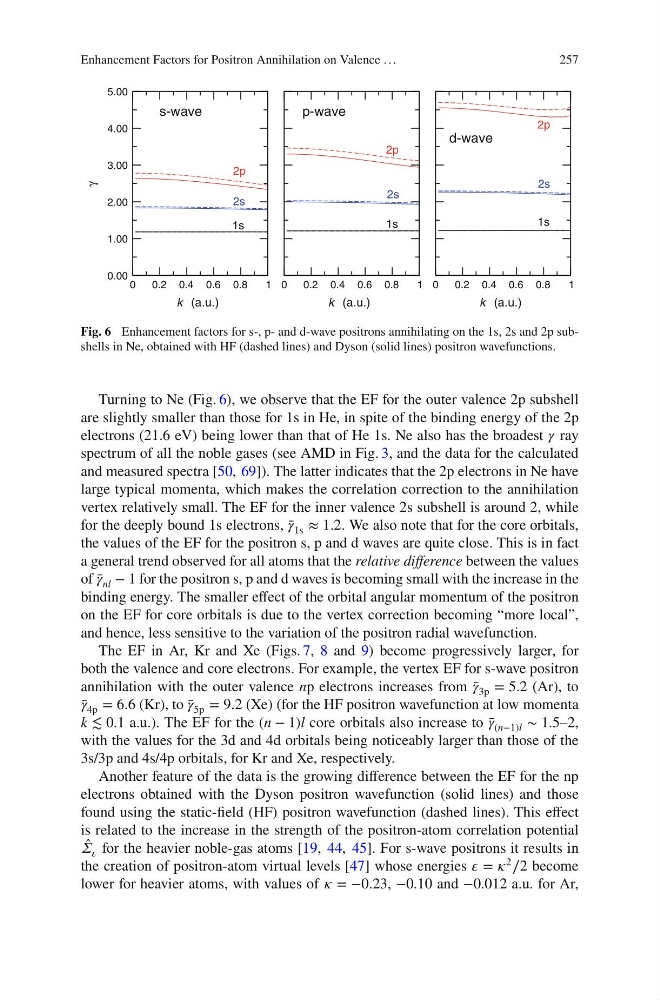
Fig. 6 Enhancement factors for s-, p- and d-wave positrons annihilating on the 1s, 2s and 2p subshells in Ne, obtained with HF (dashed lines) and Dyson (solid lines) positron wavefunctions.
Turning to Ne (Fig. 6), we observe that the EF for the outer valence 2p subshell
are slightly smaller than those for 1s in He, in spite of the binding energy of the 2p
electrons (21.6 eV) being lower than that of He 1s. Ne also has the broadest í µí»¾ ray
spectrum of all the noble gases (see AMD in Fig. 3, and the data for the calculated
and measured spectra [50, 69]). The latter indicates that the 2p electrons in Ne have
large typical momenta, which makes the correlation correction to the annihilation
vertex relatively small. The EF for the inner valence 2s subshell is around 2, while
for the deeply bound 1s electrons, ̄
í µí»¾ 1s ≈ 1.2. We also note that for the core orbitals,
the values of the EF for the positron s, p and d waves are quite close. This is in fact
a general trend observed for all atoms that the relative difference between the values
of ̄
í µí»¾ nl − 1 for the positron s, p and d waves is becoming small with the increase in the
binding energy. The smaller effect of the orbital angular momentum of the positron
on the EF for core orbitals is due to the vertex correction becoming “more local”,
and hence, less sensitive to the variation of the positron radial wavefunction.
The EF in Ar, Kr and Xe (Figs. 7, 8 and 9) become progressively larger, for
both the valence and core electrons. For example, the vertex EF for s-wave positron
annihilation with the outer valence np electrons increases from ̄
í µí»¾ 3p = 5.2 (Ar), to
̄
í µí»¾ 4p = 6.6 (Kr), to ̄
í µí»¾ 5p = 9.2 (Xe) (for the HF positron wavefunction at low momenta
k ≲ 0.1 a.u.). The EF for the (n − 1)l core orbitals also increase to ̄
í µí»¾ (n−1)l ∼ 1.5–2,
with the values for the 3d and 4d orbitals being noticeably larger than those of the
3s/3p and 4s/4p orbitals, for Kr and Xe, respectively.
Another feature of the data is the growing difference between the EF for the np
electrons obtained with the Dyson positron wavefunction (solid lines) and those
found using the static-field (HF) positron wavefunction (dashed lines). This effect
is related to the increase in the strength of the positron-atom correlation potential
̂
í µí»´ í µí¼ for the heavier noble-gas atoms [19, 44, 45]. For s-wave positrons it results in
the creation of positron-atom virtual levels [47] whose energies í µí¼ = í µí¼ 2 ∕2 become
lower for heavier atoms, with values of í µí¼ = −0.23, −0.10 and −0.012 a.u. for Ar,
257
k (a.u.)
0.00
1.00
2.00
3.00
4.00
5.00
γ
k (a.u.)
0
0.2 0.4 0.6 0.8
1 0
0.2 0.4 0.6 0.8
1 0
0.2 0.4 0.6 0.8
1
k (a.u.)
2s
2p
1s
1s
2s
2p
1s
2s
2p
s-wave
p-wave
d-wave
Fig. 6 Enhancement factors for s-, p- and d-wave positrons annihilating on the 1s, 2s and 2p subshells in Ne, obtained with HF (dashed lines) and Dyson (solid lines) positron wavefunctions.
Turning to Ne (Fig. 6), we observe that the EF for the outer valence 2p subshell
are slightly smaller than those for 1s in He, in spite of the binding energy of the 2p
electrons (21.6 eV) being lower than that of He 1s. Ne also has the broadest í µí»¾ ray
spectrum of all the noble gases (see AMD in Fig. 3, and the data for the calculated
and measured spectra [50, 69]). The latter indicates that the 2p electrons in Ne have
large typical momenta, which makes the correlation correction to the annihilation
vertex relatively small. The EF for the inner valence 2s subshell is around 2, while
for the deeply bound 1s electrons, ̄
í µí»¾ 1s ≈ 1.2. We also note that for the core orbitals,
the values of the EF for the positron s, p and d waves are quite close. This is in fact
a general trend observed for all atoms that the relative difference between the values
of ̄
í µí»¾ nl − 1 for the positron s, p and d waves is becoming small with the increase in the
binding energy. The smaller effect of the orbital angular momentum of the positron
on the EF for core orbitals is due to the vertex correction becoming “more local”,
and hence, less sensitive to the variation of the positron radial wavefunction.
The EF in Ar, Kr and Xe (Figs. 7, 8 and 9) become progressively larger, for
both the valence and core electrons. For example, the vertex EF for s-wave positron
annihilation with the outer valence np electrons increases from ̄
í µí»¾ 3p = 5.2 (Ar), to
̄
í µí»¾ 4p = 6.6 (Kr), to ̄
í µí»¾ 5p = 9.2 (Xe) (for the HF positron wavefunction at low momenta
k ≲ 0.1 a.u.). The EF for the (n − 1)l core orbitals also increase to ̄
í µí»¾ (n−1)l ∼ 1.5–2,
with the values for the 3d and 4d orbitals being noticeably larger than those of the
3s/3p and 4s/4p orbitals, for Kr and Xe, respectively.
Another feature of the data is the growing difference between the EF for the np
electrons obtained with the Dyson positron wavefunction (solid lines) and those
found using the static-field (HF) positron wavefunction (dashed lines). This effect
is related to the increase in the strength of the positron-atom correlation potential
̂
í µí»´ í µí¼ for the heavier noble-gas atoms [19, 44, 45]. For s-wave positrons it results in
the creation of positron-atom virtual levels [47] whose energies í µí¼ = í µí¼ 2 ∕2 become
lower for heavier atoms, with values of í µí¼ = −0.23, −0.10 and −0.012 a.u. for Ar,