

256
D. G. Green and G. F. Gribakin
k (a.u.)
0
1
2
3
4
5
6
7
γ
k (a.u.)
0 0.2 0.4 0.6 0.8 1 1.2 0 0.2 0.4 0.6 0.8 1 1.2 0 0.2 0.4 0.6 0.8 1 1.2
k (a.u.)
s-wave
p-wave
d-wave
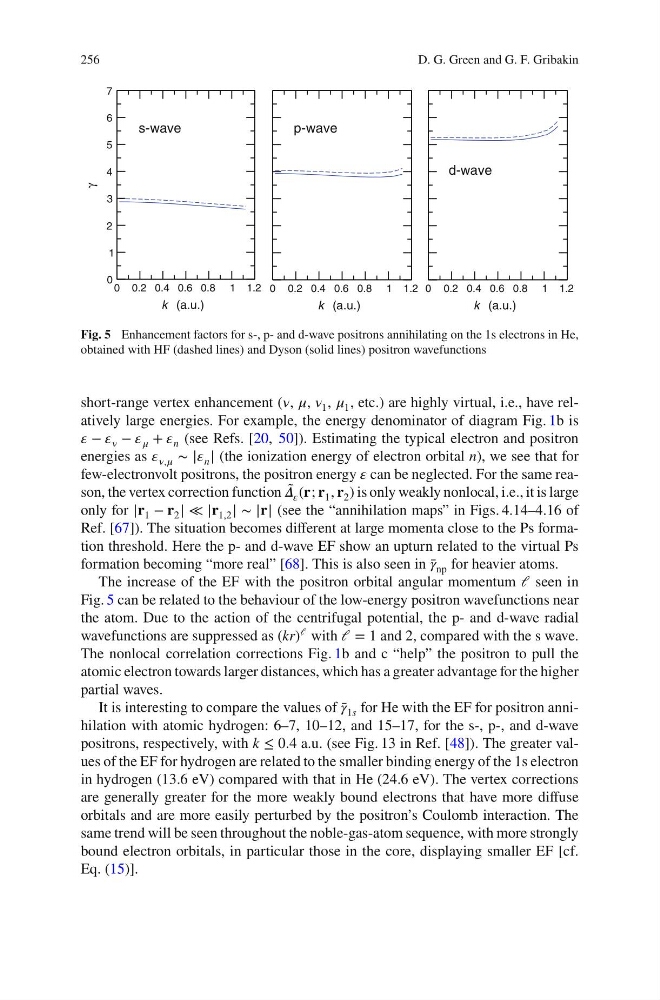
Fig. 5 Enhancement factors for s-, p- and d-wave positrons annihilating on the 1s electrons in He,
obtained with HF (dashed lines) and Dyson (solid lines) positron wavefunctions
short-range vertex enhancement (í µí¼, í µí¼, í µí¼ 1 , í µí¼ 1 , etc.) are highly virtual, i.e., have relatively large energies. For example, the energy denominator of diagram Fig. 1b is
í µí¼ − í µí¼ í µí¼ − í µí¼ í µí¼ + í µí¼ n (see Refs. [20, 50]). Estimating the typical electron and positron
energies as í µí¼ í µí¼,í µí¼ ∼ |í µí¼ n | (the ionization energy of electron orbital n), we see that for
few-electronvolt positrons, the positron energy í µí¼ can be neglected. For the same reason, the vertex correction function ̃
í µí»¥ í µí¼ (í µí°«; í µí°« 1 , í µí°« 2 ) is only weakly nonlocal, i.e., it is large
only for |í µí°« 1 − í µí°« 2 | ≪ |í µí°« 1,2 | ∼ |í µí°«| (see the “annihilation maps” in Figs. 4.14–4.16 of
Ref. [67]). The situation becomes different at large momenta close to the Ps formation threshold. Here the p- and d-wave EF show an upturn related to the virtual Ps
formation becoming “more real” [68]. This is also seen in ̄
í µí»¾ np for heavier atoms.
The increase of the EF with the positron orbital angular momentum í µí³ seen in
Fig. 5 can be related to the behaviour of the low-energy positron wavefunctions near
the atom. Due to the action of the centrifugal potential, the p- and d-wave radial
wavefunctions are suppressed as (kr)
í µí³ with í µí³ = 1 and 2, compared with the s wave.
The nonlocal correlation corrections Fig. 1b and c “help” the positron to pull the
atomic electron towards larger distances, which has a greater advantage for the higher
partial waves.
It is interesting to compare the values of ̄
í µí»¾ 1s for He with the EF for positron annihilation with atomic hydrogen: 6–7, 10–12, and 15–17, for the s-, p-, and d-wave
positrons, respectively, with k ≤ 0.4 a.u. (see Fig. 13 in Ref. [48]). The greater values of the EF for hydrogen are related to the smaller binding energy of the 1s electron
in hydrogen (13.6 eV) compared with that in He (24.6 eV). The vertex corrections
are generally greater for the more weakly bound electrons that have more diffuse
orbitals and are more easily perturbed by the positron’s Coulomb interaction. The
same trend will be seen throughout the noble-gas-atom sequence, with more strongly
bound electron orbitals, in particular those in the core, displaying smaller EF [cf.
Eq. (15)].
D. G. Green and G. F. Gribakin
k (a.u.)
0
1
2
3
4
5
6
7
γ
k (a.u.)
0 0.2 0.4 0.6 0.8 1 1.2 0 0.2 0.4 0.6 0.8 1 1.2 0 0.2 0.4 0.6 0.8 1 1.2
k (a.u.)
s-wave
p-wave
d-wave
Fig. 5 Enhancement factors for s-, p- and d-wave positrons annihilating on the 1s electrons in He,
obtained with HF (dashed lines) and Dyson (solid lines) positron wavefunctions
short-range vertex enhancement (í µí¼, í µí¼, í µí¼ 1 , í µí¼ 1 , etc.) are highly virtual, i.e., have relatively large energies. For example, the energy denominator of diagram Fig. 1b is
í µí¼ − í µí¼ í µí¼ − í µí¼ í µí¼ + í µí¼ n (see Refs. [20, 50]). Estimating the typical electron and positron
energies as í µí¼ í µí¼,í µí¼ ∼ |í µí¼ n | (the ionization energy of electron orbital n), we see that for
few-electronvolt positrons, the positron energy í µí¼ can be neglected. For the same reason, the vertex correction function ̃
í µí»¥ í µí¼ (í µí°«; í µí°« 1 , í µí°« 2 ) is only weakly nonlocal, i.e., it is large
only for |í µí°« 1 − í µí°« 2 | ≪ |í µí°« 1,2 | ∼ |í µí°«| (see the “annihilation maps” in Figs. 4.14–4.16 of
Ref. [67]). The situation becomes different at large momenta close to the Ps formation threshold. Here the p- and d-wave EF show an upturn related to the virtual Ps
formation becoming “more real” [68]. This is also seen in ̄
í µí»¾ np for heavier atoms.
The increase of the EF with the positron orbital angular momentum í µí³ seen in
Fig. 5 can be related to the behaviour of the low-energy positron wavefunctions near
the atom. Due to the action of the centrifugal potential, the p- and d-wave radial
wavefunctions are suppressed as (kr)
í µí³ with í µí³ = 1 and 2, compared with the s wave.
The nonlocal correlation corrections Fig. 1b and c “help” the positron to pull the
atomic electron towards larger distances, which has a greater advantage for the higher
partial waves.
It is interesting to compare the values of ̄
í µí»¾ 1s for He with the EF for positron annihilation with atomic hydrogen: 6–7, 10–12, and 15–17, for the s-, p-, and d-wave
positrons, respectively, with k ≤ 0.4 a.u. (see Fig. 13 in Ref. [48]). The greater values of the EF for hydrogen are related to the smaller binding energy of the 1s electron
in hydrogen (13.6 eV) compared with that in He (24.6 eV). The vertex corrections
are generally greater for the more weakly bound electrons that have more diffuse
orbitals and are more easily perturbed by the positron’s Coulomb interaction. The
same trend will be seen throughout the noble-gas-atom sequence, with more strongly
bound electron orbitals, in particular those in the core, displaying smaller EF [cf.
Eq. (15)].