

Enhancement Factors for Positron Annihilation on Valence . . .
259
k (a.u.)
0
2
4
6
8
10
12
14
16
18
γ
k (a.u.)
0 0.1 0.2 0.3 0.4 0.5 0.6 0 0.1 0.2 0.3 0.4 0.5
0 0.1 0.2 0.3 0.4 0.5
k (a.u.)
5s
5p
4s, 4p
4d
4s, 4p
s-wave
p-wave
d-wave
4d
5s
5p
4s, 4p
4d
5s
5p
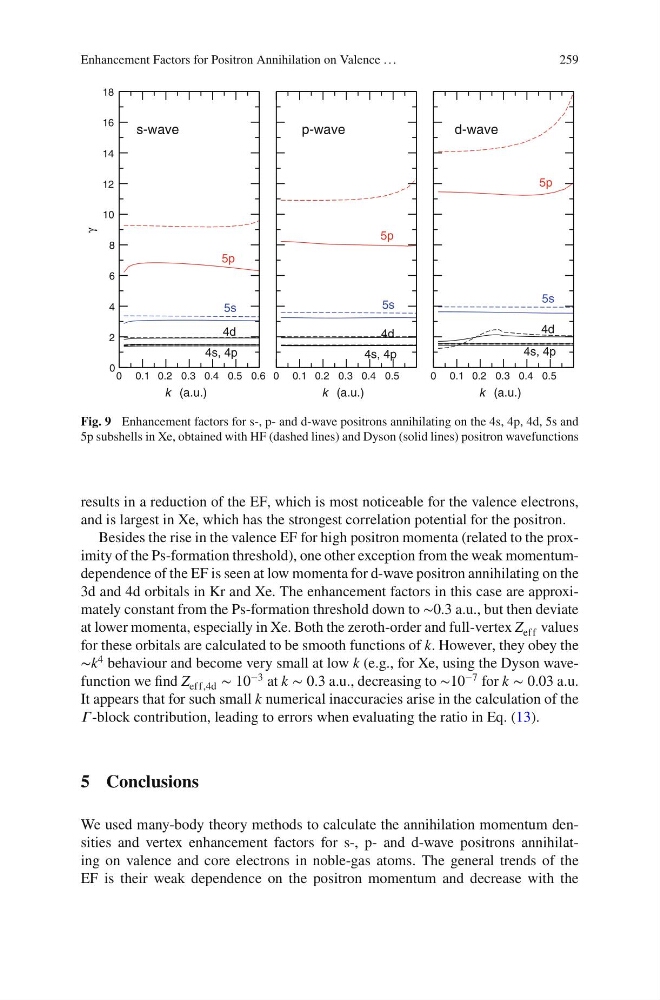
Fig. 9 Enhancement factors for s-, p- and d-wave positrons annihilating on the 4s, 4p, 4d, 5s and
5p subshells in Xe, obtained with HF (dashed lines) and Dyson (solid lines) positron wavefunctions
results in a reduction of the EF, which is most noticeable for the valence electrons,
and is largest in Xe, which has the strongest correlation potential for the positron.
Besides the rise in the valence EF for high positron momenta (related to the proximity of the Ps-formation threshold), one other exception from the weak momentumdependence of the EF is seen at low momenta for d-wave positron annihilating on the
3d and 4d orbitals in Kr and Xe. The enhancement factors in this case are approximately constant from the Ps-formation threshold down to ∼0.3 a.u., but then deviate
at lower momenta, especially in Xe. Both the zeroth-order and full-vertex Z ef f values
for these orbitals are calculated to be smooth functions of k. However, they obey the
∼k
4 behaviour and become very small at low k (e.g., for Xe, using the Dyson wavefunction we find Z ef f,4d ∼ 10
−3 at k ∼ 0.3 a.u., decreasing to ∼10
−7 for k ∼ 0.03 a.u.
It appears that for such small k numerical inaccuracies arise in the calculation of the
í µí»¤ -block contribution, leading to errors when evaluating the ratio in Eq. (13).
5 Conclusions
We used many-body theory methods to calculate the annihilation momentum densities and vertex enhancement factors for s-, p- and d-wave positrons annihilating on valence and core electrons in noble-gas atoms. The general trends of the
EF is their weak dependence on the positron momentum and decrease with the
259
k (a.u.)
0
2
4
6
8
10
12
14
16
18
γ
k (a.u.)
0 0.1 0.2 0.3 0.4 0.5 0.6 0 0.1 0.2 0.3 0.4 0.5
0 0.1 0.2 0.3 0.4 0.5
k (a.u.)
5s
5p
4s, 4p
4d
4s, 4p
s-wave
p-wave
d-wave
4d
5s
5p
4s, 4p
4d
5s
5p
Fig. 9 Enhancement factors for s-, p- and d-wave positrons annihilating on the 4s, 4p, 4d, 5s and
5p subshells in Xe, obtained with HF (dashed lines) and Dyson (solid lines) positron wavefunctions
results in a reduction of the EF, which is most noticeable for the valence electrons,
and is largest in Xe, which has the strongest correlation potential for the positron.
Besides the rise in the valence EF for high positron momenta (related to the proximity of the Ps-formation threshold), one other exception from the weak momentumdependence of the EF is seen at low momenta for d-wave positron annihilating on the
3d and 4d orbitals in Kr and Xe. The enhancement factors in this case are approximately constant from the Ps-formation threshold down to ∼0.3 a.u., but then deviate
at lower momenta, especially in Xe. Both the zeroth-order and full-vertex Z ef f values
for these orbitals are calculated to be smooth functions of k. However, they obey the
∼k
4 behaviour and become very small at low k (e.g., for Xe, using the Dyson wavefunction we find Z ef f,4d ∼ 10
−3 at k ∼ 0.3 a.u., decreasing to ∼10
−7 for k ∼ 0.03 a.u.
It appears that for such small k numerical inaccuracies arise in the calculation of the
í µí»¤ -block contribution, leading to errors when evaluating the ratio in Eq. (13).
5 Conclusions
We used many-body theory methods to calculate the annihilation momentum densities and vertex enhancement factors for s-, p- and d-wave positrons annihilating on valence and core electrons in noble-gas atoms. The general trends of the
EF is their weak dependence on the positron momentum and decrease with the