

interelectron polarization interaction and mutual screening ones reaches ∼40%), as
well as the effect of the non-Coulomb grouping levels in the Rydberg spectra.
To conclude, we have presented the results of studying the radiation decay
processes and computing reduced dipole matrix elements (radiative amplitudes) of
transitions in spectra of heavy Rydberg atoms of alkali elements (Rb, Cs, Fr; for the
states with the principal quantum number n = 10–80) on the basis of the generalized relativistic energy approach and the relativistic many-body perturbation
theory with the optimized one-quasiparticle representation. A critically important
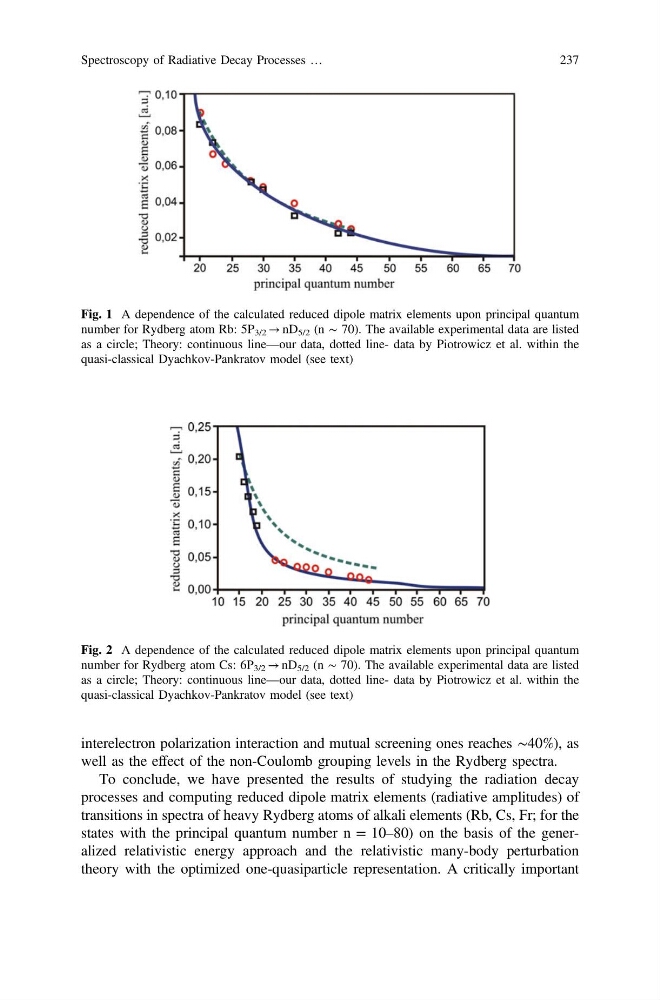
Fig. 1 A dependence of the calculated reduced dipole matrix elements upon principal quantum
number for Rydberg atom Rb: 5P 3/2 → nD 5/2 (n ∼ 70). The available experimental data are listed
as a circle; Theory: continuous line—our data, dotted line- data by Piotrowicz et al. within the
quasi-classical Dyachkov-Pankratov model (see text)
Fig. 2 A dependence of the calculated reduced dipole matrix elements upon principal quantum
number for Rydberg atom Cs: 6P 3/2 → nD 5/2 (n ∼ 70). The available experimental data are listed
as a circle; Theory: continuous line—our data, dotted line- data by Piotrowicz et al. within the
quasi-classical Dyachkov-Pankratov model (see text)
Spectroscopy of Radiative Decay Processes …
237
well as the effect of the non-Coulomb grouping levels in the Rydberg spectra.
To conclude, we have presented the results of studying the radiation decay
processes and computing reduced dipole matrix elements (radiative amplitudes) of
transitions in spectra of heavy Rydberg atoms of alkali elements (Rb, Cs, Fr; for the
states with the principal quantum number n = 10–80) on the basis of the generalized relativistic energy approach and the relativistic many-body perturbation
theory with the optimized one-quasiparticle representation. A critically important
Fig. 1 A dependence of the calculated reduced dipole matrix elements upon principal quantum
number for Rydberg atom Rb: 5P 3/2 → nD 5/2 (n ∼ 70). The available experimental data are listed
as a circle; Theory: continuous line—our data, dotted line- data by Piotrowicz et al. within the
quasi-classical Dyachkov-Pankratov model (see text)
Fig. 2 A dependence of the calculated reduced dipole matrix elements upon principal quantum
number for Rydberg atom Cs: 6P 3/2 → nD 5/2 (n ∼ 70). The available experimental data are listed
as a circle; Theory: continuous line—our data, dotted line- data by Piotrowicz et al. within the
quasi-classical Dyachkov-Pankratov model (see text)
Spectroscopy of Radiative Decay Processes …
237