

role of the many-body exchange-polarization effects and effect of the non-Coulomb
grouping levels in the Rydberg spectra has been found. The detailed numerical data
on the dipole matrix elements and transition probabilities are listed in Refs.
[99, 100].
Acknowledgements The authors are very much thankful to Prof. J. Maruani and Dr. Y. A. Wang
for invitation to make contributions on the QSCP-XVI workshop (Vancouver, Canada). The useful
comments of the anonymous referees are very much acknowledged too.
References
1. Martin W (2004) NIST spectra database, version 2.0. NIST, Washington. http://physics.nist.
gov.asd
2. Moore C (1987) NBS spectra database. NBS, Washington
3. Weiss A (1977) J Quant Spectrosc Radiat Transf 18:481; Phys Scripta T65:188 (1993)
4. Nadeem A, Haq SU (2010) Phys Rev A 81:063432; (2011) Phys Rev A 83:063404
5. Simsarian JE, Orozco LA, Sprouse GD, Zhao WZ (1998) Phys Rev A 57:2448
6. Curtis L (1995) Phys Rev A 51:4574
7. Li Y, Pretzler G, Fill EE (1995) Phys Rev A 52:R3433–R3435
8. Feng Z-G, Zhang L-J, Zhao J-M, Liand C-Y, Jia S-T (2009) J Phys B At Mol Opt Phys
42:145303
9. Marinescu M, Vrinceanu D, Sadeghpour HR (1998) Phys Rev A 58:R4259
10. Safronova UI, Johnson W, Derevianko A (1999) Phys Rev A 60:4476; Dzuba V,
Flambaum V, Safranova MS (2006) Phys Rev A 73:02211
11. Grant IP (2007) Relativistic quantum theory of atoms and molecules, theory and
computation. In: Springer series on atomic, optical, and plasma physics, vol 40. Springer,
Berlin, pp 587–626
12. Glushkov AV (2008) Relativistic quantum theory. Quantum mechanics of atomic systems.
Astroprint, Odessa, p 700
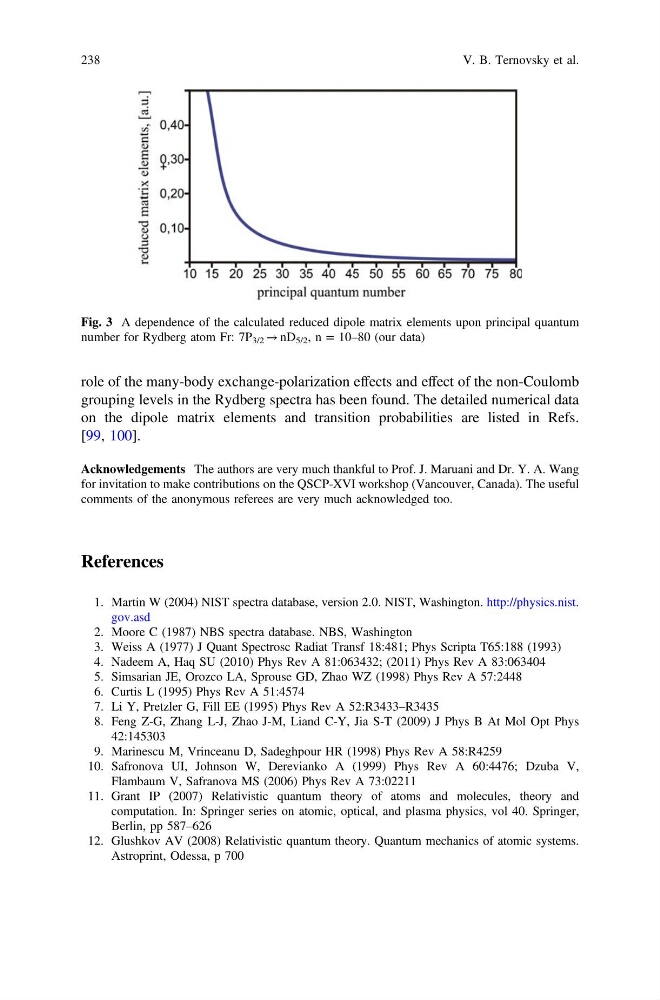
Fig. 3 A dependence of the calculated reduced dipole matrix elements upon principal quantum
number for Rydberg atom Fr: 7P 3/2 → nD 5/2 , n = 10–80 (our data)
238
V. B. Ternovsky et al.
grouping levels in the Rydberg spectra has been found. The detailed numerical data
on the dipole matrix elements and transition probabilities are listed in Refs.
[99, 100].
Acknowledgements The authors are very much thankful to Prof. J. Maruani and Dr. Y. A. Wang
for invitation to make contributions on the QSCP-XVI workshop (Vancouver, Canada). The useful
comments of the anonymous referees are very much acknowledged too.
References
1. Martin W (2004) NIST spectra database, version 2.0. NIST, Washington. http://physics.nist.
gov.asd
2. Moore C (1987) NBS spectra database. NBS, Washington
3. Weiss A (1977) J Quant Spectrosc Radiat Transf 18:481; Phys Scripta T65:188 (1993)
4. Nadeem A, Haq SU (2010) Phys Rev A 81:063432; (2011) Phys Rev A 83:063404
5. Simsarian JE, Orozco LA, Sprouse GD, Zhao WZ (1998) Phys Rev A 57:2448
6. Curtis L (1995) Phys Rev A 51:4574
7. Li Y, Pretzler G, Fill EE (1995) Phys Rev A 52:R3433–R3435
8. Feng Z-G, Zhang L-J, Zhao J-M, Liand C-Y, Jia S-T (2009) J Phys B At Mol Opt Phys
42:145303
9. Marinescu M, Vrinceanu D, Sadeghpour HR (1998) Phys Rev A 58:R4259
10. Safronova UI, Johnson W, Derevianko A (1999) Phys Rev A 60:4476; Dzuba V,
Flambaum V, Safranova MS (2006) Phys Rev A 73:02211
11. Grant IP (2007) Relativistic quantum theory of atoms and molecules, theory and
computation. In: Springer series on atomic, optical, and plasma physics, vol 40. Springer,
Berlin, pp 587–626
12. Glushkov AV (2008) Relativistic quantum theory. Quantum mechanics of atomic systems.
Astroprint, Odessa, p 700
Fig. 3 A dependence of the calculated reduced dipole matrix elements upon principal quantum
number for Rydberg atom Fr: 7P 3/2 → nD 5/2 , n = 10–80 (our data)
238
V. B. Ternovsky et al.