

included to all PT orders); PT-DF
SD
—PT with the Dirac-Hartree-Fock zeroth
approximation (plus compilation), EMP—empirical model potential method;
PT-RHF—PT with the relativistic Hartree-Fock (RHF) zeroth approximation and
PT-RHF(corr)—corrected version with using empirical data; DF-PT with the
Dirac-Fock zeroth approximation; RPT-EA—our method (relativistic PT with the
Dirac-Kohn-Sham zeroth approximation combined with an energy approach (EA)).
All data have been taken from Refs. [1–6, 10, 30, 31]).
In Fig. 1 we present a dependence of the calculated reduced dipole matrix
elements upon a principal quantum number for different states of the Rydberg atom
Rb: 5P 3/2 -nD 5/2 (n ∼ 70): available experimental data—the circles; Theory: continuous line—our data; the dotted line- data by Piotrowicz et al., obtained within the
quasiclassical Dyachkov-Pankratov model [4, 10, 12, 30, 31]. In Figs. 2 and 3 we
present the same dependences for the Rydberg states of the Cs atom: 6P 3/2 → nD 5/2
and the Fr atom: 7P 3/2 → nD 5/2 , n = 10–70.
The detailed analysis of the computation data shows very important role of the
relativistic and interelectron exchange-correlation effects (for example the contribution due to the perturbation theory second and higher orders, including the
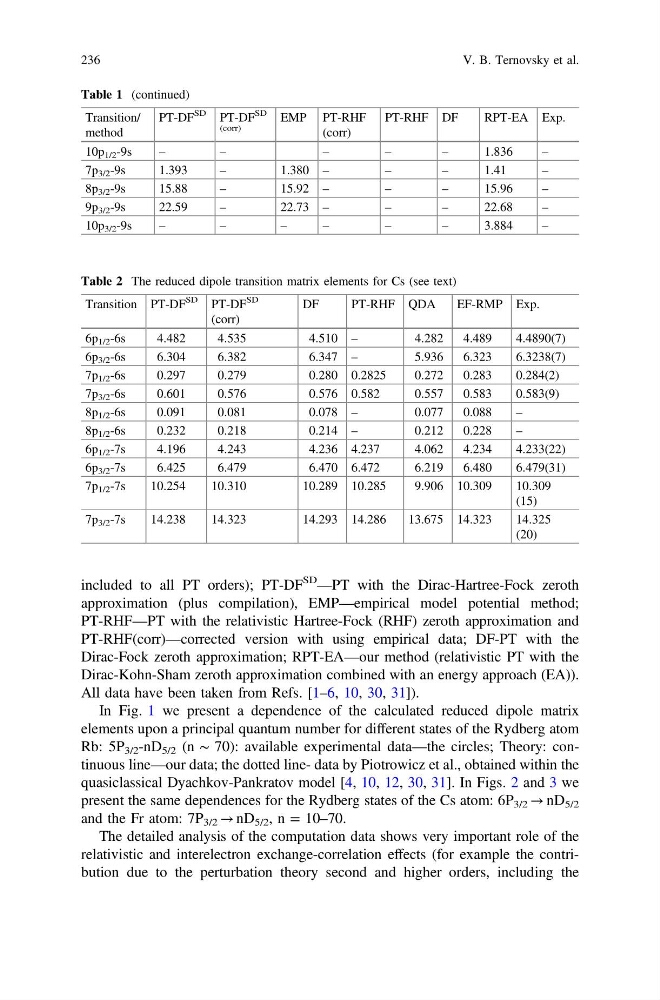
Table 2 The reduced dipole transition matrix elements for Cs (see text)
Transition PT-DF
SD
PT-DF
SD
(corr)
DF
PT-RHF QDA
EF-RMP Exp.
6p 1/2 -6s
4.482
4.535
4.510 –
4.282
4.489
4.4890(7)
6p 3/2 -6s
6.304
6.382
6.347 –
5.936
6.323
6.3238(7)
7p 1/2 -6s
0.297
0.279
0.280 0.2825
0.272
0.283
0.284(2)
7p 3/2 -6s
0.601
0.576
0.576 0.582
0.557
0.583
0.583(9)
8p 1/2 -6s
0.091
0.081
0.078 –
0.077
0.088
–
8p 1/2 -6s
0.232
0.218
0.214 –
0.212
0.228
–
6p 1/2 -7s
4.196
4.243
4.236 4.237
4.062
4.234
4.233(22)
6p 3/2 -7s
6.425
6.479
6.470 6.472
6.219
6.480
6.479(31)
7p 1/2 -7s
10.254
10.310
10.289 10.285
9.906 10.309
10.309
(15)
7p 3/2 -7s
14.238
14.323
14.293 14.286
13.675 14.323
14.325
(20)
Table 1 (continued)
Transition/
method
PT-DF
SD
PT-DF
SD
(corr)
EMP PT-RHF
(corr)
PT-RHF DF
RPT-EA Exp.
10p 1/2 -9s
–
–
–
–
–
1.836
–
7p 3/2 -9s
1.393
–
1.380 –
–
–
1.41
–
8p 3/2 -9s
15.88
–
15.92 –
–
–
15.96
–
9p 3/2 -9s
22.59
–
22.73 –
–
–
22.68
–
10p 3/2 -9s
–
–
–
–
–
–
3.884
–
236
V. B. Ternovsky et al.
SD
—PT with the Dirac-Hartree-Fock zeroth
approximation (plus compilation), EMP—empirical model potential method;
PT-RHF—PT with the relativistic Hartree-Fock (RHF) zeroth approximation and
PT-RHF(corr)—corrected version with using empirical data; DF-PT with the
Dirac-Fock zeroth approximation; RPT-EA—our method (relativistic PT with the
Dirac-Kohn-Sham zeroth approximation combined with an energy approach (EA)).
All data have been taken from Refs. [1–6, 10, 30, 31]).
In Fig. 1 we present a dependence of the calculated reduced dipole matrix
elements upon a principal quantum number for different states of the Rydberg atom
Rb: 5P 3/2 -nD 5/2 (n ∼ 70): available experimental data—the circles; Theory: continuous line—our data; the dotted line- data by Piotrowicz et al., obtained within the
quasiclassical Dyachkov-Pankratov model [4, 10, 12, 30, 31]. In Figs. 2 and 3 we
present the same dependences for the Rydberg states of the Cs atom: 6P 3/2 → nD 5/2
and the Fr atom: 7P 3/2 → nD 5/2 , n = 10–70.
The detailed analysis of the computation data shows very important role of the
relativistic and interelectron exchange-correlation effects (for example the contribution due to the perturbation theory second and higher orders, including the
Table 2 The reduced dipole transition matrix elements for Cs (see text)
Transition PT-DF
SD
PT-DF
SD
(corr)
DF
PT-RHF QDA
EF-RMP Exp.
6p 1/2 -6s
4.482
4.535
4.510 –
4.282
4.489
4.4890(7)
6p 3/2 -6s
6.304
6.382
6.347 –
5.936
6.323
6.3238(7)
7p 1/2 -6s
0.297
0.279
0.280 0.2825
0.272
0.283
0.284(2)
7p 3/2 -6s
0.601
0.576
0.576 0.582
0.557
0.583
0.583(9)
8p 1/2 -6s
0.091
0.081
0.078 –
0.077
0.088
–
8p 1/2 -6s
0.232
0.218
0.214 –
0.212
0.228
–
6p 1/2 -7s
4.196
4.243
4.236 4.237
4.062
4.234
4.233(22)
6p 3/2 -7s
6.425
6.479
6.470 6.472
6.219
6.480
6.479(31)
7p 1/2 -7s
10.254
10.310
10.289 10.285
9.906 10.309
10.309
(15)
7p 3/2 -7s
14.238
14.323
14.293 14.286
13.675 14.323
14.325
(20)
Table 1 (continued)
Transition/
method
PT-DF
SD
PT-DF
SD
(corr)
EMP PT-RHF
(corr)
PT-RHF DF
RPT-EA Exp.
10p 1/2 -9s
–
–
–
–
–
1.836
–
7p 3/2 -9s
1.393
–
1.380 –
–
–
1.41
–
8p 3/2 -9s
15.88
–
15.92 –
–
–
15.96
–
9p 3/2 -9s
22.59
–
22.73 –
–
–
22.68
–
10p 3/2 -9s
–
–
–
–
–
–
3.884
–
236
V. B. Ternovsky et al.