

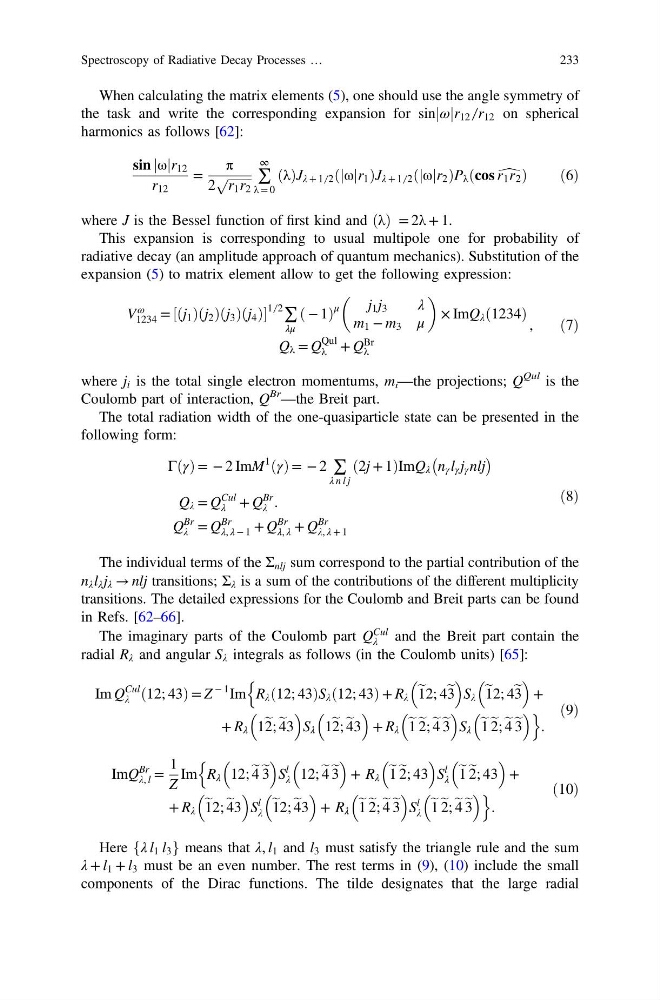
When calculating the matrix elements (5), one should use the angle symmetry of
the task and write the corresponding expansion for sin ω
j jr 12 ̸ r 12 on spherical
harmonics as follows [62]:
sin ω
j jr 12
r 12
=
π
2
ffiffiffiffiffiffiffiffi
r 1 r 2
p
∑
∞
λ = 0
ðλÞJ λ + 1 ̸ 2 ω
j jr 1
ð
ÞJ λ + 1 ̸ 2 ω
j jr 2
ð
ÞP λ ðcos d
r 1 r 2 Þ
ð6Þ
where J is the Bessel function of first kind and ðλÞ = 2λ + 1.
This expansion is corresponding to usual multipole one for probability of
radiative decay (an amplitude approach of quantum mechanics). Substitution of the
expansion (5) to matrix element allow to get the following expression:
V
ω
1234 = ðj 1 Þðj 2 Þðj 3 Þðj 4 Þ
½
1 ̸ 2 ∑
λμ
ð − 1Þ
μ
j 1 j 3
λ
m 1 − m 3 μ
× ImQ λ 1234
ð
Þ
Q λ = Q
Qul
λ + Q
Br
λ
,
ð7Þ
where j i is the total single electron momentums, m i —the projections; Q
Qul is the
Coulomb part of interaction, Q
Br
—the Breit part.
The total radiation width of the one-quasiparticle state can be presented in the
following form:
ΓðγÞ = − 2 ImM
1
ðγÞ = − 2 ∑
λ n l j
2j + 1
ð
ÞImQ λ n γ l γ j γ nlj
À
Á
Q λ = Q
Cul
λ + Q
Br
λ .
Q
Br
λ = Q
Br
λ, λ − 1 + Q
Br
λ, λ + Q
Br
λ, λ + 1
ð8Þ
The individual terms of the Σ nlj sum correspond to the partial contribution of the
n λ l λ j λ → nlj transitions; Σ λ is a sum of the contributions of the different multiplicity
transitions. The detailed expressions for the Coulomb and Breit parts can be found
in Refs. [62–66].
The imaginary parts of the Coulomb part Q
Cul
λ
and the Breit part contain the
radial R λ and angular S λ integrals as follows (in the Coulomb units) [65]:
Im Q
Cul
λ
12; 43
ð
Þ= Z
− 1 Im R λ 12; 43
ð
ÞS λ 12; 43
ð
Þ+ R λ e 12; 4 e 3
S λ e 12; 4 e 3
+
n
+ R λ 1 e 2; e 43
S λ 1 e 2; e 43
+ R λ e 1 e 2; e 4 e 3
S λ e 1 e 2; e 4 e 3
o
.
ð9Þ
ImQ
Br
λ, l =
1
Z
Im R λ 12; e 4 e 3
S
l
λ 12; e 4 e 3
+ R λ e 1 e 2; 43
S
l
λ
e 1 e 2; 43
+
n
+ R λ e 12; e 43
S
l
λ
e 12; e 43
+ R λ e 1 e 2; e 4 e 3
S
l
λ
e 1 e 2; e 4 e 3
o
.
ð10Þ
Here λ l 1 l 3
f
g means that λ, l 1 and l 3 must satisfy the triangle rule and the sum
λ + l 1 + l 3 must be an even number. The rest terms in (9), (10) include the small
components of the Dirac functions. The tilde designates that the large radial
Spectroscopy of Radiative Decay Processes …
233
the task and write the corresponding expansion for sin ω
j jr 12 ̸ r 12 on spherical
harmonics as follows [62]:
sin ω
j jr 12
r 12
=
π
2
ffiffiffiffiffiffiffiffi
r 1 r 2
p
∑
∞
λ = 0
ðλÞJ λ + 1 ̸ 2 ω
j jr 1
ð
ÞJ λ + 1 ̸ 2 ω
j jr 2
ð
ÞP λ ðcos d
r 1 r 2 Þ
ð6Þ
where J is the Bessel function of first kind and ðλÞ = 2λ + 1.
This expansion is corresponding to usual multipole one for probability of
radiative decay (an amplitude approach of quantum mechanics). Substitution of the
expansion (5) to matrix element allow to get the following expression:
V
ω
1234 = ðj 1 Þðj 2 Þðj 3 Þðj 4 Þ
½
1 ̸ 2 ∑
λμ
ð − 1Þ
μ
j 1 j 3
λ
m 1 − m 3 μ
× ImQ λ 1234
ð
Þ
Q λ = Q
Qul
λ + Q
Br
λ
,
ð7Þ
where j i is the total single electron momentums, m i —the projections; Q
Qul is the
Coulomb part of interaction, Q
Br
—the Breit part.
The total radiation width of the one-quasiparticle state can be presented in the
following form:
ΓðγÞ = − 2 ImM
1
ðγÞ = − 2 ∑
λ n l j
2j + 1
ð
ÞImQ λ n γ l γ j γ nlj
À
Á
Q λ = Q
Cul
λ + Q
Br
λ .
Q
Br
λ = Q
Br
λ, λ − 1 + Q
Br
λ, λ + Q
Br
λ, λ + 1
ð8Þ
The individual terms of the Σ nlj sum correspond to the partial contribution of the
n λ l λ j λ → nlj transitions; Σ λ is a sum of the contributions of the different multiplicity
transitions. The detailed expressions for the Coulomb and Breit parts can be found
in Refs. [62–66].
The imaginary parts of the Coulomb part Q
Cul
λ
and the Breit part contain the
radial R λ and angular S λ integrals as follows (in the Coulomb units) [65]:
Im Q
Cul
λ
12; 43
ð
Þ= Z
− 1 Im R λ 12; 43
ð
ÞS λ 12; 43
ð
Þ+ R λ e 12; 4 e 3
S λ e 12; 4 e 3
+
n
+ R λ 1 e 2; e 43
S λ 1 e 2; e 43
+ R λ e 1 e 2; e 4 e 3
S λ e 1 e 2; e 4 e 3
o
.
ð9Þ
ImQ
Br
λ, l =
1
Z
Im R λ 12; e 4 e 3
S
l
λ 12; e 4 e 3
+ R λ e 1 e 2; 43
S
l
λ
e 1 e 2; 43
+
n
+ R λ e 12; e 43
S
l
λ
e 12; e 43
+ R λ e 1 e 2; e 4 e 3
S
l
λ
e 1 e 2; e 4 e 3
o
.
ð10Þ
Here λ l 1 l 3
f
g means that λ, l 1 and l 3 must satisfy the triangle rule and the sum
λ + l 1 + l 3 must be an even number. The rest terms in (9), (10) include the small
components of the Dirac functions. The tilde designates that the large radial
Spectroscopy of Radiative Decay Processes …
233