

component f must be replaced by the small one g, and instead of l i , l ̃
i = l i − 1 should
be taken for j i < l i and l ̃
i = l i + 1 for j i > l i . The detailed definitions for the radial R λ
and angular S λ integrals can be found in Refs. [59, 64–67].
The total probability of a λ—pole transition is usually represented as a sum of
the electric P
E
λ and magnetic P
M
λ parts. The electric (or magnetic) λ—pole transition
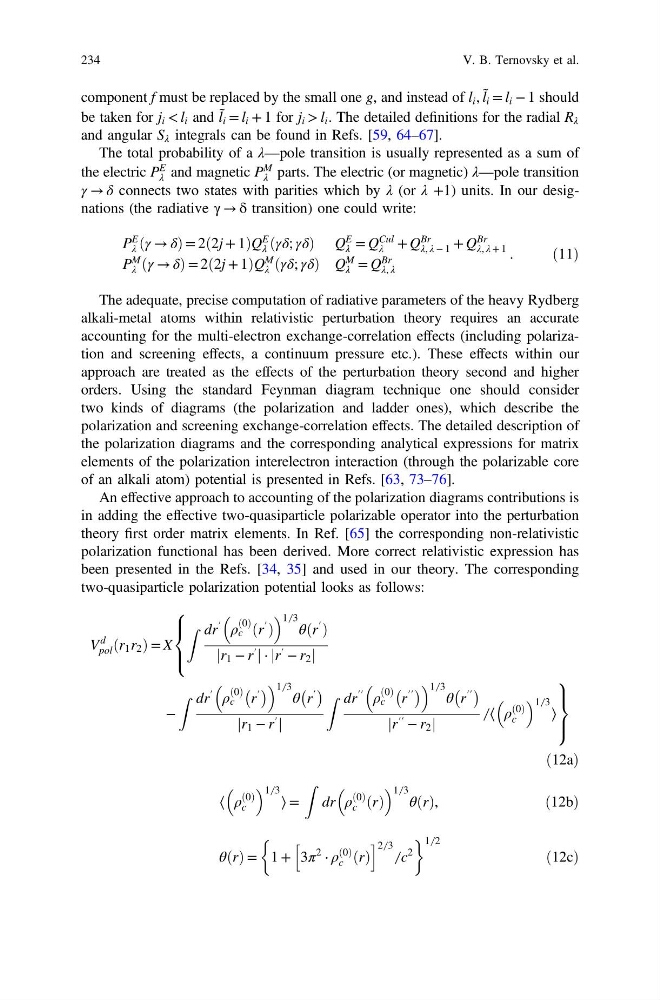
γ → δ connects two states with parities which by λ (or λ +1) units. In our designations (the radiative γ → δ transition) one could write:
P
E
λ γ → δ
ð
Þ= 2 2j + 1
ð
ÞQ
E
λ γδ; γδ
ð
Þ Q
E
λ = Q
Cul
λ + Q
Br
λ, λ − 1 + Q
Br
λ, λ + 1
P
M
λ γ → δ
ð
Þ= 2 2j + 1
ð
ÞQ
M
λ γδ; γδ
ð
Þ Q
M
λ = Q
Br
λ, λ
.
ð11Þ
The adequate, precise computation of radiative parameters of the heavy Rydberg
alkali-metal atoms within relativistic perturbation theory requires an accurate
accounting for the multi-electron exchange-correlation effects (including polarization and screening effects, a continuum pressure etc.). These effects within our
approach are treated as the effects of the perturbation theory second and higher
orders. Using the standard Feynman diagram technique one should consider
two kinds of diagrams (the polarization and ladder ones), which describe the
polarization and screening exchange-correlation effects. The detailed description of
the polarization diagrams and the corresponding analytical expressions for matrix
elements of the polarization interelectron interaction (through the polarizable core
of an alkali atom) potential is presented in Refs. [63, 73–76].
An effective approach to accounting of the polarization diagrams contributions is
in adding the effective two-quasiparticle polarizable operator into the perturbation
theory first order matrix elements. In Ref. [65] the corresponding non-relativistic
polarization functional has been derived. More correct relativistic expression has
been presented in the Refs. [34, 35] and used in our theory. The corresponding
two-quasiparticle polarization potential looks as follows:
V
d
pol r 1 r 2
ð
Þ= X
Z dr
′
ρ
ð0Þ
c ðr
′
Þ
1 ̸ 3 θðr
′
Þ
r 1 − r ′
j
j⋅ r ′ − r 2
j
j
8
> <
> :
−
Z dr
′
ρ
ð0Þ
c
r
′
À Á
1 ̸ 3 θ r
′
À Á
r 1 − r ′
j
j
Z dr
′′
ρ
ð0Þ
c
r
′′
À Á
1 ̸ 3 θ r
′′
À Á
r ′′ − r 2
j
j
̸ ⟨ ρ
ð0Þ
c
1 ̸ 3 ⟩
9
> =
> ;
ð12aÞ
⟨ ρ
ð0Þ
c
1 ̸ 3 ⟩ =
Z
dr ρ
ð0Þ
c ðrÞ
1 ̸ 3 θðrÞ,
ð12bÞ
θðrÞ = 1+ 3π
2
⋅ ρ
ð0Þ
c ðrÞ
h
i 2 ̸ 3 ̸ c
2
&
' 1 ̸ 2
ð12cÞ
234
V. B. Ternovsky et al.
i = l i − 1 should
be taken for j i < l i and l ̃
i = l i + 1 for j i > l i . The detailed definitions for the radial R λ
and angular S λ integrals can be found in Refs. [59, 64–67].
The total probability of a λ—pole transition is usually represented as a sum of
the electric P
E
λ and magnetic P
M
λ parts. The electric (or magnetic) λ—pole transition
γ → δ connects two states with parities which by λ (or λ +1) units. In our designations (the radiative γ → δ transition) one could write:
P
E
λ γ → δ
ð
Þ= 2 2j + 1
ð
ÞQ
E
λ γδ; γδ
ð
Þ Q
E
λ = Q
Cul
λ + Q
Br
λ, λ − 1 + Q
Br
λ, λ + 1
P
M
λ γ → δ
ð
Þ= 2 2j + 1
ð
ÞQ
M
λ γδ; γδ
ð
Þ Q
M
λ = Q
Br
λ, λ
.
ð11Þ
The adequate, precise computation of radiative parameters of the heavy Rydberg
alkali-metal atoms within relativistic perturbation theory requires an accurate
accounting for the multi-electron exchange-correlation effects (including polarization and screening effects, a continuum pressure etc.). These effects within our
approach are treated as the effects of the perturbation theory second and higher
orders. Using the standard Feynman diagram technique one should consider
two kinds of diagrams (the polarization and ladder ones), which describe the
polarization and screening exchange-correlation effects. The detailed description of
the polarization diagrams and the corresponding analytical expressions for matrix
elements of the polarization interelectron interaction (through the polarizable core
of an alkali atom) potential is presented in Refs. [63, 73–76].
An effective approach to accounting of the polarization diagrams contributions is
in adding the effective two-quasiparticle polarizable operator into the perturbation
theory first order matrix elements. In Ref. [65] the corresponding non-relativistic
polarization functional has been derived. More correct relativistic expression has
been presented in the Refs. [34, 35] and used in our theory. The corresponding
two-quasiparticle polarization potential looks as follows:
V
d
pol r 1 r 2
ð
Þ= X
Z dr
′
ρ
ð0Þ
c ðr
′
Þ
1 ̸ 3 θðr
′
Þ
r 1 − r ′
j
j⋅ r ′ − r 2
j
j
8
> <
> :
−
Z dr
′
ρ
ð0Þ
c
r
′
À Á
1 ̸ 3 θ r
′
À Á
r 1 − r ′
j
j
Z dr
′′
ρ
ð0Þ
c
r
′′
À Á
1 ̸ 3 θ r
′′
À Á
r ′′ − r 2
j
j
̸ ⟨ ρ
ð0Þ
c
1 ̸ 3 ⟩
9
> =
> ;
ð12aÞ
⟨ ρ
ð0Þ
c
1 ̸ 3 ⟩ =
Z
dr ρ
ð0Þ
c ðrÞ
1 ̸ 3 θðrÞ,
ð12bÞ
θðrÞ = 1+ 3π
2
⋅ ρ
ð0Þ
c ðrÞ
h
i 2 ̸ 3 ̸ c
2
&
' 1 ̸ 2
ð12cÞ
234
V. B. Ternovsky et al.