

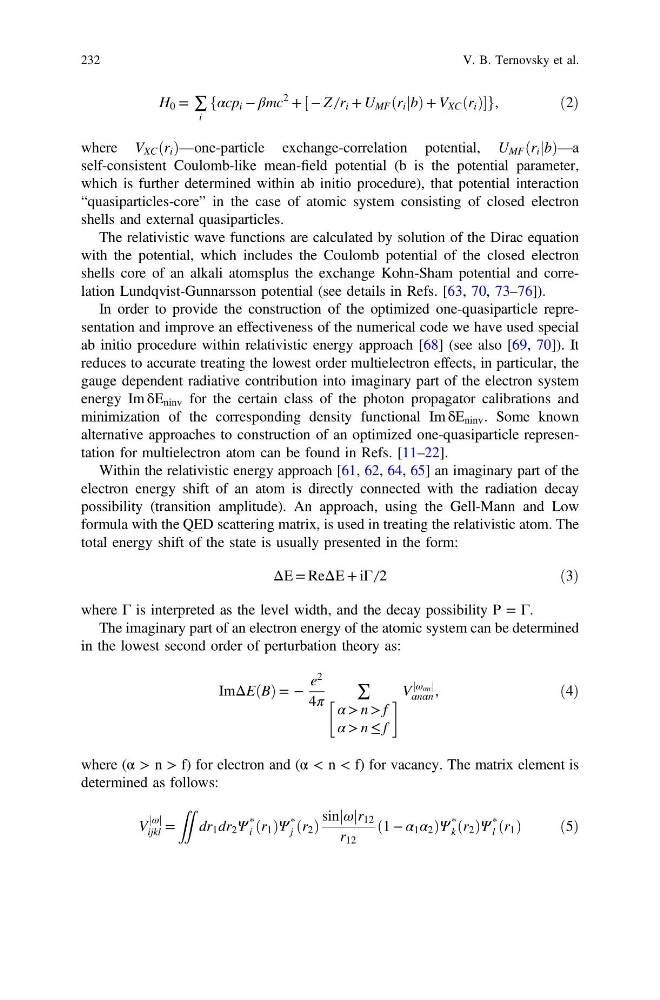
H 0 = ∑
i
fαcp i − βmc
2 + ½ − Z ̸ r i + U MF ðr i jbÞ + V XC ðr i Þg,
ð2Þ
where V XC ðr i Þ—one-particle exchange-correlation potential, U MF ðr i jbÞ—a
self-consistent Coulomb-like mean-field potential (b is the potential parameter,
which is further determined within ab initio procedure), that potential interaction
“quasiparticles-core” in the case of atomic system consisting of closed electron
shells and external quasiparticles.
The relativistic wave functions are calculated by solution of the Dirac equation
with the potential, which includes the Coulomb potential of the closed electron
shells core of an alkali atomsplus the exchange Kohn-Sham potential and correlation Lundqvist-Gunnarsson potential (see details in Refs. [63, 70, 73–76]).
In order to provide the construction of the optimized one-quasiparticle representation and improve an effectiveness of the numerical code we have used special
ab initio procedure within relativistic energy approach [68] (see also [69, 70]). It
reduces to accurate treating the lowest order multielectron effects, in particular, the
gauge dependent radiative contribution into imaginary part of the electron system
energy Im δE ninv for the certain class of the photon propagator calibrations and
minimization of the corresponding density functional Im δE ninv . Some known
alternative approaches to construction of an optimized one-quasiparticle representation for multielectron atom can be found in Refs. [11–22].
Within the relativistic energy approach [61, 62, 64, 65] an imaginary part of the
electron energy shift of an atom is directly connected with the radiation decay
possibility (transition amplitude). An approach, using the Gell-Mann and Low
formula with the QED scattering matrix, is used in treating the relativistic atom. The
total energy shift of the state is usually presented in the form:
ΔE = ReΔE + iΓ ̸ 2
ð3Þ
where Γ is interpreted as the level width, and the decay possibility P = Γ.
The imaginary part of an electron energy of the atomic system can be determined
in the lowest second order of perturbation theory as:
ImΔEðBÞ = −
e
2
4π
∑
α > n > f
α > n ≤ f
! V
ω αn
j j
αnαn ,
ð4Þ
where (α > n > f) for electron and (α < n < f) for vacancy. The matrix element is
determined as follows:
V
ω
j j
ijkl =
ZZ
dr 1 dr 2 Ψ
*
i ðr 1 ÞΨ
*
j ðr 2 Þ
sin ω
j jr 12
r 12
ð1 − α 1 α 2 ÞΨ
*
k ðr 2 ÞΨ
*
l ðr 1 Þ
ð5Þ
232
V. B. Ternovsky et al.
i
fαcp i − βmc
2 + ½ − Z ̸ r i + U MF ðr i jbÞ + V XC ðr i Þg,
ð2Þ
where V XC ðr i Þ—one-particle exchange-correlation potential, U MF ðr i jbÞ—a
self-consistent Coulomb-like mean-field potential (b is the potential parameter,
which is further determined within ab initio procedure), that potential interaction
“quasiparticles-core” in the case of atomic system consisting of closed electron
shells and external quasiparticles.
The relativistic wave functions are calculated by solution of the Dirac equation
with the potential, which includes the Coulomb potential of the closed electron
shells core of an alkali atomsplus the exchange Kohn-Sham potential and correlation Lundqvist-Gunnarsson potential (see details in Refs. [63, 70, 73–76]).
In order to provide the construction of the optimized one-quasiparticle representation and improve an effectiveness of the numerical code we have used special
ab initio procedure within relativistic energy approach [68] (see also [69, 70]). It
reduces to accurate treating the lowest order multielectron effects, in particular, the
gauge dependent radiative contribution into imaginary part of the electron system
energy Im δE ninv for the certain class of the photon propagator calibrations and
minimization of the corresponding density functional Im δE ninv . Some known
alternative approaches to construction of an optimized one-quasiparticle representation for multielectron atom can be found in Refs. [11–22].
Within the relativistic energy approach [61, 62, 64, 65] an imaginary part of the
electron energy shift of an atom is directly connected with the radiation decay
possibility (transition amplitude). An approach, using the Gell-Mann and Low
formula with the QED scattering matrix, is used in treating the relativistic atom. The
total energy shift of the state is usually presented in the form:
ΔE = ReΔE + iΓ ̸ 2
ð3Þ
where Γ is interpreted as the level width, and the decay possibility P = Γ.
The imaginary part of an electron energy of the atomic system can be determined
in the lowest second order of perturbation theory as:
ImΔEðBÞ = −
e
2
4π
∑
α > n > f
α > n ≤ f
! V
ω αn
j j
αnαn ,
ð4Þ
where (α > n > f) for electron and (α < n < f) for vacancy. The matrix element is
determined as follows:
V
ω
j j
ijkl =
ZZ
dr 1 dr 2 Ψ
*
i ðr 1 ÞΨ
*
j ðr 2 Þ
sin ω
j jr 12
r 12
ð1 − α 1 α 2 ÞΨ
*
k ðr 2 ÞΨ
*
l ðr 1 Þ
ð5Þ
232
V. B. Ternovsky et al.