

Rydberg francium spectrum are listed. The data are discussed from the viewpoint of
the correct accounting for the relativistic and exchange-correlation effects. It has
been shown that the theoretical approach used provides a precise accounting for the
important exchange-correlation effects, including the effect of essentially
non-Coulomb grouping of Rydberg levels, continuum pressure etc.
All calculations of the radiative decay (transitions) probabilities (matrix elements) in the studied atomic systems have been performed with using the generalized relativistic energy approach and the relativistic many-body perturbation
theory (PT) with using the optimized one-quasiparticle representation and an
accurate accounting of the exchange-correlation effects, including the effect of
essentially non-Coulomb grouping of Rydberg levels [61–63].
Let us remind that the theoretical fundamentals of an energy approach in a case of
the one-electron ions have been considered by Labzovsky et al. [57, 58]. Originally
the energy approach to radiative and autoionization processes in multielectron atoms
and ions has been developed by Ivanova-Ivanov et al. [59–62, 64–67]. More
accurate, advanced version of the relativistic energy approach has been further
developed in Refs. [63, 68–72]. The energy approach is based on the Gell-Mann and
Low S-matrix formalism combined with the relativistic perturbation theory. In
relativistic case the Gell-Mann and Low formula expressed an energy shift ΔE
through the electrodynamical scattering matrix including interaction with as the
photon vacuum field as a laser field. The first case is corresponding to determination
of radiative decay characteristics for atomic systems. Earlier we have applied the
corresponding generalized versions of the energy approach to many problems of
atomic, nuclear and even molecular spectroscopy, including, cooperative
electron-gamma-nuclear “shake-up” processes, electron-muon-beta-gamma-nuclear
spectroscopy, spectroscopy of atoms in a laser field etc. [73–98].
2 Relativistic Energy Approach and Many-Body
Perturbation Theory with the Dirac-Kohn-Sham Zeroth
Approximation
Let us describe in brief the key moments of our theoretical approach (look for more
details in Refs. [63, 65–69, 73–76]). As usually, the wave functions zeroth basis is
found from the Dirac equation solution with self-consistent total potential.
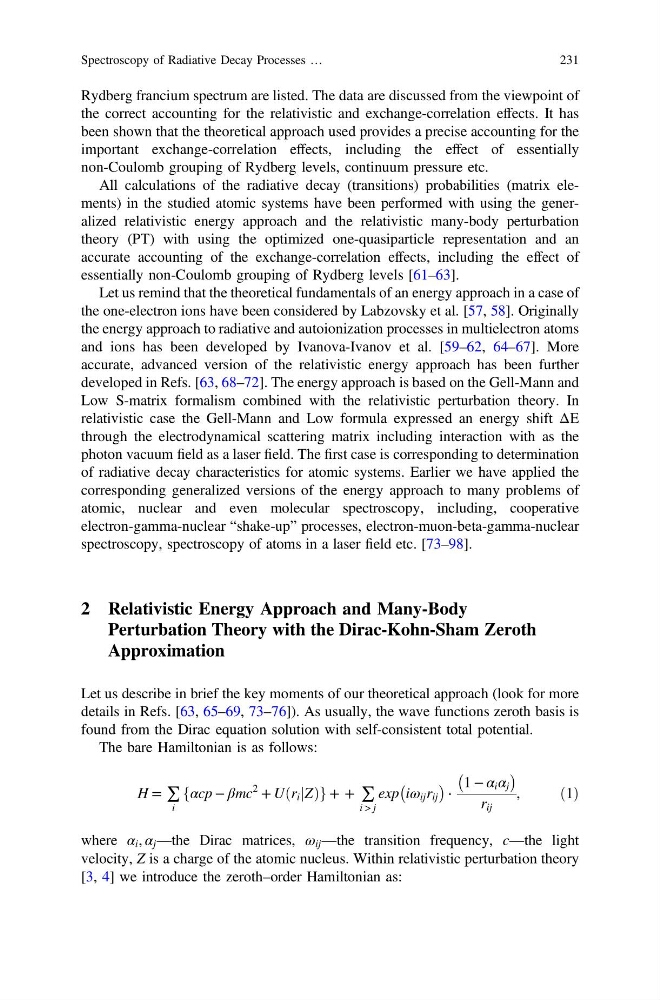
The bare Hamiltonian is as follows:
H = ∑
i
fαcp − βmc
2 + Uðr i jZÞg + + ∑
i > j
exp iω ij r ij
À
Á ⋅
1 − α i α j
À
Á
r ij
,
ð1Þ
where α i , α j —the Dirac matrices, ω ij —the transition frequency, c—the light
velocity, Z is a charge of the atomic nucleus. Within relativistic perturbation theory
[3, 4] we introduce the zeroth–order Hamiltonian as:
Spectroscopy of Radiative Decay Processes …
231
the correct accounting for the relativistic and exchange-correlation effects. It has
been shown that the theoretical approach used provides a precise accounting for the
important exchange-correlation effects, including the effect of essentially
non-Coulomb grouping of Rydberg levels, continuum pressure etc.
All calculations of the radiative decay (transitions) probabilities (matrix elements) in the studied atomic systems have been performed with using the generalized relativistic energy approach and the relativistic many-body perturbation
theory (PT) with using the optimized one-quasiparticle representation and an
accurate accounting of the exchange-correlation effects, including the effect of
essentially non-Coulomb grouping of Rydberg levels [61–63].
Let us remind that the theoretical fundamentals of an energy approach in a case of
the one-electron ions have been considered by Labzovsky et al. [57, 58]. Originally
the energy approach to radiative and autoionization processes in multielectron atoms
and ions has been developed by Ivanova-Ivanov et al. [59–62, 64–67]. More
accurate, advanced version of the relativistic energy approach has been further
developed in Refs. [63, 68–72]. The energy approach is based on the Gell-Mann and
Low S-matrix formalism combined with the relativistic perturbation theory. In
relativistic case the Gell-Mann and Low formula expressed an energy shift ΔE
through the electrodynamical scattering matrix including interaction with as the
photon vacuum field as a laser field. The first case is corresponding to determination
of radiative decay characteristics for atomic systems. Earlier we have applied the
corresponding generalized versions of the energy approach to many problems of
atomic, nuclear and even molecular spectroscopy, including, cooperative
electron-gamma-nuclear “shake-up” processes, electron-muon-beta-gamma-nuclear
spectroscopy, spectroscopy of atoms in a laser field etc. [73–98].
2 Relativistic Energy Approach and Many-Body
Perturbation Theory with the Dirac-Kohn-Sham Zeroth
Approximation
Let us describe in brief the key moments of our theoretical approach (look for more
details in Refs. [63, 65–69, 73–76]). As usually, the wave functions zeroth basis is
found from the Dirac equation solution with self-consistent total potential.
The bare Hamiltonian is as follows:
H = ∑
i
fαcp − βmc
2 + Uðr i jZÞg + + ∑
i > j
exp iω ij r ij
À
Á ⋅
1 − α i α j
À
Á
r ij
,
ð1Þ
where α i , α j —the Dirac matrices, ω ij —the transition frequency, c—the light
velocity, Z is a charge of the atomic nucleus. Within relativistic perturbation theory
[3, 4] we introduce the zeroth–order Hamiltonian as:
Spectroscopy of Radiative Decay Processes …
231