

formation of the anion occurs through the gain of an electron. The new electron
may be unpaired in which case the multiplicity increases, or it might pair with a
previously unpaired electron in the neutral cluster thus decreasing the multiplicity.
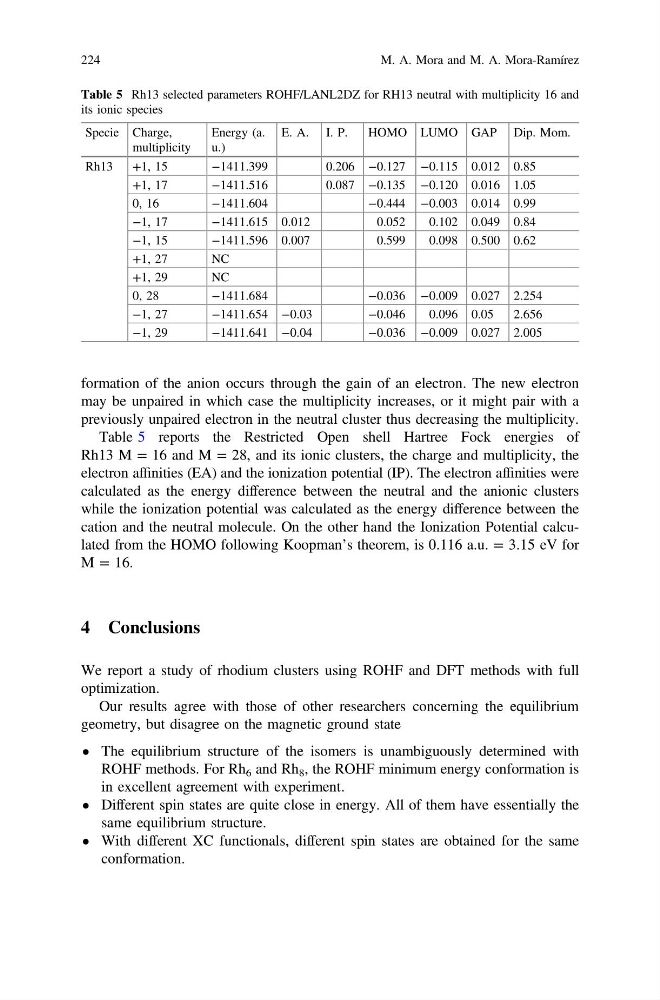
Table 5 reports the Restricted Open shell Hartree Fock energies of
Rh13 M = 16 and M = 28, and its ionic clusters, the charge and multiplicity, the
electron affinities (EA) and the ionization potential (IP). The electron affinities were
calculated as the energy difference between the neutral and the anionic clusters
while the ionization potential was calculated as the energy difference between the
cation and the neutral molecule. On the other hand the Ionization Potential calculated from the HOMO following Koopman’s theorem, is 0.116 a.u. = 3.15 eV for
M = 16.
4 Conclusions
We report a study of rhodium clusters using ROHF and DFT methods with full
optimization.
Our results agree with those of other researchers concerning the equilibrium
geometry, but disagree on the magnetic ground state
• The equilibrium structure of the isomers is unambiguously determined with
ROHF methods. For Rh 6 and Rh 8 , the ROHF minimum energy conformation is
in excellent agreement with experiment.
• Different spin states are quite close in energy. All of them have essentially the
same equilibrium structure.
• With different XC functionals, different spin states are obtained for the same
conformation.
Table 5 Rh13 selected parameters ROHF/LANL2DZ for RH13 neutral with multiplicity 16 and
its ionic species
Specie Charge,
multiplicity
Energy (a.
u.)
E. A. I. P.
HOMO LUMO GAP Dip. Mom.
Rh13
+1, 15
−1411.399
0.206 −0.127 −0.115 0.012 0.85
+1, 17
−1411.516
0.087 −0.135 −0.120 0.016 1.05
0, 16
−1411.604
−0.444 −0.003 0.014 0.99
−1, 17
−1411.615 0.012
0.052
0.102 0.049 0.84
−1, 15
−1411.596 0.007
0.599
0.098 0.500 0.62
+1, 27
NC
+1, 29
NC
0, 28
−1411.684
−0.036 −0.009 0.027 2.254
−1, 27
−1411.654 −0.03
−0.046
0.096 0.05
2.656
−1, 29
−1411.641 −0.04
−0.036 −0.009 0.027 2.005
224
M. A. Mora and M. A. Mora-Ramírez
may be unpaired in which case the multiplicity increases, or it might pair with a
previously unpaired electron in the neutral cluster thus decreasing the multiplicity.
Table 5 reports the Restricted Open shell Hartree Fock energies of
Rh13 M = 16 and M = 28, and its ionic clusters, the charge and multiplicity, the
electron affinities (EA) and the ionization potential (IP). The electron affinities were
calculated as the energy difference between the neutral and the anionic clusters
while the ionization potential was calculated as the energy difference between the
cation and the neutral molecule. On the other hand the Ionization Potential calculated from the HOMO following Koopman’s theorem, is 0.116 a.u. = 3.15 eV for
M = 16.
4 Conclusions
We report a study of rhodium clusters using ROHF and DFT methods with full
optimization.
Our results agree with those of other researchers concerning the equilibrium
geometry, but disagree on the magnetic ground state
• The equilibrium structure of the isomers is unambiguously determined with
ROHF methods. For Rh 6 and Rh 8 , the ROHF minimum energy conformation is
in excellent agreement with experiment.
• Different spin states are quite close in energy. All of them have essentially the
same equilibrium structure.
• With different XC functionals, different spin states are obtained for the same
conformation.
Table 5 Rh13 selected parameters ROHF/LANL2DZ for RH13 neutral with multiplicity 16 and
its ionic species
Specie Charge,
multiplicity
Energy (a.
u.)
E. A. I. P.
HOMO LUMO GAP Dip. Mom.
Rh13
+1, 15
−1411.399
0.206 −0.127 −0.115 0.012 0.85
+1, 17
−1411.516
0.087 −0.135 −0.120 0.016 1.05
0, 16
−1411.604
−0.444 −0.003 0.014 0.99
−1, 17
−1411.615 0.012
0.052
0.102 0.049 0.84
−1, 15
−1411.596 0.007
0.599
0.098 0.500 0.62
+1, 27
NC
+1, 29
NC
0, 28
−1411.684
−0.036 −0.009 0.027 2.254
−1, 27
−1411.654 −0.03
−0.046
0.096 0.05
2.656
−1, 29
−1411.641 −0.04
−0.036 −0.009 0.027 2.005
224
M. A. Mora and M. A. Mora-Ramírez