

important to emphasize that the DSC geometry reported as the most stable is not
retained once it is subjected to a process of optimization without any kind of
restrictions.
Rh 13 is one of the most studied [18–29, 38, 51, 60] clusters because it is
considered as the seed for different cluster growth patterns. A wide dispersion in the
calculated multiplicities is present in the literature.
The ROHF calculations for Rh 13 converge to an interesting structure presented
in Fig. 7. It is an interlocking series of pentagons, an irregular icosahedron, with a
rhodium atom in the center. The icosahedron is composed of interlocking pentagonal “caps”. Every vertex of the icosahedron is the top of a pentagonal cap. We
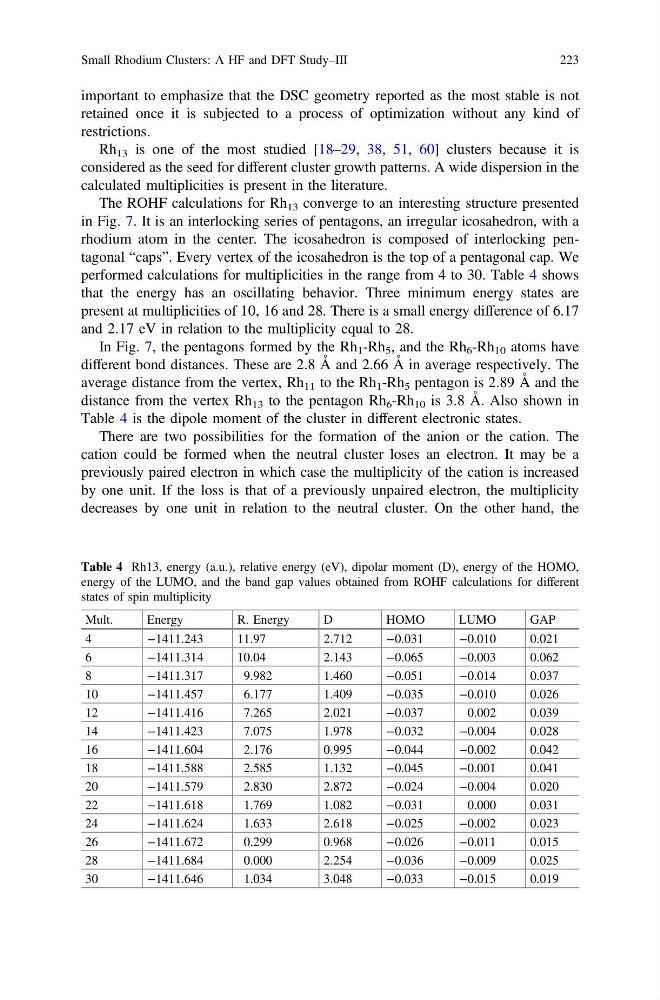
performed calculations for multiplicities in the range from 4 to 30. Table 4 shows
that the energy has an oscillating behavior. Three minimum energy states are
present at multiplicities of 10, 16 and 28. There is a small energy difference of 6.17
and 2.17 eV in relation to the multiplicity equal to 28.
In Fig. 7, the pentagons formed by the Rh 1 -Rh 5 , and the Rh 6 -Rh 10 atoms have
different bond distances. These are 2.8 Å and 2.66 Å in average respectively. The
average distance from the vertex, Rh 11 to the Rh 1 -Rh 5 pentagon is 2.89 Å and the
distance from the vertex Rh 13 to the pentagon Rh 6 -Rh 10 is 3.8 Å. Also shown in
Table 4 is the dipole moment of the cluster in different electronic states.
There are two possibilities for the formation of the anion or the cation. The
cation could be formed when the neutral cluster loses an electron. It may be a
previously paired electron in which case the multiplicity of the cation is increased
by one unit. If the loss is that of a previously unpaired electron, the multiplicity
decreases by one unit in relation to the neutral cluster. On the other hand, the
Table 4 Rh13, energy (a.u.), relative energy (eV), dipolar moment (D), energy of the HOMO,
energy of the LUMO, and the band gap values obtained from ROHF calculations for different
states of spin multiplicity
Mult.
Energy
R. Energy
D
HOMO
LUMO
GAP
4
−1411.243
11.97
2.712
−0.031
−0.010
0.021
6
−1411.314
10.04
2.143
−0.065
−0.003
0.062
8
−1411.317
9.982
1.460
−0.051
−0.014
0.037
10
−1411.457
6.177
1.409
−0.035
−0.010
0.026
12
−1411.416
7.265
2.021
−0.037
0.002
0.039
14
−1411.423
7.075
1.978
−0.032
−0.004
0.028
16
−1411.604
2.176
0.995
−0.044
−0.002
0.042
18
−1411.588
2.585
1.132
−0.045
−0.001
0.041
20
−1411.579
2.830
2.872
−0.024
−0.004
0.020
22
−1411.618
1.769
1.082
−0.031
0.000
0.031
24
−1411.624
1.633
2.618
−0.025
−0.002
0.023
26
−1411.672
0.299
0.968
−0.026
−0.011
0.015
28
−1411.684
0.000
2.254
−0.036
−0.009
0.025
30
−1411.646
1.034
3.048
−0.033
−0.015
0.019
Small Rhodium Clusters: A HF and DFT Study–III
223
retained once it is subjected to a process of optimization without any kind of
restrictions.
Rh 13 is one of the most studied [18–29, 38, 51, 60] clusters because it is
considered as the seed for different cluster growth patterns. A wide dispersion in the
calculated multiplicities is present in the literature.
The ROHF calculations for Rh 13 converge to an interesting structure presented
in Fig. 7. It is an interlocking series of pentagons, an irregular icosahedron, with a
rhodium atom in the center. The icosahedron is composed of interlocking pentagonal “caps”. Every vertex of the icosahedron is the top of a pentagonal cap. We
performed calculations for multiplicities in the range from 4 to 30. Table 4 shows
that the energy has an oscillating behavior. Three minimum energy states are
present at multiplicities of 10, 16 and 28. There is a small energy difference of 6.17
and 2.17 eV in relation to the multiplicity equal to 28.
In Fig. 7, the pentagons formed by the Rh 1 -Rh 5 , and the Rh 6 -Rh 10 atoms have
different bond distances. These are 2.8 Å and 2.66 Å in average respectively. The
average distance from the vertex, Rh 11 to the Rh 1 -Rh 5 pentagon is 2.89 Å and the
distance from the vertex Rh 13 to the pentagon Rh 6 -Rh 10 is 3.8 Å. Also shown in
Table 4 is the dipole moment of the cluster in different electronic states.
There are two possibilities for the formation of the anion or the cation. The
cation could be formed when the neutral cluster loses an electron. It may be a
previously paired electron in which case the multiplicity of the cation is increased
by one unit. If the loss is that of a previously unpaired electron, the multiplicity
decreases by one unit in relation to the neutral cluster. On the other hand, the
Table 4 Rh13, energy (a.u.), relative energy (eV), dipolar moment (D), energy of the HOMO,
energy of the LUMO, and the band gap values obtained from ROHF calculations for different
states of spin multiplicity
Mult.
Energy
R. Energy
D
HOMO
LUMO
GAP
4
−1411.243
11.97
2.712
−0.031
−0.010
0.021
6
−1411.314
10.04
2.143
−0.065
−0.003
0.062
8
−1411.317
9.982
1.460
−0.051
−0.014
0.037
10
−1411.457
6.177
1.409
−0.035
−0.010
0.026
12
−1411.416
7.265
2.021
−0.037
0.002
0.039
14
−1411.423
7.075
1.978
−0.032
−0.004
0.028
16
−1411.604
2.176
0.995
−0.044
−0.002
0.042
18
−1411.588
2.585
1.132
−0.045
−0.001
0.041
20
−1411.579
2.830
2.872
−0.024
−0.004
0.020
22
−1411.618
1.769
1.082
−0.031
0.000
0.031
24
−1411.624
1.633
2.618
−0.025
−0.002
0.023
26
−1411.672
0.299
0.968
−0.026
−0.011
0.015
28
−1411.684
0.000
2.254
−0.036
−0.009
0.025
30
−1411.646
1.034
3.048
−0.033
−0.015
0.019
Small Rhodium Clusters: A HF and DFT Study–III
223