

perform two other sets of calculations with the same B3LYP and PBE functionals.
Figure 5 shows the initial geometry, the final geometry obtained without any kind
of restriction for both functionals. Figure 6 is very similar. It is a simple double
distorted cube formed by oblique parallelepipeds. Although the geometries are very
similar, that obtained with the functional PBE shows shorter distances than the
corresponding one calculated with the B3LYP functional. The angle formed by the
distorted cubes is 140° and 124° for B3LYP and PBE respectively. The initial
geometry is not preserved during the optimization process. The geometry optimized
by us is 0.13 eV more stable with PBE, and 0.58 eV more stable with B3LYP, than
the capped double cube conformation previously reported. The energies are not the
only differences. Reference [56] reported a magnetic moment of 9 μ B for the double
simple cubic, DSC, geometry with the PBE method while we obtain a magnetic
moment of 13 μ B with the same method (PBE), and 21 μ B using B3LYP, equal to
that obtained by Reddy et al. [18] using the von Barth-Hedin form of the
exchange-correlation contributions in the discrete variational method. It is
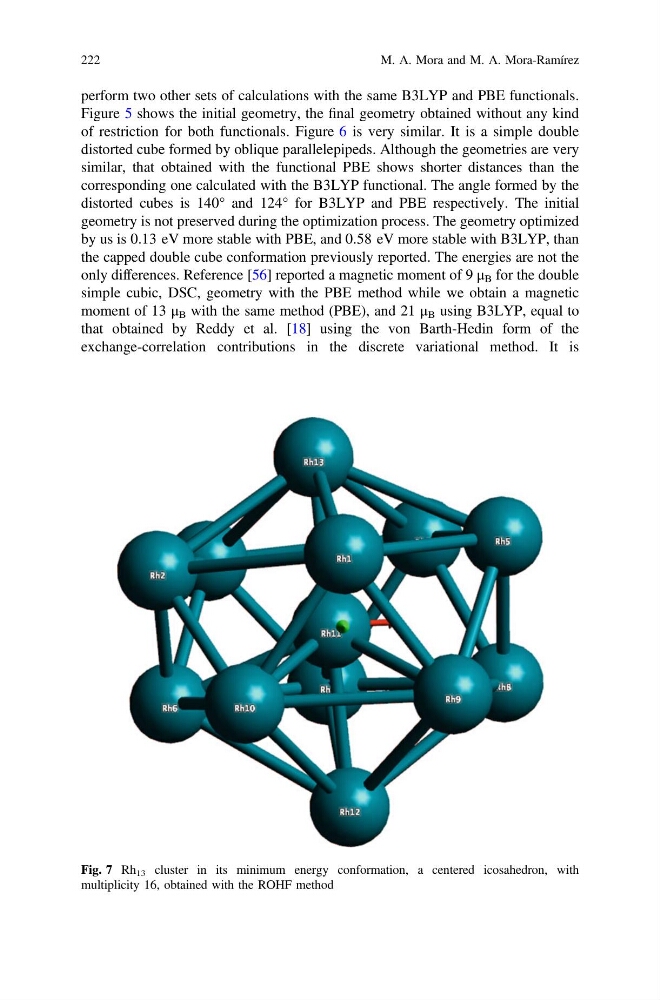
Fig. 7 Rh 13 cluster in its minimum energy conformation, a centered icosahedron, with
multiplicity 16, obtained with the ROHF method
222
M. A. Mora and M. A. Mora-Ramírez
Figure 5 shows the initial geometry, the final geometry obtained without any kind
of restriction for both functionals. Figure 6 is very similar. It is a simple double
distorted cube formed by oblique parallelepipeds. Although the geometries are very
similar, that obtained with the functional PBE shows shorter distances than the
corresponding one calculated with the B3LYP functional. The angle formed by the
distorted cubes is 140° and 124° for B3LYP and PBE respectively. The initial
geometry is not preserved during the optimization process. The geometry optimized
by us is 0.13 eV more stable with PBE, and 0.58 eV more stable with B3LYP, than
the capped double cube conformation previously reported. The energies are not the
only differences. Reference [56] reported a magnetic moment of 9 μ B for the double
simple cubic, DSC, geometry with the PBE method while we obtain a magnetic
moment of 13 μ B with the same method (PBE), and 21 μ B using B3LYP, equal to
that obtained by Reddy et al. [18] using the von Barth-Hedin form of the
exchange-correlation contributions in the discrete variational method. It is
Fig. 7 Rh 13 cluster in its minimum energy conformation, a centered icosahedron, with
multiplicity 16, obtained with the ROHF method
222
M. A. Mora and M. A. Mora-Ramírez