

hydronium protonated a different oxygen, resulting in fragmentation of the borate
molecule to form an interacting boric acid and a water dimer. Attempts to optimize
an ion pair structure at the nine levels investigated invariably led to boric acid
interacting with a water dimer. A typical pattern observed is that of protonation,
followed by detachment, and in some cases rotation of the OH group from a C s #2
boric acid to form C 3h boric acid. If such an ion pair exists, more water molecules
would be needed to stabilize it. There can be no enthalpic barrier in the absence of
additional water molecules.
3.7 The Dissociation of Borate, B(OH) 4
−
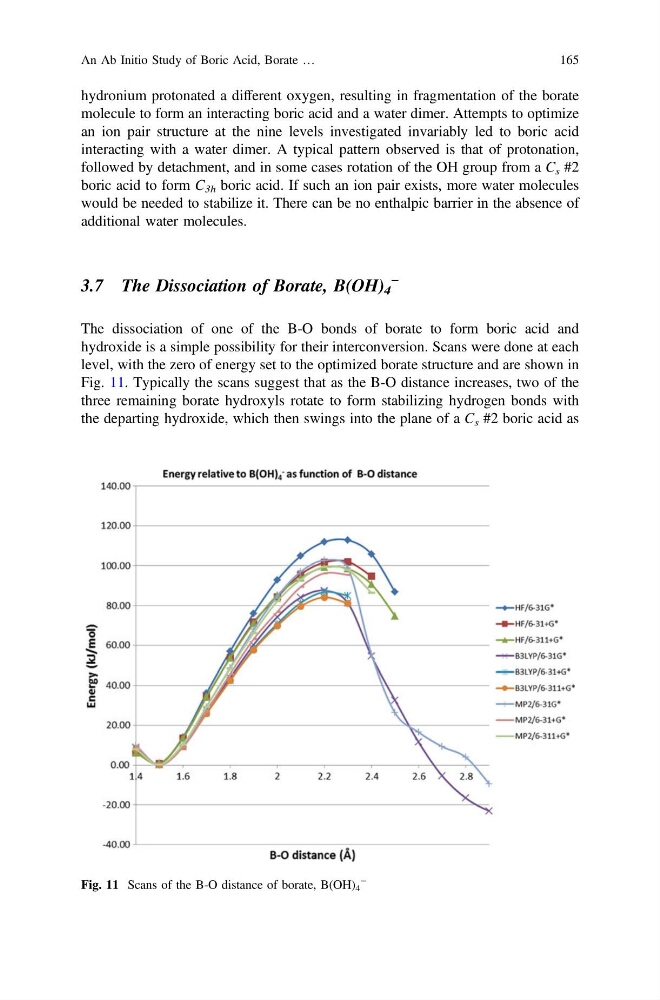
The dissociation of one of the B-O bonds of borate to form boric acid and
hydroxide is a simple possibility for their interconversion. Scans were done at each
level, with the zero of energy set to the optimized borate structure and are shown in
Fig. 11. Typically the scans suggest that as the B-O distance increases, two of the
three remaining borate hydroxyls rotate to form stabilizing hydrogen bonds with
the departing hydroxide, which then swings into the plane of a C s #2 boric acid as
Fig. 11 Scans of the B-O distance of borate, B(OH) 4
−
An Ab Initio Study of Boric Acid, Borate …
165
molecule to form an interacting boric acid and a water dimer. Attempts to optimize
an ion pair structure at the nine levels investigated invariably led to boric acid
interacting with a water dimer. A typical pattern observed is that of protonation,
followed by detachment, and in some cases rotation of the OH group from a C s #2
boric acid to form C 3h boric acid. If such an ion pair exists, more water molecules
would be needed to stabilize it. There can be no enthalpic barrier in the absence of
additional water molecules.
3.7 The Dissociation of Borate, B(OH) 4
−
The dissociation of one of the B-O bonds of borate to form boric acid and
hydroxide is a simple possibility for their interconversion. Scans were done at each
level, with the zero of energy set to the optimized borate structure and are shown in
Fig. 11. Typically the scans suggest that as the B-O distance increases, two of the
three remaining borate hydroxyls rotate to form stabilizing hydrogen bonds with
the departing hydroxide, which then swings into the plane of a C s #2 boric acid as
Fig. 11 Scans of the B-O distance of borate, B(OH) 4
−
An Ab Initio Study of Boric Acid, Borate …
165