

the transition state is passed. However, for the B3LYP/6-31G* and MP2/6-31G*
scans, which proceeded farther than the others, the hydroxide abstracted a proton
from boric acid to give BO(OH) 2
− + H 2 O. This suggested the need to explore the
relative energies of hydrated BO(OH) 2
− and of the boric acid-hydroxide complex.
3.8 Oxodihydroxoborate and Its Hydrates,
BO(OH) 2
−
⋅ nH 2 O
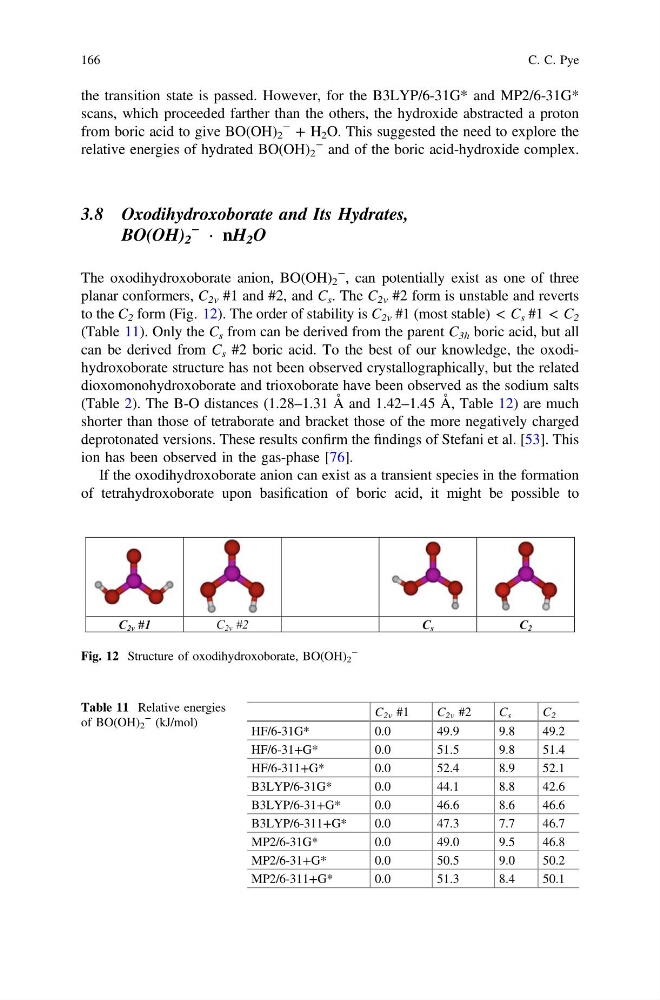
The oxodihydroxoborate anion, BO(OH) 2
−
, can potentially exist as one of three
planar conformers, C 2v #1 and #2, and C s . The C 2v #2 form is unstable and reverts
to the C 2 form (Fig. 12). The order of stability is C 2v #1 (most stable) < C s #1 < C 2
(Table 11). Only the C s from can be derived from the parent C 3h boric acid, but all
can be derived from C s #2 boric acid. To the best of our knowledge, the oxodihydroxoborate structure has not been observed crystallographically, but the related
dioxomonohydroxoborate and trioxoborate have been observed as the sodium salts
(Table 2). The B-O distances (1.28–1.31 Å and 1.42–1.45 Å, Table 12) are much
shorter than those of tetraborate and bracket those of the more negatively charged
deprotonated versions. These results confirm the findings of Stefani et al. [53]. This
ion has been observed in the gas-phase [76].
If the oxodihydroxoborate anion can exist as a transient species in the formation
of tetrahydroxoborate upon basification of boric acid, it might be possible to
C 2v #1
C 2v #2
C s
C 2
Fig. 12 Structure of oxodihydroxoborate, BO(OH) 2
−
Table 11 Relative energies
of BO(OH) 2
− (kJ/mol)
C 2v #1
C 2v #2
C s
C 2
HF/6-31G*
0.0
49.9
9.8
49.2
HF/6-31+G*
0.0
51.5
9.8
51.4
HF/6-311+G*
0.0
52.4
8.9
52.1
B3LYP/6-31G*
0.0
44.1
8.8
42.6
B3LYP/6-31+G*
0.0
46.6
8.6
46.6
B3LYP/6-311+G*
0.0
47.3
7.7
46.7
MP2/6-31G*
0.0
49.0
9.5
46.8
MP2/6-31+G*
0.0
50.5
9.0
50.2
MP2/6-311+G*
0.0
51.3
8.4
50.1
166
C. C. Pye
scans, which proceeded farther than the others, the hydroxide abstracted a proton
from boric acid to give BO(OH) 2
− + H 2 O. This suggested the need to explore the
relative energies of hydrated BO(OH) 2
− and of the boric acid-hydroxide complex.
3.8 Oxodihydroxoborate and Its Hydrates,
BO(OH) 2
−
⋅ nH 2 O
The oxodihydroxoborate anion, BO(OH) 2
−
, can potentially exist as one of three
planar conformers, C 2v #1 and #2, and C s . The C 2v #2 form is unstable and reverts
to the C 2 form (Fig. 12). The order of stability is C 2v #1 (most stable) < C s #1 < C 2
(Table 11). Only the C s from can be derived from the parent C 3h boric acid, but all
can be derived from C s #2 boric acid. To the best of our knowledge, the oxodihydroxoborate structure has not been observed crystallographically, but the related
dioxomonohydroxoborate and trioxoborate have been observed as the sodium salts
(Table 2). The B-O distances (1.28–1.31 Å and 1.42–1.45 Å, Table 12) are much
shorter than those of tetraborate and bracket those of the more negatively charged
deprotonated versions. These results confirm the findings of Stefani et al. [53]. This
ion has been observed in the gas-phase [76].
If the oxodihydroxoborate anion can exist as a transient species in the formation
of tetrahydroxoborate upon basification of boric acid, it might be possible to
C 2v #1
C 2v #2
C s
C 2
Fig. 12 Structure of oxodihydroxoborate, BO(OH) 2
−
Table 11 Relative energies
of BO(OH) 2
− (kJ/mol)
C 2v #1
C 2v #2
C s
C 2
HF/6-31G*
0.0
49.9
9.8
49.2
HF/6-31+G*
0.0
51.5
9.8
51.4
HF/6-311+G*
0.0
52.4
8.9
52.1
B3LYP/6-31G*
0.0
44.1
8.8
42.6
B3LYP/6-31+G*
0.0
46.6
8.6
46.6
B3LYP/6-311+G*
0.0
47.3
7.7
46.7
MP2/6-31G*
0.0
49.0
9.5
46.8
MP2/6-31+G*
0.0
50.5
9.0
50.2
MP2/6-311+G*
0.0
51.3
8.4
50.1
166
C. C. Pye