

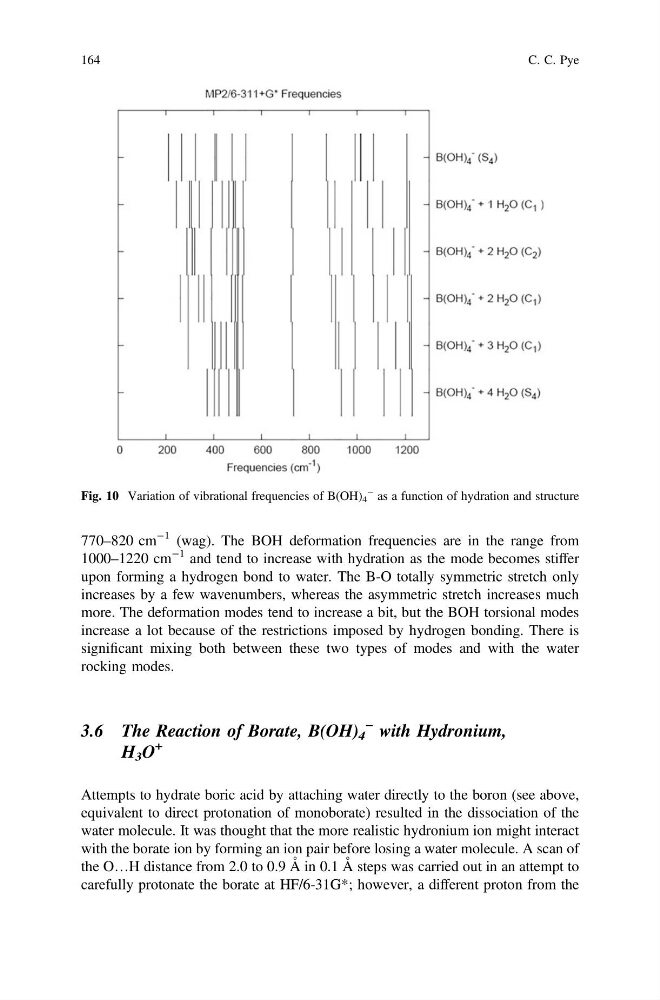
770–820 cm
−1 (wag). The BOH deformation frequencies are in the range from
1000–1220 cm
−1 and tend to increase with hydration as the mode becomes stiffer
upon forming a hydrogen bond to water. The B-O totally symmetric stretch only
increases by a few wavenumbers, whereas the asymmetric stretch increases much
more. The deformation modes tend to increase a bit, but the BOH torsional modes
increase a lot because of the restrictions imposed by hydrogen bonding. There is
significant mixing both between these two types of modes and with the water
rocking modes.
3.6 The Reaction of Borate, B(OH) 4
− with Hydronium,
H 3 O
+
Attempts to hydrate boric acid by attaching water directly to the boron (see above,
equivalent to direct protonation of monoborate) resulted in the dissociation of the
water molecule. It was thought that the more realistic hydronium ion might interact
with the borate ion by forming an ion pair before losing a water molecule. A scan of
the O…H distance from 2.0 to 0.9 Å in 0.1 Å steps was carried out in an attempt to
carefully protonate the borate at HF/6-31G*; however, a different proton from the
Fig. 10 Variation of vibrational frequencies of B(OH) 4
− as a function of hydration and structure
164
C. C. Pye
−1 (wag). The BOH deformation frequencies are in the range from
1000–1220 cm
−1 and tend to increase with hydration as the mode becomes stiffer
upon forming a hydrogen bond to water. The B-O totally symmetric stretch only
increases by a few wavenumbers, whereas the asymmetric stretch increases much
more. The deformation modes tend to increase a bit, but the BOH torsional modes
increase a lot because of the restrictions imposed by hydrogen bonding. There is
significant mixing both between these two types of modes and with the water
rocking modes.
3.6 The Reaction of Borate, B(OH) 4
− with Hydronium,
H 3 O
+
Attempts to hydrate boric acid by attaching water directly to the boron (see above,
equivalent to direct protonation of monoborate) resulted in the dissociation of the
water molecule. It was thought that the more realistic hydronium ion might interact
with the borate ion by forming an ion pair before losing a water molecule. A scan of
the O…H distance from 2.0 to 0.9 Å in 0.1 Å steps was carried out in an attempt to
carefully protonate the borate at HF/6-31G*; however, a different proton from the
Fig. 10 Variation of vibrational frequencies of B(OH) 4
− as a function of hydration and structure
164
C. C. Pye