

MP2/6-311+G* levels, but reverts to C 1 #1a by forming a hydrogen bond between
the DD and AA water molecules. This structure also exists at the other levels.
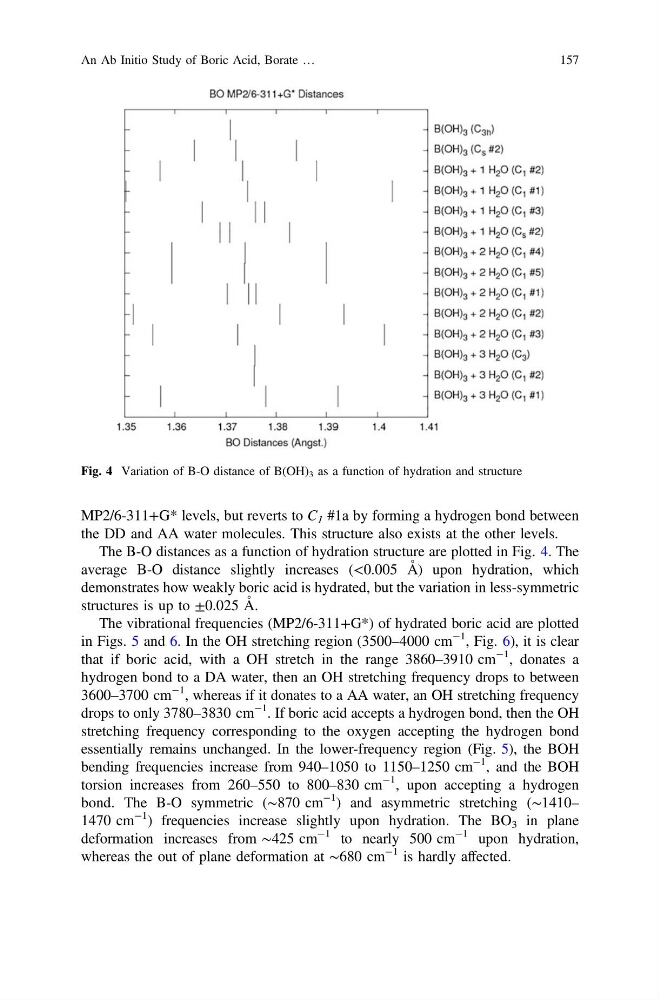
The B-O distances as a function of hydration structure are plotted in Fig. 4. The
average B-O distance slightly increases (<0.005 Å) upon hydration, which
demonstrates how weakly boric acid is hydrated, but the variation in less-symmetric
structures is up to ±0.025 Å.
The vibrational frequencies (MP2/6-311+G*) of hydrated boric acid are plotted
in Figs. 5 and 6. In the OH stretching region (3500–4000 cm
−1 , Fig. 6), it is clear
that if boric acid, with a OH stretch in the range 3860–3910 cm
−1 , donates a
hydrogen bond to a DA water, then an OH stretching frequency drops to between
3600–3700 cm
−1 , whereas if it donates to a AA water, an OH stretching frequency
drops to only 3780–3830 cm
−1 . If boric acid accepts a hydrogen bond, then the OH
stretching frequency corresponding to the oxygen accepting the hydrogen bond
essentially remains unchanged. In the lower-frequency region (Fig. 5), the BOH
bending frequencies increase from 940–1050 to 1150–1250 cm
−1 , and the BOH
torsion increases from 260–550 to 800–830 cm
−1 , upon accepting a hydrogen
bond. The B-O symmetric (∼870 cm
−1 ) and asymmetric stretching (∼1410–
1470 cm
−1 ) frequencies increase slightly upon hydration. The BO 3 in plane
deformation increases from ∼425 cm
−1 to nearly 500 cm
−1 upon hydration,
whereas the out of plane deformation at ∼680 cm
−1 is hardly affected.
Fig. 4 Variation of B-O distance of B(OH) 3 as a function of hydration and structure
An Ab Initio Study of Boric Acid, Borate …
157
the DD and AA water molecules. This structure also exists at the other levels.
The B-O distances as a function of hydration structure are plotted in Fig. 4. The
average B-O distance slightly increases (<0.005 Å) upon hydration, which
demonstrates how weakly boric acid is hydrated, but the variation in less-symmetric
structures is up to ±0.025 Å.
The vibrational frequencies (MP2/6-311+G*) of hydrated boric acid are plotted
in Figs. 5 and 6. In the OH stretching region (3500–4000 cm
−1 , Fig. 6), it is clear
that if boric acid, with a OH stretch in the range 3860–3910 cm
−1 , donates a
hydrogen bond to a DA water, then an OH stretching frequency drops to between
3600–3700 cm
−1 , whereas if it donates to a AA water, an OH stretching frequency
drops to only 3780–3830 cm
−1 . If boric acid accepts a hydrogen bond, then the OH
stretching frequency corresponding to the oxygen accepting the hydrogen bond
essentially remains unchanged. In the lower-frequency region (Fig. 5), the BOH
bending frequencies increase from 940–1050 to 1150–1250 cm
−1 , and the BOH
torsion increases from 260–550 to 800–830 cm
−1 , upon accepting a hydrogen
bond. The B-O symmetric (∼870 cm
−1 ) and asymmetric stretching (∼1410–
1470 cm
−1 ) frequencies increase slightly upon hydration. The BO 3 in plane
deformation increases from ∼425 cm
−1 to nearly 500 cm
−1 upon hydration,
whereas the out of plane deformation at ∼680 cm
−1 is hardly affected.
Fig. 4 Variation of B-O distance of B(OH) 3 as a function of hydration and structure
An Ab Initio Study of Boric Acid, Borate …
157