

Our approach to hydration of boric acid is to solvate the boric acid molecule as
completely as possible with a small number of water molecules in order to efficiently model the vibrational spectra. Of course, water molecules might prefer to
hydrogen-bond to other water molecules instead of to boric acid. This work is
therefore somewhat complementary to that of Tachikawa [52], who studied similar
clusters with up to five water molecules and found several in which water molecules
were hydrogen bonded to each other.
3.4 Borate, B(OH) 4
−
Five forms of monoborate were investigated (Fig. 7). Two of these (D 2d #2 or S 4 #3,
and S 4 #1) were minima, with the S 4 #1 structure being lower in energy by 7–10 kJ/mol
at the Hartree-Fock levels (Table 8). The D 2d #2 is only a minimum at the Hartree-Fock
levels. We confirm the presence of a second shallow minimum (S 4 #3) at the correlated
levels, as first found by Stefani et al. [53] The S 4 #2 structure is a transition state that
connects the D 2d #2/S 4 #3 and S 4 #1 structures. It is 2–3 kJ/mol higher in energy than
D 2d #2. A D 2 structure, derived from D 2d #1, ascended in symmetry to give the D 2d #2
structure at all levels.
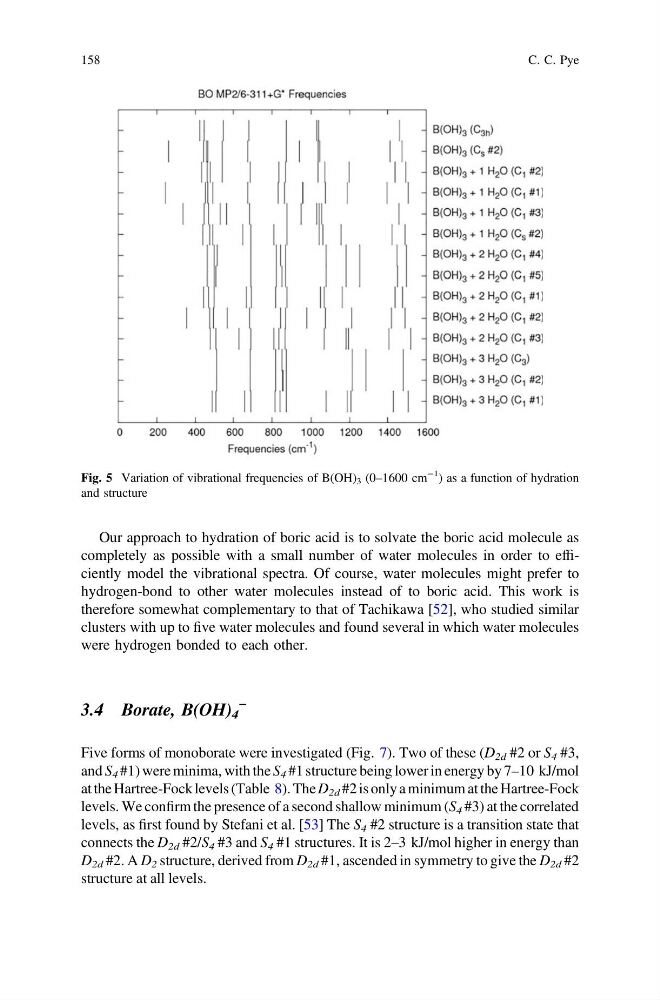
Fig. 5 Variation of vibrational frequencies of B(OH) 3 (0–1600 cm
−1
) as a function of hydration
and structure
158
C. C. Pye
completely as possible with a small number of water molecules in order to efficiently model the vibrational spectra. Of course, water molecules might prefer to
hydrogen-bond to other water molecules instead of to boric acid. This work is
therefore somewhat complementary to that of Tachikawa [52], who studied similar
clusters with up to five water molecules and found several in which water molecules
were hydrogen bonded to each other.
3.4 Borate, B(OH) 4
−
Five forms of monoborate were investigated (Fig. 7). Two of these (D 2d #2 or S 4 #3,
and S 4 #1) were minima, with the S 4 #1 structure being lower in energy by 7–10 kJ/mol
at the Hartree-Fock levels (Table 8). The D 2d #2 is only a minimum at the Hartree-Fock
levels. We confirm the presence of a second shallow minimum (S 4 #3) at the correlated
levels, as first found by Stefani et al. [53] The S 4 #2 structure is a transition state that
connects the D 2d #2/S 4 #3 and S 4 #1 structures. It is 2–3 kJ/mol higher in energy than
D 2d #2. A D 2 structure, derived from D 2d #1, ascended in symmetry to give the D 2d #2
structure at all levels.
Fig. 5 Variation of vibrational frequencies of B(OH) 3 (0–1600 cm
−1
) as a function of hydration
and structure
158
C. C. Pye