

B3LYP/6-31+G*, B3LYP/6-311+G*, and MP2/6-31+G* levels but reverted to a
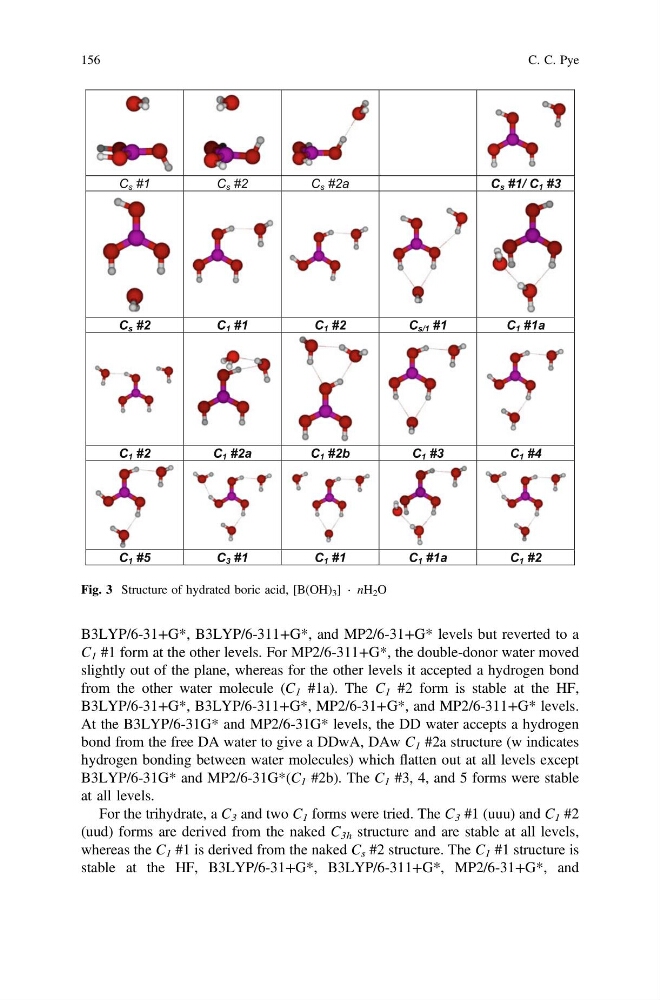
C 1 #1 form at the other levels. For MP2/6-311+G*, the double-donor water moved
slightly out of the plane, whereas for the other levels it accepted a hydrogen bond
from the other water molecule (C 1 #1a). The C 1 #2 form is stable at the HF,
B3LYP/6-31+G*, B3LYP/6-311+G*, MP2/6-31+G*, and MP2/6-311+G* levels.
At the B3LYP/6-31G* and MP2/6-31G* levels, the DD water accepts a hydrogen
bond from the free DA water to give a DDwA, DAw C 1 #2a structure (w indicates
hydrogen bonding between water molecules) which flatten out at all levels except
B3LYP/6-31G* and MP2/6-31G*(C 1 #2b). The C 1 #3, 4, and 5 forms were stable
at all levels.
For the trihydrate, a C 3 and two C 1 forms were tried. The C 3 #1 (uuu) and C 1 #2
(uud) forms are derived from the naked C 3h structure and are stable at all levels,
whereas the C 1 #1 is derived from the naked C s #2 structure. The C 1 #1 structure is
stable at the HF, B3LYP/6-31+G*, B3LYP/6-311+G*, MP2/6-31+G*, and
C s #1
C s #2
C s #2a
C s #1/ C 1 #3
C s #2
C 1 #1
C 1 #2
C s/1 #1
C 1 #1a
C 1 #2
C 1 #2a
C 1 #2b
C 1 #3
C 1 #4
C 1 #5
C 3 #1
C 1 #1
C 1 #1a
C 1 #2
Fig. 3 Structure of hydrated boric acid, [B(OH) 3 ] ⋅ nH 2 O
156
C. C. Pye
C 1 #1 form at the other levels. For MP2/6-311+G*, the double-donor water moved
slightly out of the plane, whereas for the other levels it accepted a hydrogen bond
from the other water molecule (C 1 #1a). The C 1 #2 form is stable at the HF,
B3LYP/6-31+G*, B3LYP/6-311+G*, MP2/6-31+G*, and MP2/6-311+G* levels.
At the B3LYP/6-31G* and MP2/6-31G* levels, the DD water accepts a hydrogen
bond from the free DA water to give a DDwA, DAw C 1 #2a structure (w indicates
hydrogen bonding between water molecules) which flatten out at all levels except
B3LYP/6-31G* and MP2/6-31G*(C 1 #2b). The C 1 #3, 4, and 5 forms were stable
at all levels.
For the trihydrate, a C 3 and two C 1 forms were tried. The C 3 #1 (uuu) and C 1 #2
(uud) forms are derived from the naked C 3h structure and are stable at all levels,
whereas the C 1 #1 is derived from the naked C s #2 structure. The C 1 #1 structure is
stable at the HF, B3LYP/6-31+G*, B3LYP/6-311+G*, MP2/6-31+G*, and
C s #1
C s #2
C s #2a
C s #1/ C 1 #3
C s #2
C 1 #1
C 1 #2
C s/1 #1
C 1 #1a
C 1 #2
C 1 #2a
C 1 #2b
C 1 #3
C 1 #4
C 1 #5
C 3 #1
C 1 #1
C 1 #1a
C 1 #2
Fig. 3 Structure of hydrated boric acid, [B(OH) 3 ] ⋅ nH 2 O
156
C. C. Pye