

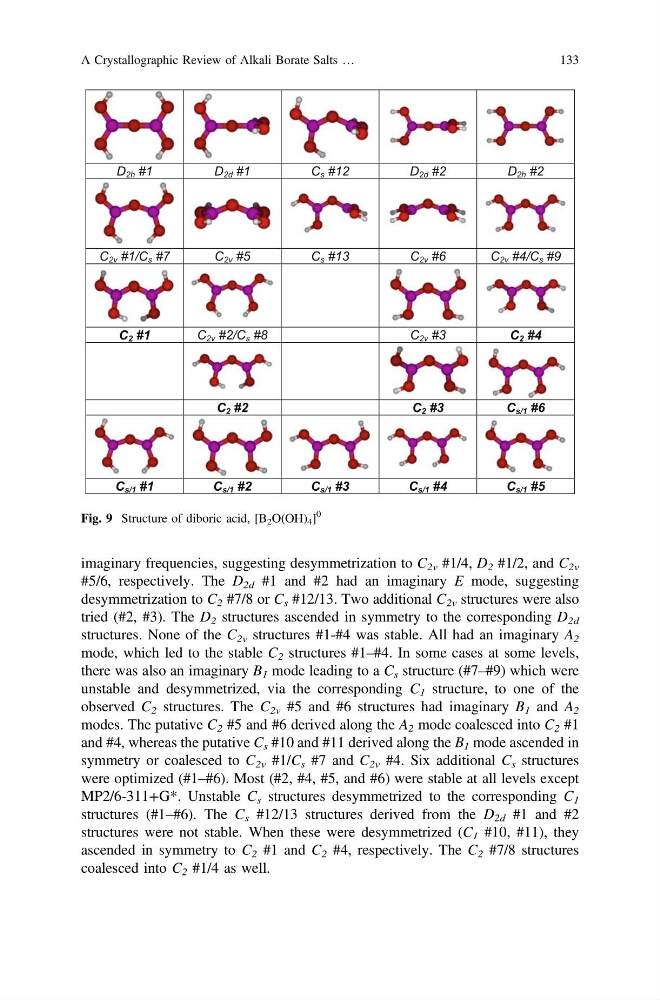
imaginary frequencies, suggesting desymmetrization to C 2v #1/4, D 2 #1/2, and C 2v
#5/6, respectively. The D 2d #1 and #2 had an imaginary E mode, suggesting
desymmetrization to C 2 #7/8 or C s #12/13. Two additional C 2v structures were also
tried (#2, #3). The D 2 structures ascended in symmetry to the corresponding D 2d
structures. None of the C 2v structures #1-#4 was stable. All had an imaginary A 2
mode, which led to the stable C 2 structures #1–#4. In some cases at some levels,
there was also an imaginary B 1 mode leading to a C s structure (#7–#9) which were
unstable and desymmetrized, via the corresponding C 1 structure, to one of the
observed C 2 structures. The C 2v #5 and #6 structures had imaginary B 1 and A 2
modes. The putative C 2 #5 and #6 derived along the A 2 mode coalesced into C 2 #1
and #4, whereas the putative C s #10 and #11 derived along the B 1 mode ascended in
symmetry or coalesced to C 2v #1/C s #7 and C 2v #4. Six additional C s structures
were optimized (#1–#6). Most (#2, #4, #5, and #6) were stable at all levels except
MP2/6-311+G*. Unstable C s structures desymmetrized to the corresponding C 1
structures (#1–#6). The C s #12/13 structures derived from the D 2d #1 and #2
structures were not stable. When these were desymmetrized (C 1 #10, #11), they
ascended in symmetry to C 2 #1 and C 2 #4, respectively. The C 2 #7/8 structures
coalesced into C 2 #1/4 as well.
D 2h #1
D 2d #1
C s #12
D 2d #2
D 2h #2
C 2v #1/C s #7
C 2v #5
C s #13
C 2v #6
C 2v #4/C s #9
C 2 #1
C 2v #2/C s
C
8
#
2v #3
C 2 #4
C 2
C
2
#
2 #3
C s/1 #6
C s/1 #1
C s/1 #2
C s/1 #3
C s/1 #4
C s/1 #5
Fig. 9 Structure of diboric acid, [B 2 O(OH) 4 ]
0
A Crystallographic Review of Alkali Borate Salts …
133
#5/6, respectively. The D 2d #1 and #2 had an imaginary E mode, suggesting
desymmetrization to C 2 #7/8 or C s #12/13. Two additional C 2v structures were also
tried (#2, #3). The D 2 structures ascended in symmetry to the corresponding D 2d
structures. None of the C 2v structures #1-#4 was stable. All had an imaginary A 2
mode, which led to the stable C 2 structures #1–#4. In some cases at some levels,
there was also an imaginary B 1 mode leading to a C s structure (#7–#9) which were
unstable and desymmetrized, via the corresponding C 1 structure, to one of the
observed C 2 structures. The C 2v #5 and #6 structures had imaginary B 1 and A 2
modes. The putative C 2 #5 and #6 derived along the A 2 mode coalesced into C 2 #1
and #4, whereas the putative C s #10 and #11 derived along the B 1 mode ascended in
symmetry or coalesced to C 2v #1/C s #7 and C 2v #4. Six additional C s structures
were optimized (#1–#6). Most (#2, #4, #5, and #6) were stable at all levels except
MP2/6-311+G*. Unstable C s structures desymmetrized to the corresponding C 1
structures (#1–#6). The C s #12/13 structures derived from the D 2d #1 and #2
structures were not stable. When these were desymmetrized (C 1 #10, #11), they
ascended in symmetry to C 2 #1 and C 2 #4, respectively. The C 2 #7/8 structures
coalesced into C 2 #1/4 as well.
D 2h #1
D 2d #1
C s #12
D 2d #2
D 2h #2
C 2v #1/C s #7
C 2v #5
C s #13
C 2v #6
C 2v #4/C s #9
C 2 #1
C 2v #2/C s
C
8
#
2v #3
C 2 #4
C 2
C
2
#
2 #3
C s/1 #6
C s/1 #1
C s/1 #2
C s/1 #3
C s/1 #4
C s/1 #5
Fig. 9 Structure of diboric acid, [B 2 O(OH) 4 ]
0
A Crystallographic Review of Alkali Borate Salts …
133