

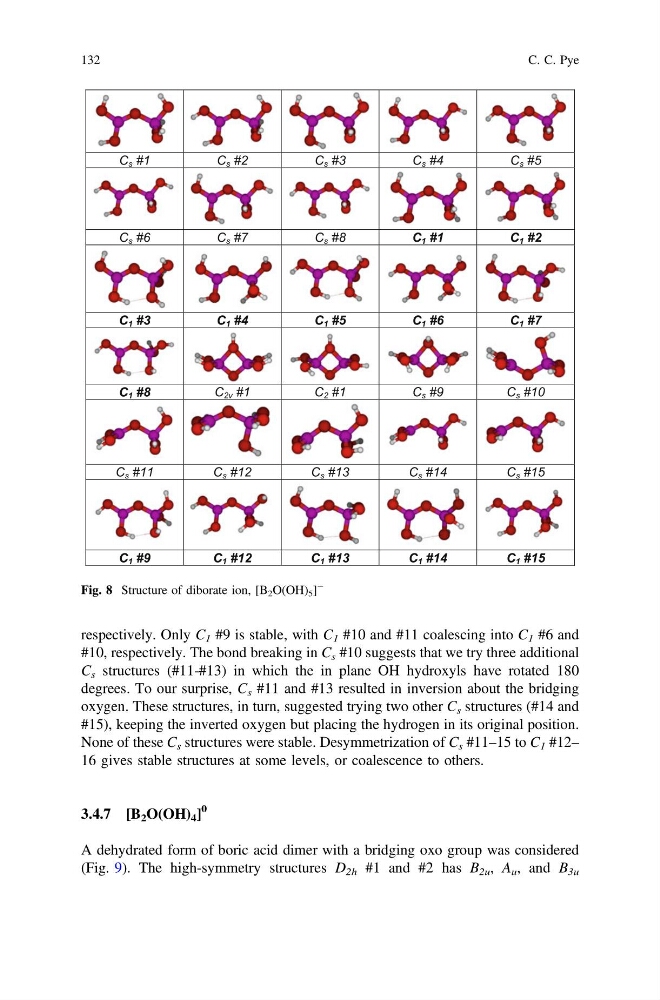
respectively. Only C 1 #9 is stable, with C 1 #10 and #11 coalescing into C 1 #6 and
#10, respectively. The bond breaking in C s #10 suggests that we try three additional
C s structures (#11-#13) in which the in plane OH hydroxyls have rotated 180
degrees. To our surprise, C s #11 and #13 resulted in inversion about the bridging
oxygen. These structures, in turn, suggested trying two other C s structures (#14 and
#15), keeping the inverted oxygen but placing the hydrogen in its original position.
None of these C s structures were stable. Desymmetrization of C s #11–15 to C 1 #12–
16 gives stable structures at some levels, or coalescence to others.
3.4.7 [B 2 O(OH) 4 ]
0
A dehydrated form of boric acid dimer with a bridging oxo group was considered
(Fig. 9). The high-symmetry structures D 2h #1 and #2 has B 2u , A u , and B 3u
C s #1
C s #2
C s #3
C s #4
C s #5
C s #6
C s #7
C s #8
C 1 #1
C 1 #2
C 1 #3
C 1 #4
C 1 #5
C 1 #6
C 1 #7
C 1 #8
C 2v #1
C 2 #1
C s #9
C s #10
C s #11
C s #12
C s #13
C s #14
C s #15
C 1 #9
C 1 #12
C 1 #13
C 1 #14
C 1 #15
Fig. 8 Structure of diborate ion, [B 2 O(OH) 5 ]
−
132
C. C. Pye
#10, respectively. The bond breaking in C s #10 suggests that we try three additional
C s structures (#11-#13) in which the in plane OH hydroxyls have rotated 180
degrees. To our surprise, C s #11 and #13 resulted in inversion about the bridging
oxygen. These structures, in turn, suggested trying two other C s structures (#14 and
#15), keeping the inverted oxygen but placing the hydrogen in its original position.
None of these C s structures were stable. Desymmetrization of C s #11–15 to C 1 #12–
16 gives stable structures at some levels, or coalescence to others.
3.4.7 [B 2 O(OH) 4 ]
0
A dehydrated form of boric acid dimer with a bridging oxo group was considered
(Fig. 9). The high-symmetry structures D 2h #1 and #2 has B 2u , A u , and B 3u
C s #1
C s #2
C s #3
C s #4
C s #5
C s #6
C s #7
C s #8
C 1 #1
C 1 #2
C 1 #3
C 1 #4
C 1 #5
C 1 #6
C 1 #7
C 1 #8
C 2v #1
C 2 #1
C s #9
C s #10
C s #11
C s #12
C s #13
C s #14
C s #15
C 1 #9
C 1 #12
C 1 #13
C 1 #14
C 1 #15
Fig. 8 Structure of diborate ion, [B 2 O(OH) 5 ]
−
132
C. C. Pye