

3.4.5 [B 2 O(OH) 6 ]
2−
The diborate ion [B 2 O(OH) 6 ]
2− has been observed as the magnesium salt in the
mineral pinnoite. Stadler found that the space group of pinnoite was P4 2 or P4 2 /m,
with a = 7.617(2) and c = 8.190(2), and proposed that the ion was [B 2 O(OH) 6 ]
2−
[102]. The space group was confirmed as P4 2 (a = 7.62(1), c = 8.19(1) by Paton
and MacDonald and the structure of the ion confirmed [103]. The structure was
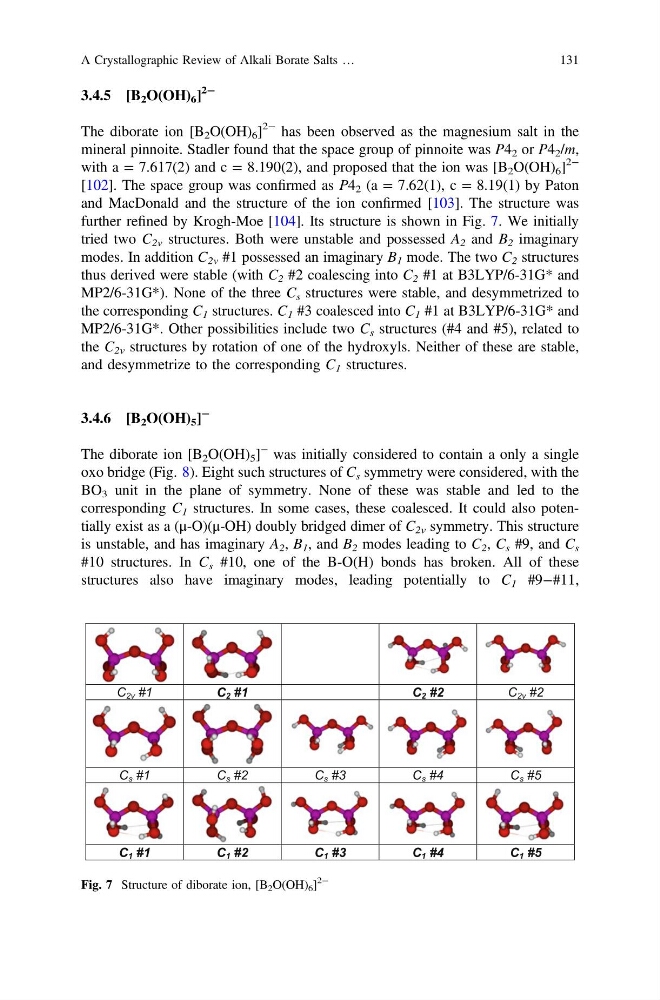
further refined by Krogh-Moe [104]. Its structure is shown in Fig. 7. We initially
tried two C 2v structures. Both were unstable and possessed A 2 and B 2 imaginary
modes. In addition C 2v #1 possessed an imaginary B 1 mode. The two C 2 structures
thus derived were stable (with C 2 #2 coalescing into C 2 #1 at B3LYP/6-31G* and
MP2/6-31G*). None of the three C s structures were stable, and desymmetrized to
the corresponding C 1 structures. C 1 #3 coalesced into C 1 #1 at B3LYP/6-31G* and
MP2/6-31G*. Other possibilities include two C s structures (#4 and #5), related to
the C 2v structures by rotation of one of the hydroxyls. Neither of these are stable,
and desymmetrize to the corresponding C 1 structures.
3.4.6 [B 2 O(OH) 5 ]
−
The diborate ion [B 2 O(OH) 5 ]
− was initially considered to contain a only a single
oxo bridge (Fig. 8). Eight such structures of C s symmetry were considered, with the
BO 3 unit in the plane of symmetry. None of these was stable and led to the
corresponding C 1 structures. In some cases, these coalesced. It could also potentially exist as a (μ-O)(μ-OH) doubly bridged dimer of C 2v symmetry. This structure
is unstable, and has imaginary A 2 , B 1 , and B 2 modes leading to C 2 , C s #9, and C s
#10 structures. In C s #10, one of the B-O(H) bonds has broken. All of these
structures also have imaginary modes, leading potentially to C 1 #9−#11,
C 2v #1
C 2
C
1
#
2 #2
C 2v #2
C s #1
C s #2
C s #3
C s #4
C s #5
C 1 #1
C 1 #2
C 1 #3
C 1 #4
C 1 #5
Fig. 7 Structure of diborate ion, [B 2 O(OH) 6 ]
2−
A Crystallographic Review of Alkali Borate Salts …
131
2−
The diborate ion [B 2 O(OH) 6 ]
2− has been observed as the magnesium salt in the
mineral pinnoite. Stadler found that the space group of pinnoite was P4 2 or P4 2 /m,
with a = 7.617(2) and c = 8.190(2), and proposed that the ion was [B 2 O(OH) 6 ]
2−
[102]. The space group was confirmed as P4 2 (a = 7.62(1), c = 8.19(1) by Paton
and MacDonald and the structure of the ion confirmed [103]. The structure was
further refined by Krogh-Moe [104]. Its structure is shown in Fig. 7. We initially
tried two C 2v structures. Both were unstable and possessed A 2 and B 2 imaginary
modes. In addition C 2v #1 possessed an imaginary B 1 mode. The two C 2 structures
thus derived were stable (with C 2 #2 coalescing into C 2 #1 at B3LYP/6-31G* and
MP2/6-31G*). None of the three C s structures were stable, and desymmetrized to
the corresponding C 1 structures. C 1 #3 coalesced into C 1 #1 at B3LYP/6-31G* and
MP2/6-31G*. Other possibilities include two C s structures (#4 and #5), related to
the C 2v structures by rotation of one of the hydroxyls. Neither of these are stable,
and desymmetrize to the corresponding C 1 structures.
3.4.6 [B 2 O(OH) 5 ]
−
The diborate ion [B 2 O(OH) 5 ]
− was initially considered to contain a only a single
oxo bridge (Fig. 8). Eight such structures of C s symmetry were considered, with the
BO 3 unit in the plane of symmetry. None of these was stable and led to the
corresponding C 1 structures. In some cases, these coalesced. It could also potentially exist as a (μ-O)(μ-OH) doubly bridged dimer of C 2v symmetry. This structure
is unstable, and has imaginary A 2 , B 1 , and B 2 modes leading to C 2 , C s #9, and C s
#10 structures. In C s #10, one of the B-O(H) bonds has broken. All of these
structures also have imaginary modes, leading potentially to C 1 #9−#11,
C 2v #1
C 2
C
1
#
2 #2
C 2v #2
C s #1
C s #2
C s #3
C s #4
C s #5
C 1 #1
C 1 #2
C 1 #3
C 1 #4
C 1 #5
Fig. 7 Structure of diborate ion, [B 2 O(OH) 6 ]
2−
A Crystallographic Review of Alkali Borate Salts …
131