

3.4.8 [B 2 O 2 (OH) 4 ]
2–
Structures containing two oxo bridges between the two boron atoms are now
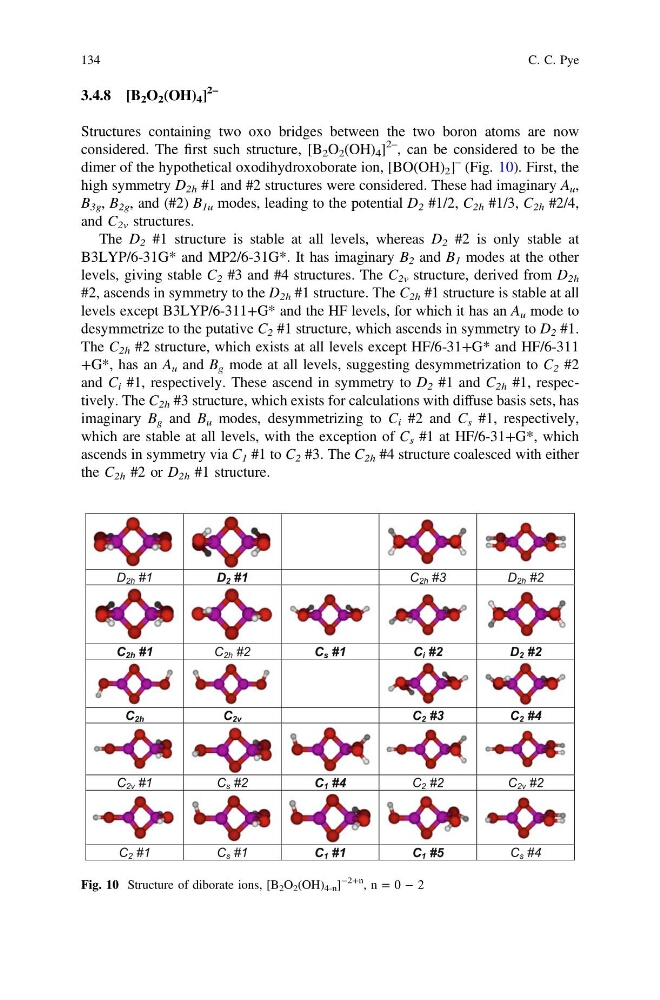
considered. The first such structure, [B 2 O 2 (OH) 4 ]
2– , can be considered to be the
dimer of the hypothetical oxodihydroxoborate ion, [BO(OH) 2 ]
– (Fig. 10). First, the
high symmetry D 2h #1 and #2 structures were considered. These had imaginary A u ,
B 3g , B 2g , and (#2) B 1u modes, leading to the potential D 2 #1/2, C 2h #1/3, C 2h #2/4,
and C 2v structures.
The D 2 #1 structure is stable at all levels, whereas D 2 #2 is only stable at
B3LYP/6-31G* and MP2/6-31G*. It has imaginary B 2 and B 1 modes at the other
levels, giving stable C 2 #3 and #4 structures. The C 2v structure, derived from D 2h
#2, ascends in symmetry to the D 2h #1 structure. The C 2h #1 structure is stable at all
levels except B3LYP/6-311+G* and the HF levels, for which it has an A u mode to
desymmetrize to the putative C 2 #1 structure, which ascends in symmetry to D 2 #1.
The C 2h #2 structure, which exists at all levels except HF/6-31+G* and HF/6-311
+G*, has an A u and B g mode at all levels, suggesting desymmetrization to C 2 #2
and C i #1, respectively. These ascend in symmetry to D 2 #1 and C 2h #1, respectively. The C 2h #3 structure, which exists for calculations with diffuse basis sets, has
imaginary B g and B u modes, desymmetrizing to C i #2 and C s #1, respectively,
which are stable at all levels, with the exception of C s #1 at HF/6-31+G*, which
ascends in symmetry via C 1 #1 to C 2 #3. The C 2h #4 structure coalesced with either
the C 2h #2 or D 2h #1 structure.
D 2h #1
D 2 #1
C 2h #3
D 2h #2
C 2h #1
C 2h #2
C s #1
C i #2
D 2 #2
C 2h
C 2v
C 2 #3
C 2 #4
C 2v #1
C s #2
C 1 #4
C 2 #2
C 2v #2
C 2 #1
C s #1
C 1 #1
C 1 #5
C s #4
Fig. 10 Structure of diborate ions, [B 2 O 2 (OH) 4-n ]
−2+n , n = 0 − 2
134
C. C. Pye
2–
Structures containing two oxo bridges between the two boron atoms are now
considered. The first such structure, [B 2 O 2 (OH) 4 ]
2– , can be considered to be the
dimer of the hypothetical oxodihydroxoborate ion, [BO(OH) 2 ]
– (Fig. 10). First, the
high symmetry D 2h #1 and #2 structures were considered. These had imaginary A u ,
B 3g , B 2g , and (#2) B 1u modes, leading to the potential D 2 #1/2, C 2h #1/3, C 2h #2/4,
and C 2v structures.
The D 2 #1 structure is stable at all levels, whereas D 2 #2 is only stable at
B3LYP/6-31G* and MP2/6-31G*. It has imaginary B 2 and B 1 modes at the other
levels, giving stable C 2 #3 and #4 structures. The C 2v structure, derived from D 2h
#2, ascends in symmetry to the D 2h #1 structure. The C 2h #1 structure is stable at all
levels except B3LYP/6-311+G* and the HF levels, for which it has an A u mode to
desymmetrize to the putative C 2 #1 structure, which ascends in symmetry to D 2 #1.
The C 2h #2 structure, which exists at all levels except HF/6-31+G* and HF/6-311
+G*, has an A u and B g mode at all levels, suggesting desymmetrization to C 2 #2
and C i #1, respectively. These ascend in symmetry to D 2 #1 and C 2h #1, respectively. The C 2h #3 structure, which exists for calculations with diffuse basis sets, has
imaginary B g and B u modes, desymmetrizing to C i #2 and C s #1, respectively,
which are stable at all levels, with the exception of C s #1 at HF/6-31+G*, which
ascends in symmetry via C 1 #1 to C 2 #3. The C 2h #4 structure coalesced with either
the C 2h #2 or D 2h #1 structure.
D 2h #1
D 2 #1
C 2h #3
D 2h #2
C 2h #1
C 2h #2
C s #1
C i #2
D 2 #2
C 2h
C 2v
C 2 #3
C 2 #4
C 2v #1
C s #2
C 1 #4
C 2 #2
C 2v #2
C 2 #1
C s #1
C 1 #1
C 1 #5
C s #4
Fig. 10 Structure of diborate ions, [B 2 O 2 (OH) 4-n ]
−2+n , n = 0 − 2
134
C. C. Pye