

104
M. Senami et al.
-1.0 ×10
-7
-5.0 ×10
-8
0.0 ×10
0
5.0 ×10
-8
1.0 ×10
-7
0
50
100
150
200
250
300
350
chirality density [a.u.]
dihedral angle [degrees]
-4.0× 10
-7
-2.0× 10
-7
0.0 ×10
0
2.0 ×10
-7
4.0 ×10
-7
0
50
100
150
200
250
300
350
chirality density [a.u.]
dihedral angle [degrees]
(a) H2O2
(b) H 2 S 2
-1.0 ×10
-6
-5.0 ×10
-7
0.0 ×10
0
5.0 ×10
-7
1.0 ×10
-6
0
50
100
150
200
250
300
350
chirality density [a.u.]
dihedral angle [degrees]
-2.0 ×10
-5
-1.5 ×10
-5
-1.0 ×10
-5
-5.0× 10
-6
0.0 ×10
0
5.0 ×10
-6
1.0 ×10
-5
1.5 ×10
-5
2.0 ×10
-5
0
50
100
150
200
250
300
350
chirality density [a.u.]
dihedral angle [degrees]
(c) H 2 Se 2
(d) H 2 Te 2
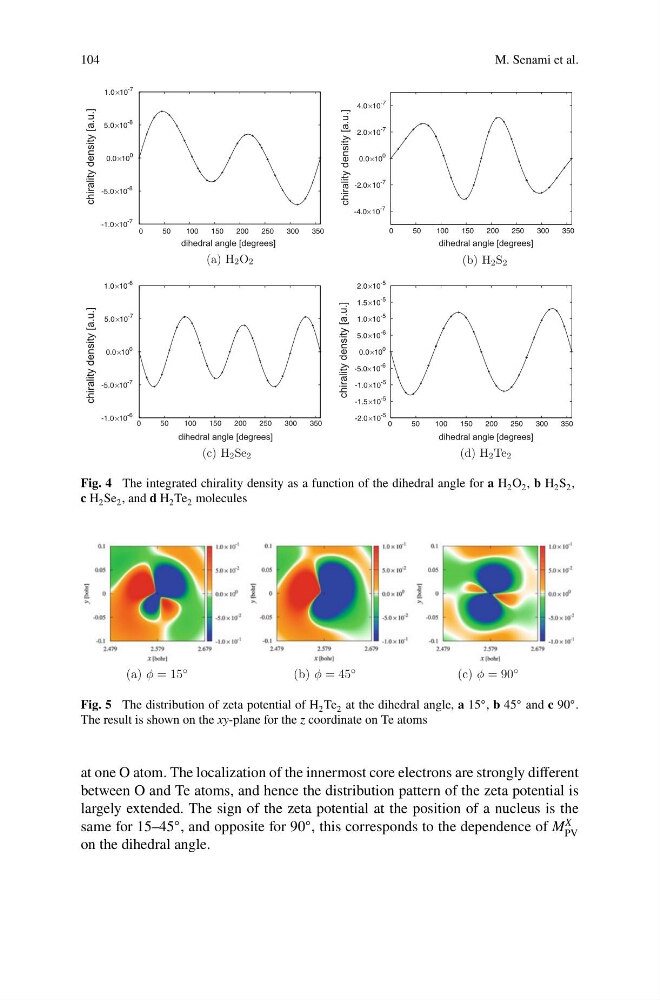
Fig. 4 The integrated chirality density as a function of the dihedral angle for a H 2 O 2 , b H 2 S 2 ,
c H 2 Se 2 , and d H 2 Te 2 molecules
(a) φ = 15 ◦
(b) φ = 45 ◦
(c) φ = 90 ◦
Fig. 5 The distribution of zeta potential of H 2 Te 2 at the dihedral angle, a 15 ◦ , b 45 ◦ and c 90 ◦ .
The result is shown on the xy-plane for the z coordinate on Te atoms
at one O atom. The localization of the innermost core electrons are strongly different
between O and Te atoms, and hence the distribution pattern of the zeta potential is
largely extended. The sign of the zeta potential at the position of a nucleus is the
same for 15–45
◦ , and opposite for 90
◦ , this corresponds to the dependence of M
X
PV
on the dihedral angle.
M. Senami et al.
-1.0 ×10
-7
-5.0 ×10
-8
0.0 ×10
0
5.0 ×10
-8
1.0 ×10
-7
0
50
100
150
200
250
300
350
chirality density [a.u.]
dihedral angle [degrees]
-4.0× 10
-7
-2.0× 10
-7
0.0 ×10
0
2.0 ×10
-7
4.0 ×10
-7
0
50
100
150
200
250
300
350
chirality density [a.u.]
dihedral angle [degrees]
(a) H2O2
(b) H 2 S 2
-1.0 ×10
-6
-5.0 ×10
-7
0.0 ×10
0
5.0 ×10
-7
1.0 ×10
-6
0
50
100
150
200
250
300
350
chirality density [a.u.]
dihedral angle [degrees]
-2.0 ×10
-5
-1.5 ×10
-5
-1.0 ×10
-5
-5.0× 10
-6
0.0 ×10
0
5.0 ×10
-6
1.0 ×10
-5
1.5 ×10
-5
2.0 ×10
-5
0
50
100
150
200
250
300
350
chirality density [a.u.]
dihedral angle [degrees]
(c) H 2 Se 2
(d) H 2 Te 2
Fig. 4 The integrated chirality density as a function of the dihedral angle for a H 2 O 2 , b H 2 S 2 ,
c H 2 Se 2 , and d H 2 Te 2 molecules
(a) φ = 15 ◦
(b) φ = 45 ◦
(c) φ = 90 ◦
Fig. 5 The distribution of zeta potential of H 2 Te 2 at the dihedral angle, a 15 ◦ , b 45 ◦ and c 90 ◦ .
The result is shown on the xy-plane for the z coordinate on Te atoms
at one O atom. The localization of the innermost core electrons are strongly different
between O and Te atoms, and hence the distribution pattern of the zeta potential is
largely extended. The sign of the zeta potential at the position of a nucleus is the
same for 15–45
◦ , and opposite for 90
◦ , this corresponds to the dependence of M
X
PV
on the dihedral angle.