

Difference of Chirality of the Electron Between Enantiomers of H 2 X 2
105
(a) φ = 15 ◦
(b) φ = 45 ◦
(c) φ = 90 ◦
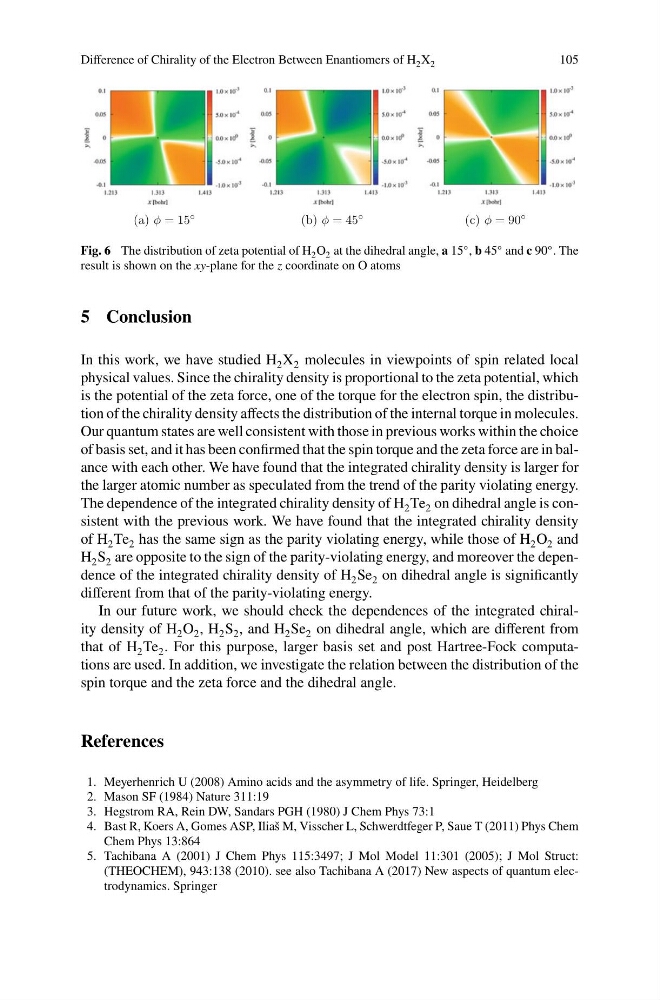
Fig. 6 The distribution of zeta potential of H 2 O 2 at the dihedral angle, a 15 ◦ , b 45 ◦ and c 90 ◦ . The
result is shown on the xy-plane for the z coordinate on O atoms
5 Conclusion
In this work, we have studied H 2 X 2 molecules in viewpoints of spin related local
physical values. Since the chirality density is proportional to the zeta potential, which
is the potential of the zeta force, one of the torque for the electron spin, the distribution of the chirality density affects the distribution of the internal torque in molecules.
Our quantum states are well consistent with those in previous works within the choice
of basis set, and it has been confirmed that the spin torque and the zeta force are in balance with each other. We have found that the integrated chirality density is larger for
the larger atomic number as speculated from the trend of the parity violating energy.
The dependence of the integrated chirality density of H 2 Te 2 on dihedral angle is consistent with the previous work. We have found that the integrated chirality density
of H 2 Te 2 has the same sign as the parity violating energy, while those of H 2 O 2 and
H 2 S 2 are opposite to the sign of the parity-violating energy, and moreover the dependence of the integrated chirality density of H 2 Se 2 on dihedral angle is significantly
different from that of the parity-violating energy.
In our future work, we should check the dependences of the integrated chirality density of H 2 O 2 , H 2 S 2 , and H 2 Se 2 on dihedral angle, which are different from
that of H 2 Te 2 . For this purpose, larger basis set and post Hartree-Fock computations are used. In addition, we investigate the relation between the distribution of the
spin torque and the zeta force and the dihedral angle.
References
1. Meyerhenrich U (2008) Amino acids and the asymmetry of life. Springer, Heidelberg
2. Mason SF (1984) Nature 311:19
3. Hegstrom RA, Rein DW, Sandars PGH (1980) J Chem Phys 73:1
4. Bast R, Koers A, Gomes ASP, Iliaš M, Visscher L, Schwerdtfeger P, Saue T (2011) Phys Chem
Chem Phys 13:864
5. Tachibana A (2001) J Chem Phys 115:3497; J Mol Model 11:301 (2005); J Mol Struct:
(THEOCHEM), 943:138 (2010). see also Tachibana A (2017) New aspects of quantum electrodynamics. Springer
105
(a) φ = 15 ◦
(b) φ = 45 ◦
(c) φ = 90 ◦
Fig. 6 The distribution of zeta potential of H 2 O 2 at the dihedral angle, a 15 ◦ , b 45 ◦ and c 90 ◦ . The
result is shown on the xy-plane for the z coordinate on O atoms
5 Conclusion
In this work, we have studied H 2 X 2 molecules in viewpoints of spin related local
physical values. Since the chirality density is proportional to the zeta potential, which
is the potential of the zeta force, one of the torque for the electron spin, the distribution of the chirality density affects the distribution of the internal torque in molecules.
Our quantum states are well consistent with those in previous works within the choice
of basis set, and it has been confirmed that the spin torque and the zeta force are in balance with each other. We have found that the integrated chirality density is larger for
the larger atomic number as speculated from the trend of the parity violating energy.
The dependence of the integrated chirality density of H 2 Te 2 on dihedral angle is consistent with the previous work. We have found that the integrated chirality density
of H 2 Te 2 has the same sign as the parity violating energy, while those of H 2 O 2 and
H 2 S 2 are opposite to the sign of the parity-violating energy, and moreover the dependence of the integrated chirality density of H 2 Se 2 on dihedral angle is significantly
different from that of the parity-violating energy.
In our future work, we should check the dependences of the integrated chirality density of H 2 O 2 , H 2 S 2 , and H 2 Se 2 on dihedral angle, which are different from
that of H 2 Te 2 . For this purpose, larger basis set and post Hartree-Fock computations are used. In addition, we investigate the relation between the distribution of the
spin torque and the zeta force and the dihedral angle.
References
1. Meyerhenrich U (2008) Amino acids and the asymmetry of life. Springer, Heidelberg
2. Mason SF (1984) Nature 311:19
3. Hegstrom RA, Rein DW, Sandars PGH (1980) J Chem Phys 73:1
4. Bast R, Koers A, Gomes ASP, Iliaš M, Visscher L, Schwerdtfeger P, Saue T (2011) Phys Chem
Chem Phys 13:864
5. Tachibana A (2001) J Chem Phys 115:3497; J Mol Model 11:301 (2005); J Mol Struct:
(THEOCHEM), 943:138 (2010). see also Tachibana A (2017) New aspects of quantum electrodynamics. Springer