

Difference of Chirality of the Electron Between Enantiomers of H 2 X 2
103
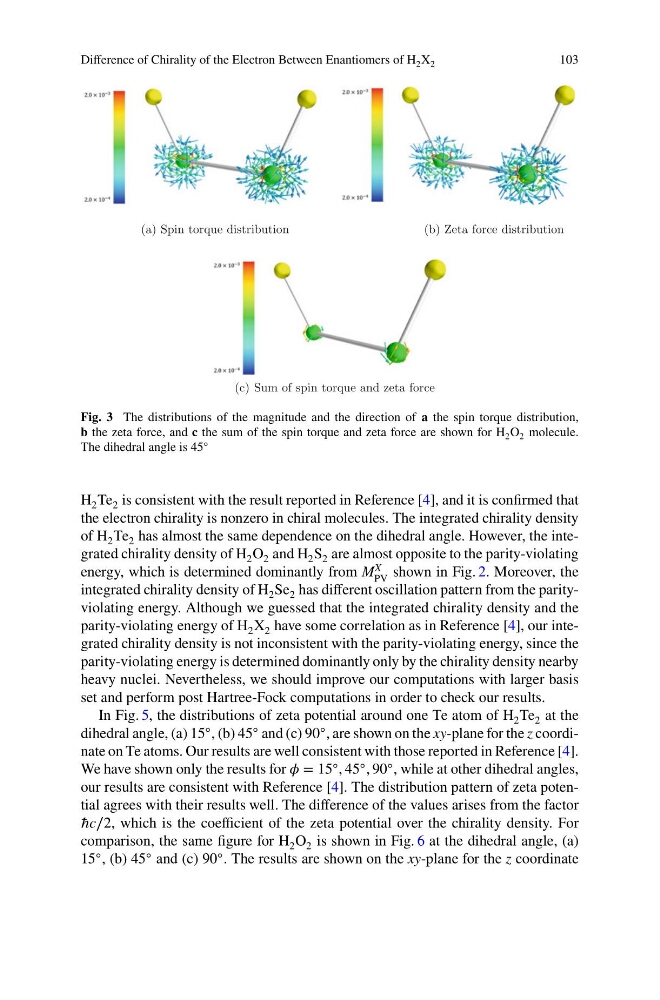
(a) Spin torque distribution
(b) Zeta force distribution
(c) Sum of spin torque and zeta force
Fig. 3 The distributions of the magnitude and the direction of a the spin torque distribution,
b the zeta force, and c the sum of the spin torque and zeta force are shown for H 2 O 2 molecule.
The dihedral angle is 45 ◦
H 2 Te 2 is consistent with the result reported in Reference [4], and it is confirmed that
the electron chirality is nonzero in chiral molecules. The integrated chirality density
of H 2 Te 2 has almost the same dependence on the dihedral angle. However, the integrated chirality density of H 2 O 2 and H 2 S 2 are almost opposite to the parity-violating
energy, which is determined dominantly from M
X
PV
shown in Fig. 2. Moreover, the
integrated chirality density of H 2 Se 2 has different oscillation pattern from the parityviolating energy. Although we guessed that the integrated chirality density and the
parity-violating energy of H 2 X 2 have some correlation as in Reference [4], our integrated chirality density is not inconsistent with the parity-violating energy, since the
parity-violating energy is determined dominantly only by the chirality density nearby
heavy nuclei. Nevertheless, we should improve our computations with larger basis
set and perform post Hartree-Fock computations in order to check our results.
In Fig. 5, the distributions of zeta potential around one Te atom of H 2 Te 2 at the
dihedral angle, (a) 15
◦ , (b) 45
◦ and (c) 90
◦ , are shown on the xy-plane for the z coordinate on Te atoms. Our results are well consistent with those reported in Reference [4].
We have shown only the results for í µí¼ = 15 ◦ , 45 ◦ , 90 ◦ , while at other dihedral angles,
our results are consistent with Reference [4]. The distribution pattern of zeta potential agrees with their results well. The difference of the values arises from the factor
ℏc∕2, which is the coefficient of the zeta potential over the chirality density. For
comparison, the same figure for H 2 O 2 is shown in Fig. 6 at the dihedral angle, (a)
15 ◦ , (b) 45 ◦ and (c) 90 ◦ . The results are shown on the xy-plane for the z coordinate
103
(a) Spin torque distribution
(b) Zeta force distribution
(c) Sum of spin torque and zeta force
Fig. 3 The distributions of the magnitude and the direction of a the spin torque distribution,
b the zeta force, and c the sum of the spin torque and zeta force are shown for H 2 O 2 molecule.
The dihedral angle is 45 ◦
H 2 Te 2 is consistent with the result reported in Reference [4], and it is confirmed that
the electron chirality is nonzero in chiral molecules. The integrated chirality density
of H 2 Te 2 has almost the same dependence on the dihedral angle. However, the integrated chirality density of H 2 O 2 and H 2 S 2 are almost opposite to the parity-violating
energy, which is determined dominantly from M
X
PV
shown in Fig. 2. Moreover, the
integrated chirality density of H 2 Se 2 has different oscillation pattern from the parityviolating energy. Although we guessed that the integrated chirality density and the
parity-violating energy of H 2 X 2 have some correlation as in Reference [4], our integrated chirality density is not inconsistent with the parity-violating energy, since the
parity-violating energy is determined dominantly only by the chirality density nearby
heavy nuclei. Nevertheless, we should improve our computations with larger basis
set and perform post Hartree-Fock computations in order to check our results.
In Fig. 5, the distributions of zeta potential around one Te atom of H 2 Te 2 at the
dihedral angle, (a) 15
◦ , (b) 45
◦ and (c) 90
◦ , are shown on the xy-plane for the z coordinate on Te atoms. Our results are well consistent with those reported in Reference [4].
We have shown only the results for í µí¼ = 15 ◦ , 45 ◦ , 90 ◦ , while at other dihedral angles,
our results are consistent with Reference [4]. The distribution pattern of zeta potential agrees with their results well. The difference of the values arises from the factor
ℏc∕2, which is the coefficient of the zeta potential over the chirality density. For
comparison, the same figure for H 2 O 2 is shown in Fig. 6 at the dihedral angle, (a)
15 ◦ , (b) 45 ◦ and (c) 90 ◦ . The results are shown on the xy-plane for the z coordinate