

in self-healing concretes. Spores are known to be more resistant to harsh conditions
than vegetative cells, and hence the survival rate of spores in concrete is expected to
be better than that of vegetative cells. However, the survival study results indicate
that the survival of spores in concrete was not significantly higher than that of
vegetative cells (Table 4). Thus, it is mandatory to protect the cells/spores from
the harsh environment of the concrete to enhance their viability.
Certain additives such as fly ash and silica fume are known to improve the
viability of cells in mortar preparation [202–204]. Even if such additions improve
viability, direct addition of cells/spores and their nutrients pose two more problems.
One of the limitations is that direct addition of the healing agents (microbes and their
nutrients) may lead to undesirable foaming during mixing which affects the quality
of the concrete [172]. The other challenge is that the microbes added to the concrete
during mixing can be activated by the presence of air, moisture, and nutrients, which
may lead to untimely and undesirable calcite precipitation that depletes the resources
(calcium source and microbial nutrients). These problems related to direct addition
of bioagents and nutrients to the concrete mix triggered the search for a compatible
protection system. Over the years, an array of methods and materials have been tried
to protect the microbes and improve their viability and restrain their activity during
mixing and casting. Immobilization of cells/spores has emerged as a prominent
protection system. Three different methods of immobilizations: (1) encapsulation
in porous solids such as diatomaceous earth and clay [10], (2) microencapsulation in
gels such as in silica gel [172], and (3) use of pellets and flakes [205] have been tried.
The encapsulation method showed good results in self-healing efficiency with
respect to crack filling and the amount of calcium carbonate precipitation. This may
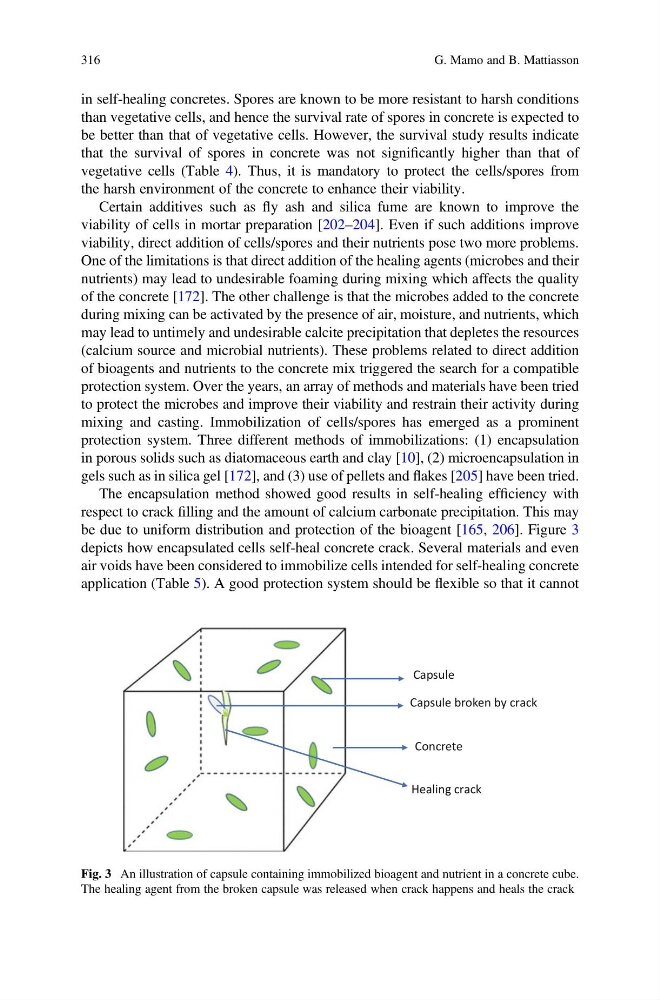
be due to uniform distribution and protection of the bioagent [165, 206]. Figure 3
depicts how encapsulated cells self-heal concrete crack. Several materials and even
air voids have been considered to immobilize cells intended for self-healing concrete
application (Table 5). A good protection system should be flexible so that it cannot
Capsule
Concrete
Healing crack
Capsule broken by crack
Fig. 3 An illustration of capsule containing immobilized bioagent and nutrient in a concrete cube.
The healing agent from the broken capsule was released when crack happens and heals the crack
316
G. Mamo and B. Mattiasson
than vegetative cells, and hence the survival rate of spores in concrete is expected to
be better than that of vegetative cells. However, the survival study results indicate
that the survival of spores in concrete was not significantly higher than that of
vegetative cells (Table 4). Thus, it is mandatory to protect the cells/spores from
the harsh environment of the concrete to enhance their viability.
Certain additives such as fly ash and silica fume are known to improve the
viability of cells in mortar preparation [202–204]. Even if such additions improve
viability, direct addition of cells/spores and their nutrients pose two more problems.
One of the limitations is that direct addition of the healing agents (microbes and their
nutrients) may lead to undesirable foaming during mixing which affects the quality
of the concrete [172]. The other challenge is that the microbes added to the concrete
during mixing can be activated by the presence of air, moisture, and nutrients, which
may lead to untimely and undesirable calcite precipitation that depletes the resources
(calcium source and microbial nutrients). These problems related to direct addition
of bioagents and nutrients to the concrete mix triggered the search for a compatible
protection system. Over the years, an array of methods and materials have been tried
to protect the microbes and improve their viability and restrain their activity during
mixing and casting. Immobilization of cells/spores has emerged as a prominent
protection system. Three different methods of immobilizations: (1) encapsulation
in porous solids such as diatomaceous earth and clay [10], (2) microencapsulation in
gels such as in silica gel [172], and (3) use of pellets and flakes [205] have been tried.
The encapsulation method showed good results in self-healing efficiency with
respect to crack filling and the amount of calcium carbonate precipitation. This may
be due to uniform distribution and protection of the bioagent [165, 206]. Figure 3
depicts how encapsulated cells self-heal concrete crack. Several materials and even
air voids have been considered to immobilize cells intended for self-healing concrete
application (Table 5). A good protection system should be flexible so that it cannot
Capsule
Concrete
Healing crack
Capsule broken by crack
Fig. 3 An illustration of capsule containing immobilized bioagent and nutrient in a concrete cube.
The healing agent from the broken capsule was released when crack happens and heals the crack
316
G. Mamo and B. Mattiasson